Urns against immigrants: an idyllic little town in England holds a referendum to become independent from the United Kingdom
Piddington, of 370 inhabitants, protests against the reception of 1,250 asylum seekers and fuels the great British political debate

-
CAT -
CAST
LondonIn the film Passport to Pimlico (1949), the explosion of a World War II bomb uncovers an ancient royal charter proving that a part of this neighborhood in South London legally belongs to the Duchy of Burgundy. The discovery triggers a delirious debate over sovereignty and the identity of its inhabitants, who try to take advantage of the legal loophole to escape postwar restrictions. An administrative absurdity ends up becoming a matter of state.
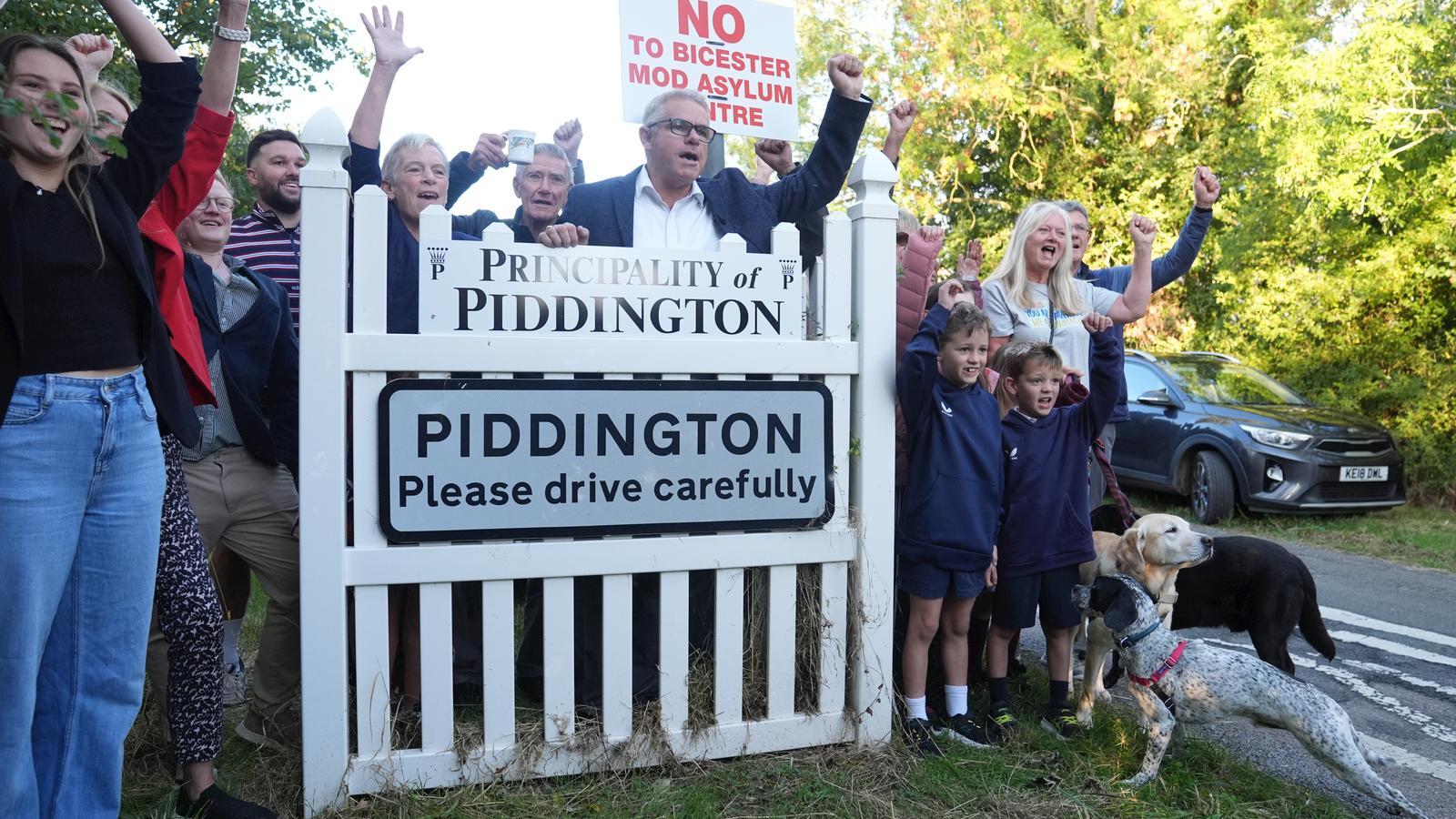
In Piddington, a village of about 370 inhabitants located in the county of Oxfordshire, a hundred kilometers northwest of London, the absurdity and the bomb are of a different kind. Last week, its residents approved in a symbolic referendum the secession from the United Kingdom. The consultation, obviously, has no legal validity, but it does have a considerable political and media weight: 92% of the participants, 286 neighbors against 26, voted in favor of breaking with Westminster. And to reaffirm their will, the town has decided to call itself principality.
The origin of the protest is the British government's decision to install in an old Royal Air Force (RAF) base, located a kilometer and a half from the village, a reception center for at least 1,250 migrants, expandable to more than 3,000.
Explosive context
The initiative is part of an explosive political context. Immigration has become one of the major issues of the British public debate since the Brexit referendum, and it is also one of the main battlegrounds for the populist right.
The repercussions of the Piddington vote have been significant enough for another town, Barnham, in the county of Suffolk, 140 kilometers northeast of London, to express its intention to follow the same path as a form of opposition to a similar center. And the leader of the Reform Party, Nigel Farage, has even predicted that many more similar consultations will take place. The local and global far-right – Elon Musk has supported Piddington via X – are rubbing their hands together.
The symbolic component of the protest was accentuated by the fact that the vote took place on September 15, the 86th anniversary of Battle of Britain Day, the day that commemorates the great offensive of the Luftwaffe on London in 1940 and the response of the RAF. It is no coincidence that Tim McNally, chairman of the Piddington parish council, defined the date as the day of the "battle for Great Britain" and an example of "democracy in action".
McNally explained to the British press that, accustomed to managing everyday issues such as the state of the roads, potholes, or street furniture, the notice received on July 26 regarding the installation of the center made them realize that they could not stand idly by. According to the municipal leader, the village was left "depressed" and "psychologically shocked".
Among the residents, the concern focuses primarily on security and the future of the community. Victoria Hubbobs, who has lived in the village for nearly a decade, asserts that she had chosen Piddington because it represented "a safe place" where her children could enjoy the same freedom and sense of community that she had experienced during her childhood. Now, however, she considers that the situation "deprives my children of their childhood".
Another villager, Mario Terzino, was pessimistic about the village's future prospects. And he stated that he did not see himself living there in the long term for the safety of his 18-year-old daughter. He fears that properties will lose all their value. "We won't be able to sell our homes. I don't think we could even give them away," he asserted.

Piddington and Barnham share some characteristics that can help to understand the nature of the protest. Both are small rural communities and demographically not very diverse. In Piddington, 95.5% of residents are white and 43.8% are over 65 years old. Barnham, with 584 inhabitants, presents a slightly more balanced age structure, with 58.8% of the population of working age and 17.7% over 65 years old. 97.1% of the residents are white. In the electoral districts of both locations, the option to leave the European Union won in the 2016 referendum.
Beyond the anecdote of the first referendum and the possibility that more might be called, the case of Piddington once again demonstrates to what extent immigration continues to be an explosive issue in British politics.
And this is despite the fact that migrant arrivals across the English Channel have decreased significantly compared to previous years: in 2025, 41,472 people arrived, and as of September 15th of this year, only 17,729 have crossed it.
The other side of the coin
The flip side of the coin is Greenock, an industrial city in western Scotland, which is facing a serious demographic crisis: since 1981 it has lost 22,000 inhabitants and is expected to lose 16% more of its current 78,000 in the next two decades. In this context, the arrival of African migrants, refugees, and other foreigners has contributed to stabilizing the population. For this reason, the council wants to attract more and help them put down roots. The presence of new African businesses and new workers in the health sector is proof of this.
There is a serious problem, however. The lack of jobs: in four years, 1,500 jobs have been lost, and former economic engines such as IBM or the shipyards have disappeared from the landscape. In testimonies collected by local and national press, many neighbors describe Greenock as an "empty" or "ghost" city, and question whether it can be repopulated without creating jobs that attract more people. In this context, refugees have even more difficulty finding employment, despite the fact that the majority would like to integrate and be independent.
The council offers English classes and support to access skilled jobs. Immigration, which has tripled to about 750 annual arrivals, has slowed the decline, but has also generated tensions and protests. The big unknown is whether Greenock will be able to turn this repopulation into a sustainable economic recovery.
