The ten life-size sharks that have triggered bookings at Cosmocaixa before they can be seen
The exhibition 'Sharks. The guardians of the ocean' can be seen until September 2027

-
CAT -
CAST
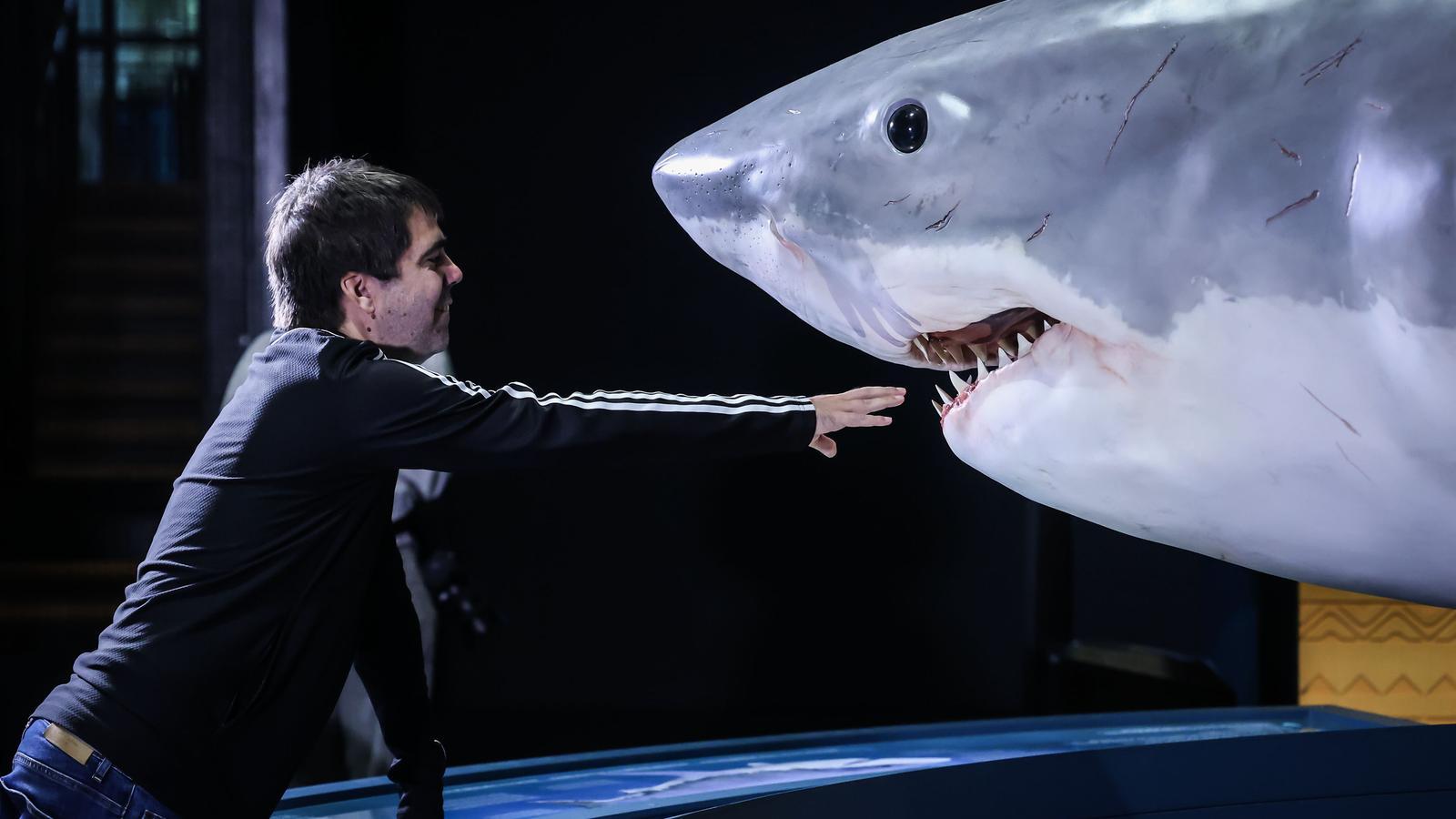
Barcelona"It is an exhibition that will leave no one indifferent: it will impress first and then lead to awareness." This is explained by the director of CosmoCaixa, Valentí Farràs, accompanied by Kim Mckay, the director of the Australian Museum. But it is almost impossible to look at them. An immense great white shark stands right behind them. It is four and a half meters long and bares its teeth next to the director of the Science Museum, stealing all the attention. It does not do it alone: a dozen life-sized shark replicas have invaded the -5 floor of CosmoCaixa in one of the most complete exhibitions ever held in the world about these unfairly feared sharks. Barcelona will be the first European city to host the exhibition Sharks. Guardians of the Ocean, which has been exhibited for two years in Australia and is the result of an exhaustive three-decade investigation by experts from all over.
The exhibition received up to 200,000 visits at the Australian museum and Farràs has already predicted that in Barcelona some 600,000 people could walk among the immense sharks from this Thursday until September 26, 2027. The forecast is not disproportionate: although it has not yet opened to the public, guided tours for this exhibition are already sold out until Christmas. "We will open more," the director reassured. "They are beautiful creatures and I find it very exciting that [the exhibition] is coming to Europe because the more informed the public is, the better the conservation of sharks will be, and this can be achieved with magnificent specimens like this one," Mckay celebrated, pointing to the great white shark watching her from a few meters away.
The shark with an angle grinder in its mouth
One of the crown jewels of the exhibition is the Helicoprion, the only extinct specimen in the display and one of the rarest: a shark that went extinct just as the dinosaurs were beginning to emerge and which featured a saw-like tooth whorl in the middle of its mouth that it would rotate to feed on shelled animals. The Helicoprion is the excuse to explain why there are no shark fossils: the majority of their body is cartilage and cartilage does not fossilize the way bones do. For this reason, the main way to know what the sharks were like is through their large teeth, which did indeed become fossilized.

Amidst interactives, videos, and immersive experiences, the data repeats itself. There is a large circular screen that allows you to enter the sea and feel as if you are surrounded by various species of sharks; or a device that allows you to observe the room as if you had the eyes of a hammerhead shark, which allow you to see what is beside you when you look forward. Some curiosities are quite heterogeneous: many of us eat shark without knowing it in frozen paella mixes sold in supermarkets or when we order a serving of dogfish at a beach bar; there are fluorescent sharks that glow at the bottom of the sea; the Mediterranean Sea already has whale sharks due to the increase in water temperature; the heat is making sharks all over the world larger because the warmth accelerates their metabolism and makes them grow more; sharks dive and rise to the surface using the fat in their liver; when a great white shark loses a tooth, it only takes a few hours to replace it, and over the course of its life, it has more than 10,000...
And between one piece of data and another, new protagonists emerge, like the tiger shark, known as "the scavenger of the sea" because it eats absolutely everything. In fact, beneath it, you can observe all sorts of objects that have been found inside the stomachs of real specimens: from a car license plate to a human arm. Or sharks that do not look like sharks: the frilled shark, which does not even have a dorsal fin; the catshark, which can live out of water by moving with its ventral fins to crawl between puddles of water; and the prickly shark, which feeds only on eggs.
Beyond the draw of the ten shark specimens, among which are the hammerhead shark or the bluntnose sixgill shark, but also lesser-known species such as the frilled shark or the prickly shark –"we couldn't have the whale shark because it can reach 19 meters and we would have had to get rid of half the exhibition," joked the exhibition coordinator, Josep Miquel del Campo—, the exhibition accumulates an infinity of curiosities that demand hours to explore. "Whoever wants to know them all will have to come two or three times," assures del Campo. All in an exhibition that, through direct, short, and impactful messages, seeks to convey two clear messages: on one hand, that sharks are not super-predators that want to attack humans and, on the other, that it is in our hands to ensure they survive for another 450 million years.
The damage done by Spielberg and Williams
Beyond the animals, the exhibition also accumulates stories of many characters relevant to the history of the shark. From Valerie May Taylor, the first person to dive with sharks outside a cage –as documented in a real video in the exhibition, she did so in a chainmail suit, hiding pieces of tuna to attract the sharks so they would bite her arm while she watched impassively– to Paul de Gelder, a Royal Australian Navy diver who, after losing an arm and a leg in a shark attack, became a conservationist for these animals.
As expected, the exhibition also includes Steven Spielberg and John Williams, responsible for the film and the soundtrack of Jaws, which changed –for the worse– the image of these animals, which cause fewer than 10 deaths per year. In fact, the exhibition has a section detailing how Peter Benchley, the author of the book on which the film is based, claims he was "horrified" by the hatred it generated towards sharks and maintains that he would now adapt the work to make the victim the shark.
