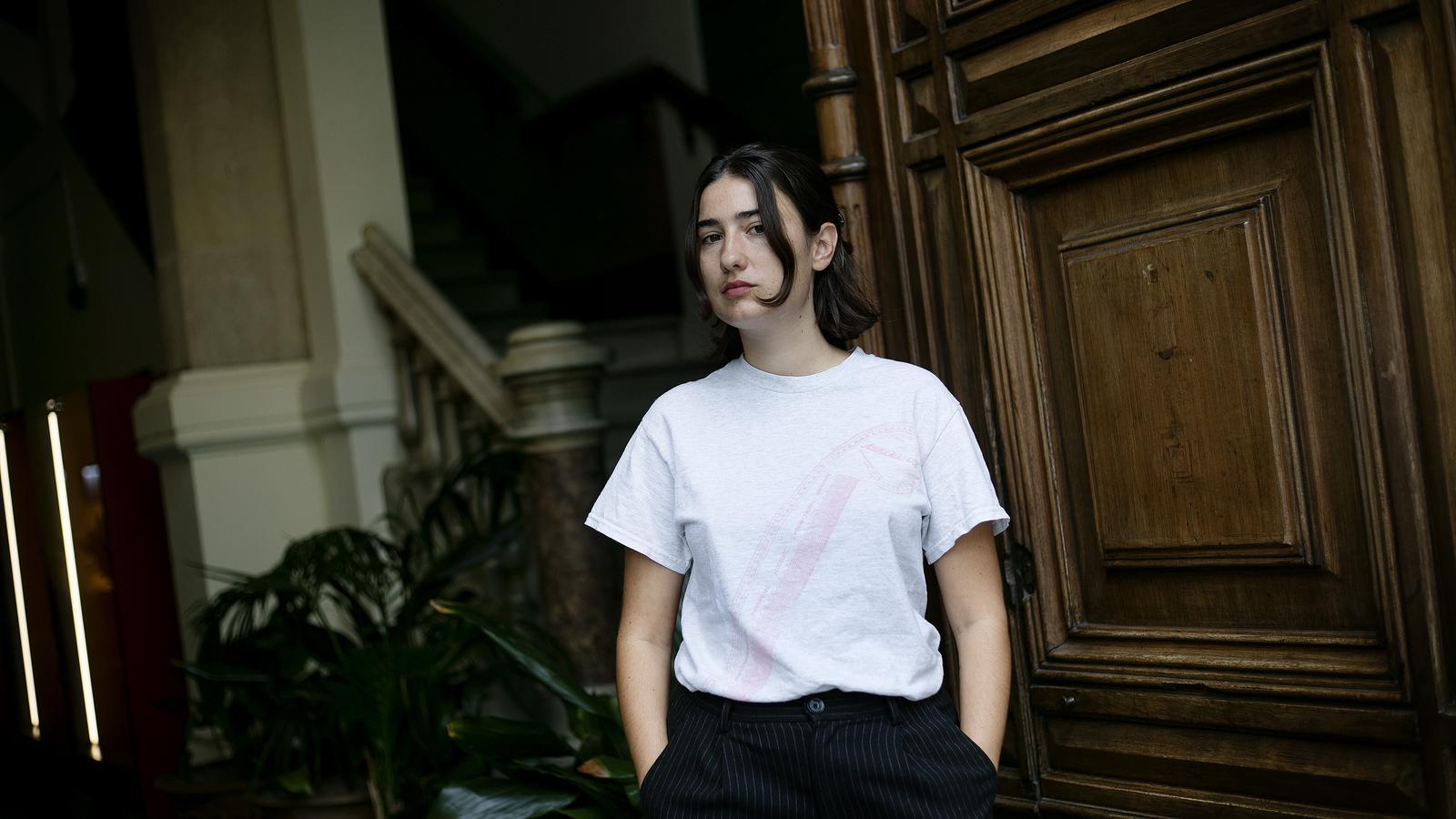
Berta Prieto: "Since we are medicated, we do not dare to project anything better"
Playwright, theater director and actress

-
CAT -
CAST

A stuffed animal with anxiety, protected by a hood. The doll appears as a prop in her series Segunda temporada, co-created with Miguel Ángel Blanca for Filmin, and Berta Prieto not only kept it for everything it says about our times but has also turned it into her WhatsApp profile picture. After the success of Autodefensa and plays like Del fandom al troleig, this multifaceted artist claims time to be able to continue developing her voice.
The character you co-wrote and play is a novelist but earns a living as a ghostwriter for an insufferable influencer girl who is monetizing having overcome anorexia. Does living off culture mean taking on survival jobs?
— There are things you clearly accept for money. I try not to make them too visible and I try not to sell my soul. Neoliberal logics are aggressively entering the world of actors and books, and the logic of the influencer, so having red lines is out of fashion.
Do you rebel against this?
— I rebel against the hypocrisy of all this. People get paid a lot of money to make a Netflix series: there is no need for you to make four more crappy ones. But you make them and on top of that you come out with the victim narrative about having to do things for money? It seems like a lack of respect to me for those who really work for money and are not actors or writers. Whoever does it usually has much more money than me, and I share an apartment.
Several plays written and directed, two television series premiered... are they not enough to have a roof of one's own?
— As things stand, it is impossible to live alone in Barcelona. No matter how much I have done a series, it is still on Filmin.
And what if Netflix came along and offered you ten times the budget?
— It's just that I am very loyal to the people I do things with. Filmin is my home. I would go with those from home first. If Netflix gave me absolute freedom I would work with them, but the thing is that freedom is not there. No other platform lets you make the scripts you want and the casting you want, without putting famous actors to sell the series.
Do you consider yourself a spokesperson for your generation?
— At first I said no, because the question seemed like an attempt to pigeonhole me. But I think that if someone feels represented by it, it's super positive. In the end, there are very few state fictions that I feel speak about me. That said, this second series for me is a step forward. I want to leave behind Berta from Autodefensa, because I find it very cringe how people stretch the fucking gum just so they don't have to give up that slice of fame.
Second season is a more demanding series for the viewer.
— We artists have the responsibility to make people understand us and to connect, but that does not mean flattening the discourse or running everything through the TV3 filter. We should not act mysterious and snobbish so that only certain elites who have attended who knows which schools applaud us. We must create popular art, which does not mean easy, nor made by AI, nor that treats people like idiots.
Your character is panicked about becoming “a 30-year-old lady”. You don't have them yet. Do you feel age pressure?
— I am very afraid of going out of style. I only know how to do this! For everything else, I am completely hopeless. The phrase is ironic, but it captures a generational feeling. I myself feel that when I turn 30 I will die: since we live all the time in a voracious cultural world that keeps throwing out new voices, new voices... there is no time, path, or interest for people to develop. Look: it is always the first films by directors.
You speak of feminine. Does this affect women more?
— We build our careers more from our identity, as do gay men or queer people. We put our self on the grill, our dissidences, and from that, we create our voice and articulate the discourse. The problem is that when you have made your identity your business, it is much easier for it to expire. For people to say: bah, we have already seen that. We expect constant adventure.
Paula has a very formal boyfriend who motivates her less than zero. And an affair with a rapper who attracts her a lot, but gives her a hard life. In love, do you die of boredom, or of pain?
— I would rather die in flames than bored. The conventional boyfriend that you have been told is what you should desire can be a prison. Rogelio, on the other hand, with all his contradictions, represents genuineness. And the protagonist feels precisely that she has lost this authenticity, that she has sold herself out, and that is killing her.
“You want me calm and drugged,” she snaps at her polished boyfriend.
— Yes because it is the only way to put up with this crap.
But is it not better to live anesthetized than in permanent torture?
— The phrase in fact stems from a personal experience. I take antidepressants, my friends take antidepressants. I wouldn't like to normalize it, but this happens. And I don't know if one lives better this way, but we are in a moment in which almost everyone is medicated.
And where does this collective neurosis come from?
— From the environment. From the brutal lack of material resources: housing, the cost of living, poorly paid jobs... All of this translates into mental health problems. Because we are medicated, we do not dare to project anything better. Or to dream of anything better. The phrase means that there is no other way to endure this sanitization of life. If you are not medicated, what you want is to burst and say enough is enough.
The series speaks a lot about failure, and also about guilt. In the end, does Christian education weigh heavily?
— We are at a moment where there is a very strong Catholic return and this is not free. A few years ago we were talking about feminism and now the mainstream references are people who believe in God.
Do you have spiritual concerns?
— I may have my spiritual concerns, but I am not a publicist for God, and even less so for the Church. They are an intimate thing and difficult to put into words. I do not understand this business of making it the brand of your project. Everyone who is dedicated to something artistic must have them because you have to water a minimum faith in something that is very complicated. But beyond that... I am not even baptized. I would not know how to pray a Lord's Prayer for you.
