France restricts the right to demonstrate to avoid disturbances
Macron accuses far-left groups of "sedition" and of wanting to "bring down the Republic"

-
CAT -
CAST
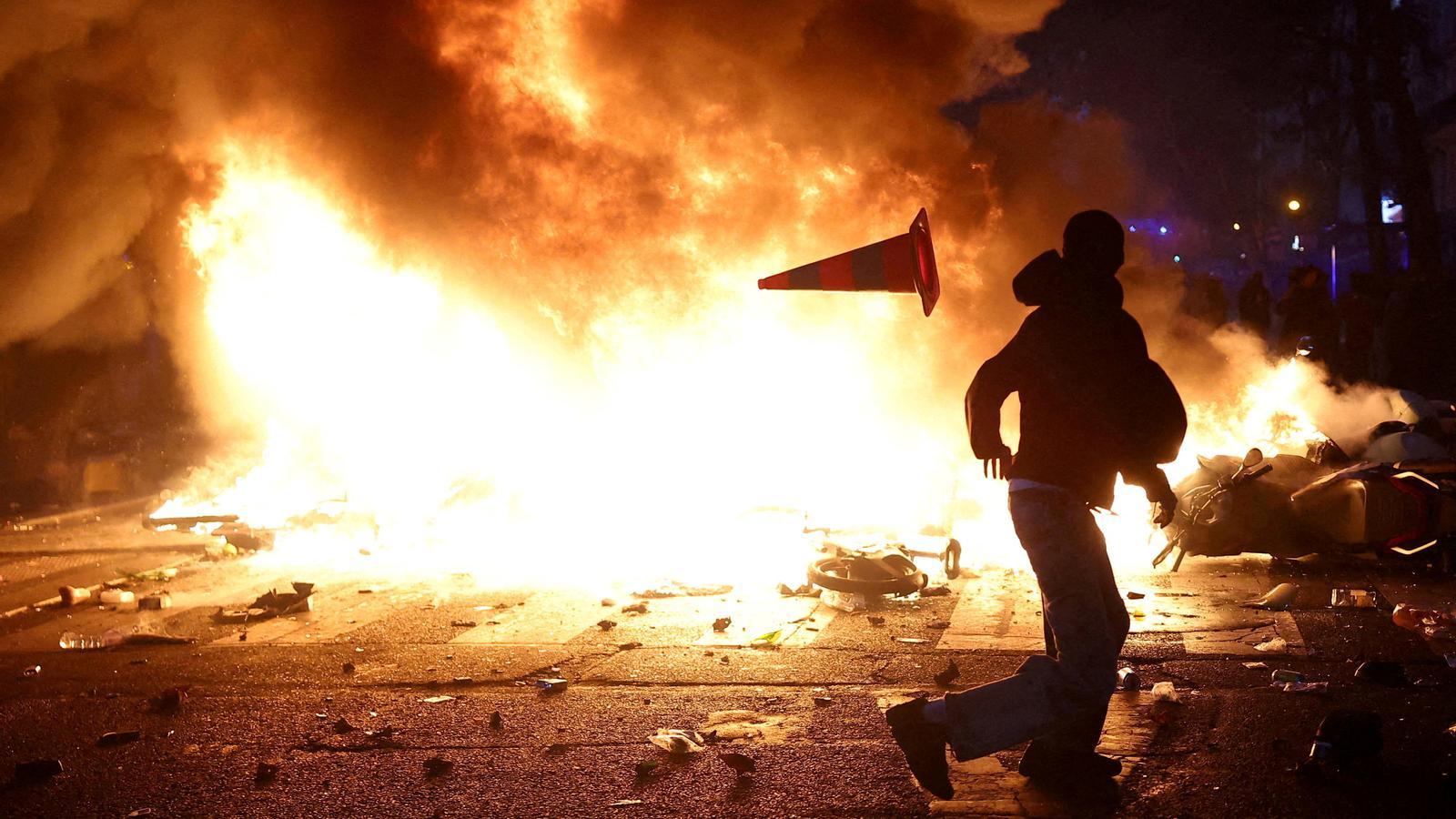
ParisFrance is trying to shield itself to avoid situations of chaos and violence once again this Saturday, when another day of major mobilizations is expected. The President of France, Emmanuel Macron, has chosen the strategy of a firm hand to stop the riots: limiting the right to demonstrate. The French head of state asked the prefects this Thursday to ban all demonstrations for the coming days—and especially, looking ahead to Saturday—that are not called by the unions. Macron considers any protest that does not have the unions behind it "illegitimate." "The general instruction is that there should be no demonstrations in the coming days," the President of the Republic explained.
The prefects are already applying the instruction. In some regions, they have even gone beyond Macron's request and have opted not to authorize any protests. In Marseille and Lyon, the two largest cities in France excluding the capital, all demonstrations will be banned for Saturday, while in other cities, such as Rouen or Toulon, only those with a route that passes through the city center will be banned. In fact, Macron has stated that marches called by unions that pass through city centers will not be authorized, but they will be offered alternative routes with the intention of protecting the businesses that suffered looting and destruction last Saturday.
In the case of Marseille, there will also be a curfew in the city center for the entire population every night starting this Friday, and no public transport will operate during the day on Saturday. The prefecture wants to completely empty the center and have people stay at home to prevent the riots from being repeated.
In his address, the President of the Republic, in line with the last few days, pointed to the far-left as the main party responsible for the riots. In this case, however, he raised the tone of his words and accused groups of "ultra-leftists" of "sedition" and of having wanted to topple the country with the chaos that was experienced on October 17th. "On Saturday, there were political and seditious acts, led by ultra-left groups, with the goal of bringing down the Republic," Macron asserted.
The president's decision to restrict the right to demonstrate has not been well received by the yellow vests movement, which had called for hundreds of actions across French territory for Saturday. "We reject that a government should decide which demonstration is legitimate and which is not. It is an extremely serious violation of the right and of fundamental freedoms," warned the yellow vests union in a statement.
The ban has also been criticized by the judiciary. "We are particularly shocked by the notion of legitimacy [...]. At no time is it mandatory to be part of a union to have the freedom to demonstrate, which is a fundamental freedom. There must be a necessary balance between respecting a fundamental freedom and placing limits on it when necessary, but always under extremely limited conditions," assured the national secretary of the French Magistrates' Union, Manon Lefebvre, to BFMTV.
Errors by the intelligence services
Macron has announced that he will resort to this highly exceptional measure after a meeting with intelligence service officials and his government ministers to evaluate the security failures of last week and assess what measures need to be taken ahead of Saturday. The tenant of the Élysée has admitted that there was a forecasting error, and that the intelligence services failed to foresee the scale of the mobilization and the riots. The President of the Republic has also called a defense council for this Friday.
The violent groups that acted in many cities mobilized through social media. For this reason, the government is also considering "suspending" the use of social media during Saturday's day of protest. Despite the technical difficulty of putting it into practice, the Interior Minister, Laurent Nuñez, assured this Wednesday that "there is nothing that prohibits suspending social media when exceptional circumstances arise".
20% more police
For Saturday, 20% more police forces will be mobilized than on October 17, according to what the number two of the Interior Ministry, Jean-Didier Berger, has declared to the television station BFMTV. He also explained that the planned deployment will be reinforced by soldiers from Operation Sentinel –those who usually patrol French cities to prevent terrorist attacks– and by elite police and gendarmerie units, as well as helicopters and armored vehicles. To achieve this extraordinary mobilization, the decision has been taken to "cancel the holidays" of the members of the security forces. In France, this week and the next there are school holidays and many workers take the opportunity to take a few days of rest.
Paris is the only one of the large cities where a demonstration has been authorized. In this case, it is the one called by the CGT, which will go from the Place de la Bastille to the Place de la Nation. In contrast, the march organized by students and the yellow vests, which also intended to leave from the Bastille to the Opera, will be prohibited. "The violence observed last weekend, as well as at the end of recent demonstrations, especially on October 13, demands maximum caution when choosing routes in order to maintain public order," declared the police prefecture of the capital.

