Trump threatens to "annihilate" the Iranians while Tehran conveys to Washington its conditions to end the war
The American president defends his military campaign in the Middle East and acknowledges that there probably will not be an understanding until after the legislative elections

-
CAT -
CAST
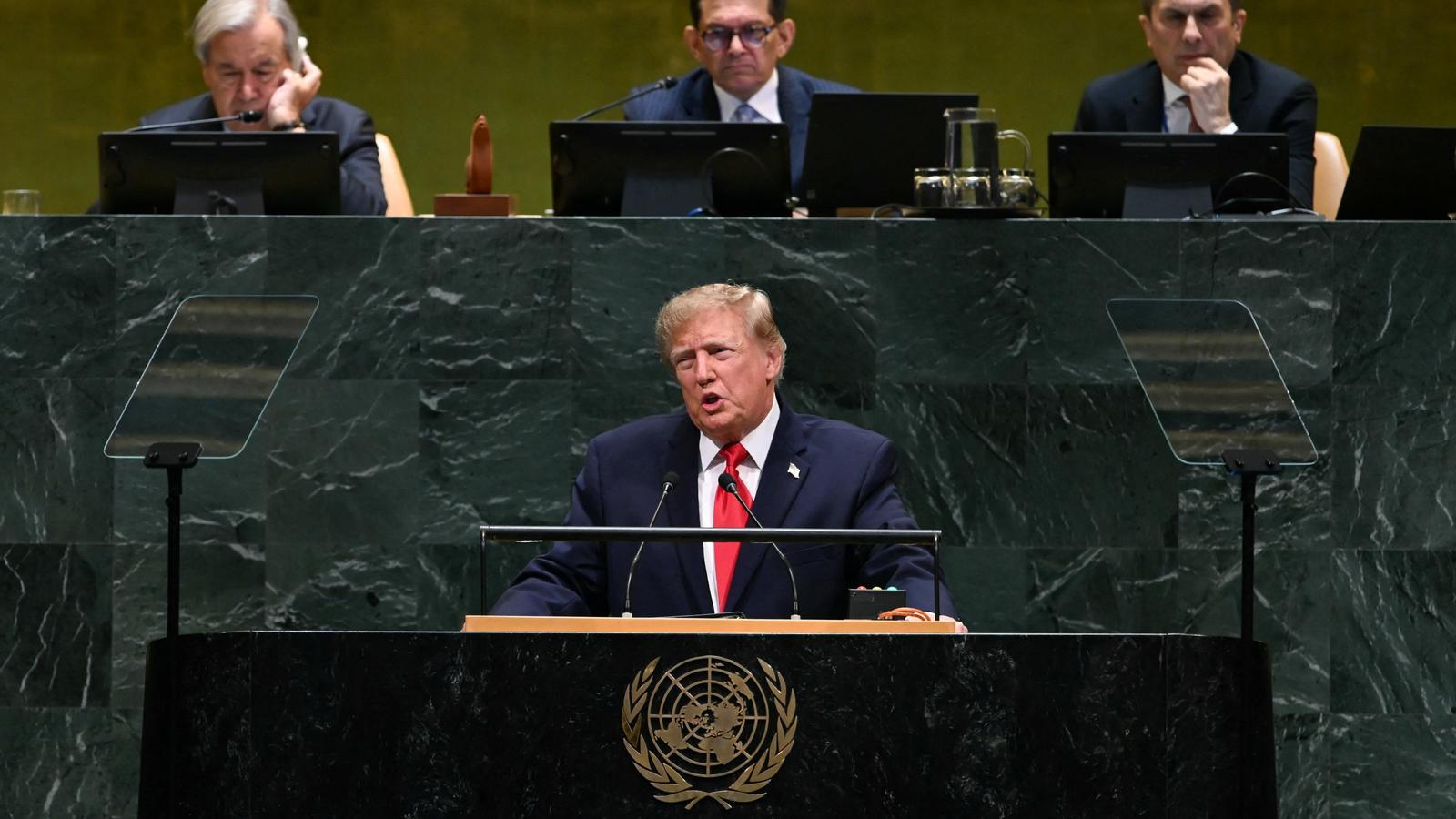
WashingtonDonald Trump has reworked the speech he used last year to address the UN General Assembly and has incorporated a long reference to the war in Iran. Beyond attacking the United Nations, the US president has repeated this Tuesday the same version of the conflict that he has been proclaiming for seven months: that the regime is finished and that "it will never be allowed to build a nuclear bomb." He has acknowledged, however, that "the only thing that has not disappeared [in Iran] is inflation, which is destroying the country." Americans, who see the price of gasoline continuing to rise, probably have some comments to add to these words from the president. Last week the Federal Reserve decided to raise interest rates for the first time since 2023 following the latest inflation data in the country, which is already bordering on 3.4%.
The US president has appeared at the UN to once again defend his military campaign in the Middle East, which was supposed to be a "field trip" of about four weeks and has ended up turning into a war with no exit and a diplomatic fiasco on the eve of the November midterms. Trump has presented the conflict as a necessary step to maintain peace. "While others have talked about peace, I have made it a reality. While others have ignored threats, I have faced them. While others have talked about courage, the United States has demonstrated it," he stated, and then repeated that he has put an end to eight wars.
Despite the Pentagon's depleted arsenal, which is being consumed at a frantic pace, Trump has returned to threatening to "annihilate" Iran and "send it to hell" if the regime does not capitulate and reach an agreement. "Will a deal be made with Iran that allows them to rebuild and create a country much greater than it ever was before?", said the tycoon, describing the dilemma that he claims to be facing. "Or do I annihilate the Islamic Republic, and do it quickly, without ever giving them the chance to kill and destroy people and countries again? Do I send them to hell with no chance of survival and no hope of future greatness or future generations?".
After promising hell to the Iranians, Trump has done himself a favor and gifted a month of grace to the ayatollahs: "I believe we will reach a deal after the elections." The American president implicitly acknowledges that the Islamic Republic will continue to maintain the blockade of the Strait of Hormuz in order to further erode his waning popularity. Much to the chagrin of many Republican congressmen seeking reelection this November, Trump had already taken it upon himself in Dallas to turn the event into a referendum on his own person.
Unlike the tycoon, the Iranians have practically not needed to open their mouths to make a show of force. Despite the war, the State Department has allowed the Iranian president, Masoud Pezeshkian, and a small delegation to travel to New York. At no time has Pezeshkian shown any interest – at least publicly – in meeting with Trump in the corridors of the UN. Hours after speaking at the General Assembly, the American president assured the press that an American delegation had met with the Iranians. A meeting that had not yet been confirmed by Tehran.
This Wednesday, however, Tehran confirmed this indirect contact, through a Qatari mediator, and conveyed its conditions to the United States to end the war. Among the demands are the end of hostilities, the lifting of the naval blockade and the economic war, and the release of frozen Iranian assets.
According to the American leader, the meeting "lasted at least three hours" and "went very well." The Republican said that the special envoy, Steve Witkoff, and his son-in-law, Jared Kushner, were present at the meeting.

Attacks on the UN and the ICC
During his speech, Trump celebrated the military intervention in Venezuela last January, where the US military deposed Nicolás Maduro as the country's leader. Unlike the Iranian and Cuban representatives, who left the room when the Republican attacked and belittled them, the interim Venezuelan president Delcy Rodríguez listened attentively as the US president boasted about having achieved control of a large part of the country's crude oil reserves.Last year Trump took to the podium of the General Assembly to disparage the body founded as one of the pillars of the new international order following the Second World War. A year after saying that the UN only served to make symbolic statements, the tycoon is the president-for-life of the Peace Board, which has yet to achieve any tangible milestone on the ground beyond bombastic and repetitive announcements about the peace process in Gaza. But that has not stopped the tycoon from claiming again that he has put an end to the Gaza war.
Beyond attacking the UN, which he has once again accused of imposing an "extreme left agenda", Trump has also attacked the International Criminal Court (ICC). For months his administration has declared open war on the ICC, and has encouraged its member countries to abandon the Rome Statute in order to erode the organization's capacity to act. An idea he reiterated from the podium: "We will never allow members of the US armed forces, or anyone else, to be investigated or subjected to show trials by an anti-American court. I urge people in all ICC member countries to officially renounce this out-of-control institution immediately".
