Iran has begun to restore internet access after almost three months of blocking, since the US and Israel initiated the war on April 28. This was confirmed by NetBlocks, an organization that monitors internet traffic and censorship. This partial restoration comes a day after Iranian President Masoud Pezeshkian ordered it, and it marks the end of the longest blockade in history worldwide.
The US attacks Iran again with peace negotiations underway
Washington justifies it as a move of "self-defense" against the "threats of Iranian forces" while Tehran considers it a violation of the ceasefire
26/05/2026 - 20:47 h
-
CAT -
CAST
BarcelonaThe United States launched new attacks against southern Iran early Tuesday, targeting missile bases and ships attempting to lay mines, the U.S. Central Command reported. In a statement, it affirmed that these were "self-defense" attacks designed to protect American troops from "threats posed by Iranian forces." Iranian media reported that three explosions were heard in Bandar Abbas, on the coast of the Strait of Hormuz, a major port and Iranian naval base.
"U.S. Central Command continues to defend our forces while exercising restraint during the ongoing ceasefire," said spokesman Tim Hawkins, who did not specify which ships were attacked, where they were located, or exactly where the U.S. attacks took place. According to the "New York Times", a senior military official said that Iranian surface-to-air missiles were threatening some of the U.S. Navy's warships in the Gulf of Oman and the Arabian Sea that are enforcing a blockade against vessels attempting to enter or exit Iranian ports.
The Iranian Revolutionary Guard responded with a statement saying it reserves the "legitimate and determined" right to respond to any ceasefire violations, and added that its air defenses had shot down a U.S. MQ-9 drone and fired at an F-35 fighter jet and an RQ-4 drone that had entered Iranian airspace. For its part, the Foreign Ministry accused Washington of violating the ceasefire in effect since April 8 and considered that the "aggressive" actions of the U.S. demonstrate its "bad faith" and "failure to uphold commitments."
to sign the so-called Abraham AccordsAfter weeks of indirect negotiations, signals arrived this weekend that significant progress had been made on a memorandum of understanding that, initially, would stop the war and give negotiators two months to reach a final agreement.
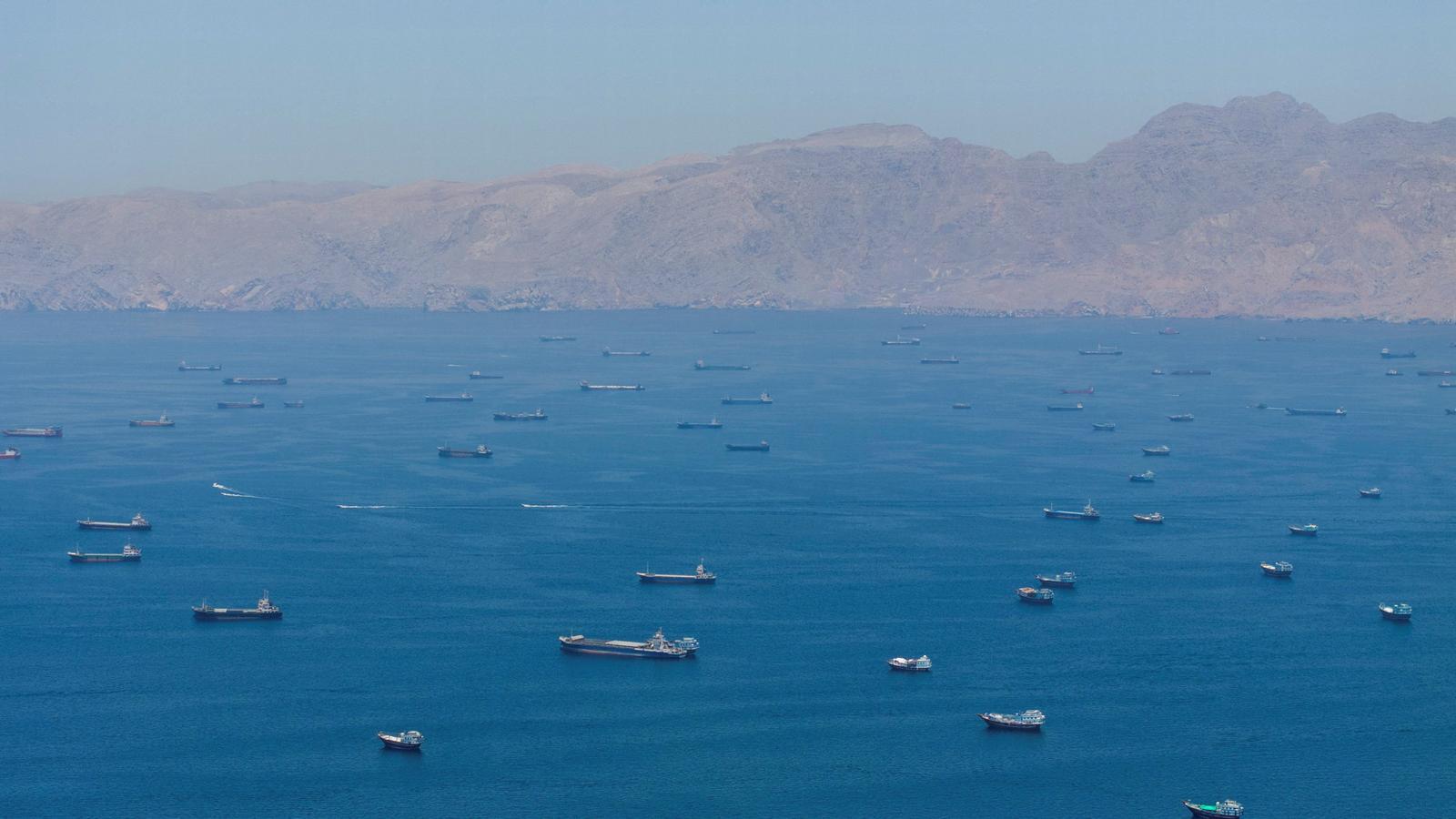
Rubio stated that Washington will give diplomacy every chance to succeed before considering whether to deal with Iran "in another way". He also assured that Donald Trump has "expressed his desire to achieve it". Nevertheless, he warned that the situation in the Strait of Hormuz is unsustainable and stressed that any agreement with Tehran will have to guarantee transit through this route immediately. "The strait must be open. It will be open, one way or another. [...] What is happening there is illegal, illicit, unsustainable for the world and unacceptable," he said, and once again reproached Iran for seeking to set a toll for transit.
In a post on Truth Social on Monday, President Donald Trump said that talks with Iran were going "well," but warned of new attacks if they failed. "It will either be a Great Deal for everyone, or there will be no Deal," he wrote. Hours later, the army reported attacks in southern Iran.
Pressure on Gulf countries
During the weekend, Trump spoke with various regional leaders, allowing for an alignment on the initial draft, according to Rubio. In another message on Truth Social this Monday, the American president urged the mediating states, starting with Qatar and Saudi Arabia, to sign the so-called Abraham Accords, which involve the normalization of relations with Israel, if they want the pact that would allow the Strait of Hormuz to be reopened to prosper.
The next day, the supreme leader, Mojtaba Khamenei, published a message on his X account in which he insisted on the message that the war launched by the US and Israel has harmed their situation in the region because they are losing power there. "The hands of time do not turn back, and the nations and territories of the region will no longer serve as a shield for American bases. The United States will no longer have a safe haven for evil or to establish military bases in the region, but rather is moving further away from its former position day by day," he wrote. He also predicted the end of the state of Israel: "The cancerous tumor of Israel is also approaching the final stages of its miserable existence."
According to sources cited by various media, the critical points of the negotiation between Washington and Tehran are the conditions for reopening the Strait of Hormuz – here Iran insists on its right to charge a toll – and the enriched uranium reserves, which the US demands be eliminated.
In a post on Truth Social this Monday night, Trump referred to this point and suggested that he could accept Iran destroying the material in its own territory: "Enriched uranium (nuclear powder!) will be immediately delivered to the United States to be taken away and destroyed or, preferably, jointly and in coordination with the Islamic Republic of Iran, it will be destroyed in situ or, elsewhere acceptable, with the Atomic Energy Commission, or its equivalent, as a witness to this process and event," he wrote.
Unblock frozen assets
Another of the great stumbling blocks in the negotiations are the Iranian funds frozen by the United States. In fact, the governor of the Central Bank of Iran, Abdolnaser Hemmati, has also traveled to Qatar. In this Gulf country there is a large part of the frozen assets, about 12 billion dollars, which Tehran hopes to recover, at least in part. The Reuters agency published last month that negotiations were underway to unblock about 6 billion dollars deposited in Qatar.
But this Tuesday, the Iranian agency Tasnim, citing a source close to Iran's negotiating team, reported that Tehran demands that the memorandum of understanding include the unfreezing of about 24 billion dollars. According to the agency, Iran's chief negotiator, Mohammad Baqr Qalibaf, has traveled to Qatar to reach an agreement on a mechanism to implement this demand.
Israel promises more war in Lebanon
Meanwhile, Israeli Prime Minister Benjamin Netanyahu has warned that he will intensify attacks against Hezbollah in Lebanon. "We are at war with Hezbollah," he said in a video released this Monday. Shortly after, the Israeli army reported that it was attacking the infrastructure of the pro-Iranian militia in the Bekaa Valley, in eastern Lebanon, and in other areas.
Israel and Lebanon agreed to a ceasefire in mid-April, without Hezbollah's participation, but the Hebrew army has maintained its bombings. Netanyahu boasted of having killed more than 600 militiamen in recent weeks and warned that the army will intensify pressure: "We are not taking our foot off the accelerator. On the contrary, I have ordered that we press the accelerator even harder."
Iran begins to restore internet access after almost three months of blocking

