The surname that never disappeared returns to power in Peru
Keiko Fujimori takes office as the new president of Peru 26 years after her father's resignation
-
CAT -
CAST
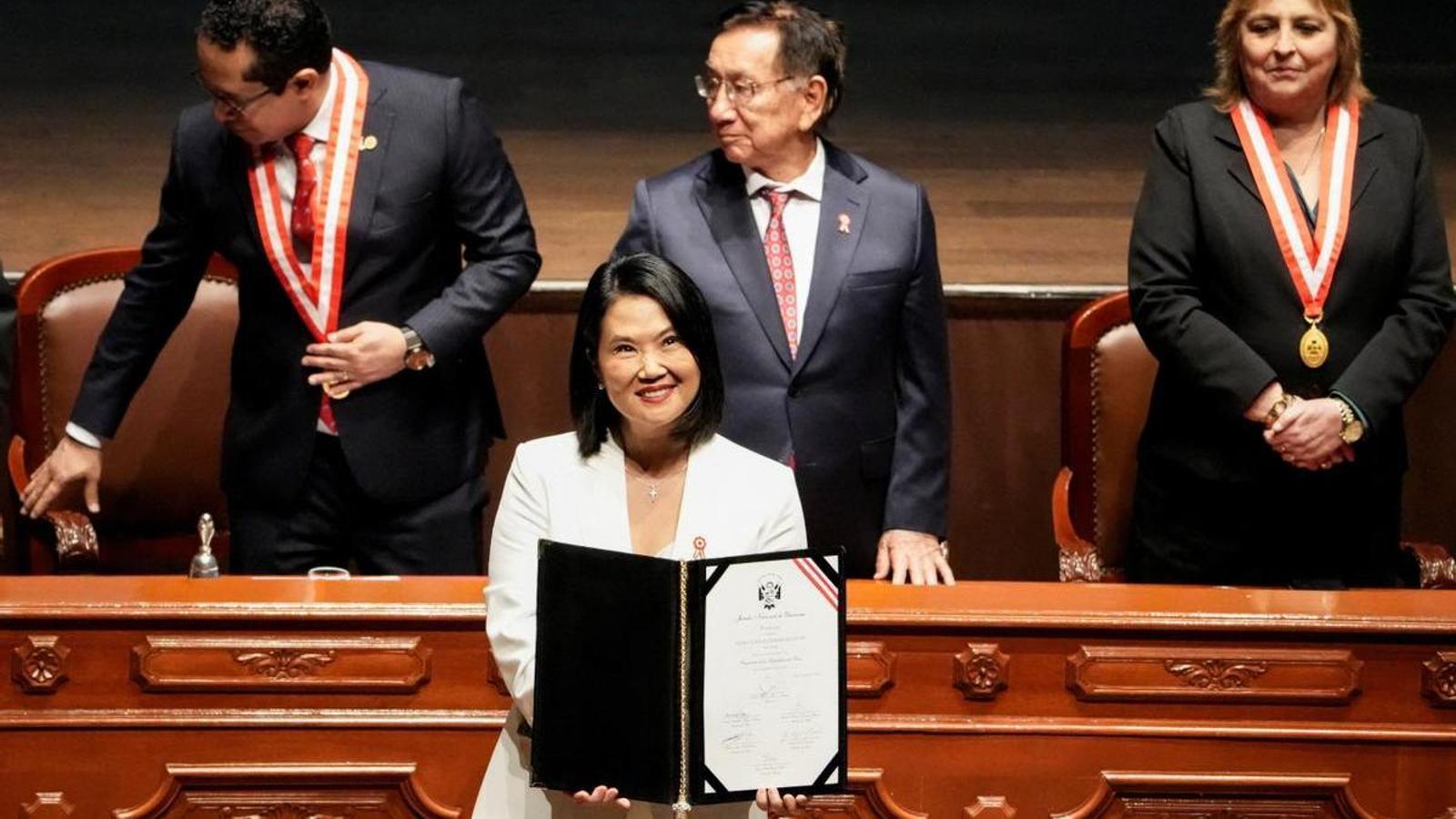
BarcelonaTwenty-six years after Alberto Fujimori's resignation by fax, the surname that dominated Peruvian politics during the nineties returns to the Government Palace of Peru. This time it is the turn of Keiko Fujimori, the eldest daughter of El Chino, who this Tuesday takes office as president after having prevailed by a margin of only 50,000 votes to the progressive candidate Roberto Sánchez.
The daughter of the former president convicted of corruption and human rights violations assumes the highest office in the state in a country that remains deeply divided by her father's legacy. Some Peruvians see Keiko Fujimori's investiture as the beginning of a new era of political stability, while others warn of a possible rollback of democratic guarantees. It is natural to think that, after almost thirty years, the Andean country would want to relegate the surname associated with authoritarianism to a past page. The reality, however, is different. Even without holding the presidency, the movement has managed to maintain a strong influence in the different pillars of the Peruvian state. "Fujimorismo has never left," summarizes CIDOB researcher Anna Ayuso.
The seats won election after election by Fuerza Popular, Keiko Fujimori's party, have been the main bastion of Fujimorism during these years. This influence in Congress has determined the stability of different executives, which has aggravated the institutional crisis that Peru has been dragging for a decade: in just ten years, the country has seen nine presidents, through dismissals, resignations, and constitutional successions.
Peruvian analyst Alejandro Boyco highlights how, amidst an ephemeral landscape marked by extreme party fragmentation, turncoatism, and shifting alliances, Keiko Fujimori's party has managed to consolidate itself as one of the few stable political organizations in the country, with a solid territorial structure and loyal bases.
Why now?
One of the questions is why Keiko Fujimori has now managed to exceed 50% of the votes after three consecutive defeats in the second round. The experts consulted agree that the answer is not a sudden increase in support for Fujimorism. On the contrary, the new president continues to be one of the most polarizing figures in the country, with 43% social disapproval, according to a survey by RPP, Peru's main communication group.
According to Boyco, many voters have not voted for her because they have a decided adherence to her political project, but rather as a "lesser evil" in the face of reprehensible behavior from the left. "Previous governments have been involved in various corruption cases, which has led some sectors of the historically anti-Fujimorist population to risk voting for the former president's daughter, who represented the only available alternative," argues the political scientist.
Along the same lines, political scientist Leticia Ruiz highlights the implicit support of the rest of the conservative candidates for Fujimori as a determining factor in the elections, which transformed from a "Keiko against everyone" to a confrontation between two large ideological blocs. "It's not that people have become Fujimorists, but rather that an identity has been consolidated by negation," points out Ruiz.
A legacy that maintains the fracture
Although Keiko Fujimori initially tried to distance herself from her father's figure, in recent years Fujimorism has once again boasted about Alberto Fujimori's legacy, especially regarding economic reforms and the victory against the terrorist group Shining Path. However, this claim of the regime's achievements ignores the corruption and serious human rights violations of those years.
Several groups of relatives of the victims of Alberto Fujimori's state violence have recently demonstrated their "concern about the authoritarian regime and impunity" embodied by the president-elect of Peru. The affected also reject national reconciliation until those who disappeared during the conflict are found.
Ayuso recalls that Keiko Fujimori avoids condemning her father's authoritarian methods. In this context, the proposal for "national reconciliation" advocated by the leader of Fuerza Popular faces an evident limit: "We cannot speak of reconciliation if there is no prior recognition of excesses," points out the researcher.

Same surname, different contexts
Unlike the new populist leaders who have emerged across Latin America and with whom he has an affinity, Keiko Fujimori is not an outsider. "She comes from within the system itself," says Boyco, who recalls that she is a leader forged within the institutions that have occupied a central place in Peruvian politics for three decades.
However, governing like her father will not be easy for her. Ruiz points out how Alberto Fujimori came to power in a Peru battered by terrorist guerrillas and devastating hyperinflation, while currently the challenges are different: citizen insecurity, inequality, and the need to maintain economic growth. Furthermore, without an absolute majority in Congress, the new president will be forced to negotiate every step with other conservative forces.
The new president's great promise is to recover her father's "tough hand" policy in the fight to combat insecurity. In addition to announcing the construction of four large prisons "faster than Bukele," Keiko Fujimori has already announced her intention to take the army to the streets for "raids against crime." In fact, her influence is already noticeable in Parliament, where legislative changes have been approved so that military and police remain under military rather than civilian jurisdiction, giving them greater legal immunity.
