The south of Lebanon, between hope and skepticism
The Lebanese distrust that the agreement between the United States and Iran, which Israel does not embrace, guarantees peace in the country

-
CAT -
CAST
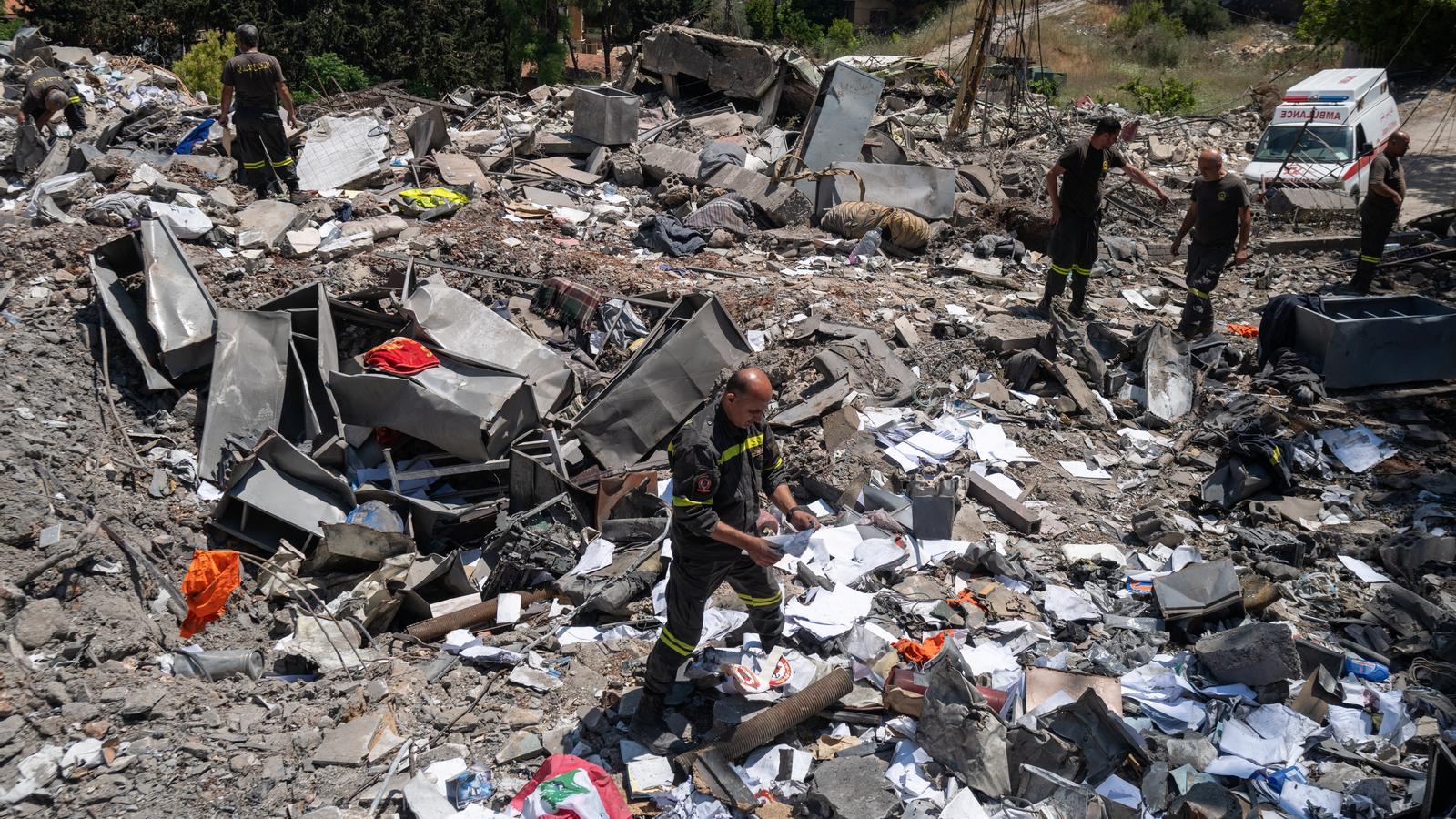
Nabatieh (Lebanon)Where for decades the commercial life of southern Lebanon was concentrated, today tons of concrete, twisted beams and gaping facades accumulate. The arches that survived the bombings rise over empty shops, broken shop windows and streets where it is difficult to recognize where one business began and the next ended. Several mosques and husseiniyas, the religious buildings of the Shiites, still show the wounds of the attacks. In some streets in the center, the silence is only broken by the noise of machinery removing rubble.
Despite the destruction, some residents have begun to return. The return is slow. And, above all, incomplete. "These stones are about 250 years old," says Ibrahim Yassine, mayor of Nabatieh, as he moves aside the blocks of an old stone house that had collapsed on a shop in the center. It is not his. The owner had come a few days earlier to check the damage and had left again.
Yassine is now helping to clean up a premises. He is trying to secure a space where supplies were still stored before the war. "People are returning drop by drop – he explains –. So far, about 40 or 50 people must have returned. The most common thing is that they come, see how their houses are, and then leave again."
The pattern is repeated throughout the city: brief visits, quick inspections, attempts to rescue what can be salvaged before returning to the places where they remain displaced. "We are recommending that people not return yet – he adds –. We are continuing to clean the streets and we have managed to restore communications. We are very aware of what may happen in the coming days".

The image of Nabatieh is that of a city trying to reopen without being prepared. Some businesses have started to clear the rubble. Others remain completely destroyed. Entire families enter their homes for a few hours to check if anything is still standing. "It was the work of a lifetime to get this apartment," says retired Colonel Najib Ayyad, who now lives in Beirut with his daughter. His building in Nabatieh has been severely damaged and, he admits, will probably have to be demolished.
Ayyad has only returned to recover personal belongings. From a window, he observes the Beaufort Castle, one of the symbols of southern Lebanon, today under Israeli control. "If the apartment were intact, I wouldn't return while there are Israeli forces in the area," he says. "There are snipers, there is artillery. It's not safe." His testimony explains a key part of this incomplete return: even when there is a will to return, many still believe it is not possible.
Israel maintains the occupation
The return is not only a matter of rubble; it is also a matter of security. Southern Lebanon continues to be crossed by invisible lines of military control. Israel has recently published a new map of the so-called "yellow zone", which extends into Lebanese territory and expands the previously established perimeter. According to this new scheme, some areas near Nabatieh fall within a strip under military control or direct surveillance.
On the other hand, Hezbollah rejects any configuration that implies the creation of security zones or partial control. Its secretary-general, Naim Qassem, has stated that any negotiation must be limited to the Israeli withdrawal, the end of attacks, and the reconstruction of the south, and has explicitly rejected any debate on the disarmament of the movement or the division of the territory.
In practice, these opposing positions translate into a very concrete reality in Nabatieh: no one is sure that the current situation is definitive. And this also explains the trickle of returns. Because the city does not depend solely on what happens in its streets, but on a broader agreement that is not yet fully defined.

The memorandum agreed between the United States and Iran has opened a window of regional de-escalation that has allowed some displaced people to return to southern Lebanon. But its implementation on the ground remains unclear, especially regarding the Lebanese border.
In parallel, a new round of talks between the Lebanese, Israeli and American delegations on the future of the south of the country is scheduled for June 23 in Washington. On the table is a five-point framework that includes a definitive ceasefire. The United States announced one on Friday between Israel and Hezbollah, although the Israeli army, after the announcement, continued to bomb Lebanon. The meeting also needs to address Israel's withdrawal from occupied areas, the deployment of the Lebanese army on the border, the release of detainees, and the start of reconstruction.
Lebanon, the weak point of the agreement
However, a large part of the uncertainty that is felt today in the south stems from an unresolved issue. Although the memorandum signed between the United States and Iran has opened a window for regional de-escalation, not all actors grant Lebanon the same role. Tehran has forced Lebanon to be included in the ceasefire instead of abandoning its ally, Hezbollah. The Iranian authorities have insisted that any reduction in tensions must include an end to Israeli operations in Lebanon. Hezbollah shares this view and considers that stability in the south requires a complete Israeli withdrawal, an end to attacks, and the beginning of reconstruction.
Israel maintains the exact opposite. Benjamin Netanyahu's government has made it clear that it does not feel addressed by the provisions relating to Lebanon and that it will maintain its freedom of action against Hezbollah whenever it deems it necessary. The Minister of Defense, Israel Katz, has also reiterated that Israeli troops will remain in the areas they control as long as there is a need for security. This difference in interpretation makes Lebanon one of the main unknowns of the agreement. While Iran presents the country as one of the direct beneficiaries of regional de-escalation, Israel continues to consider it a separate front, subject to its own military calculations.
"It's always the same story"
But in Nabatieh, as in the rest of southern Lebanon, these plans do not yet translate into certainties. "It's always the same story," says Soumaya Olleiq, displaced from Yohmor al-Shaqif. "They announce a ceasefire and then everything starts again. I am not optimistic." Distrust is also present in various southern localities, where residents have experienced several waves of return and displacement in recent months. Local authorities also insist on caution. It is recommended not to return permanently to many municipalities while cleanup and damage assessment work continues.
The return coincides, moreover, with the month of Muharram, during which the black flags of Shiite mourning hang from balconies, husseiniyas, and damaged mosques. Religious ceremonies are held among destroyed buildings and partially cleared streets. "This year Ashura is experienced in a different way," says Mahdi Sadek, responsible for organizing the commemorations in Nabatieh. "The war has forced us to experience many of the things we remember on these dates." But even this religious framework takes a backseat to immediate concerns: water, electricity, housing, and security.
At the end of the day, Nabatieh remains a partially returned city. Some merchants sweep dust in front of shops without doors or windows. Others observe what remains of their businesses without knowing whether to rebuild them or wait. It seems the war has lost intensity, but daily life has not yet returned. And in Nabatieh, for now, returning means checking if what has remained standing resists for another day.

