The PP also avoids close combat with Morocco
The Populars are tougher than the Spanish government, but they do not directly point to the Alaouite country for the crisis in Ceuta

-
CAT -
CAST
MadridAn example of how the bilateral relationship with Morocco is one of Spain's most complex and sensitive foreign relations is the stance taken by the PP regarding the migratory crisis in Ceuta. Alberto Núñez Feijóo's party, from the opposition, has a harsher tone than the Spanish government on the role Morocco has played in the influx of thousands of migrants swimming into Ceuta. But at the same time, they avoid direct confrontation with the Alaouite kingdom, which has led to criticism from José Manuel García-Margallo (PP), former Minister of Foreign Affairs under Mariano Rajoy, who accuses his party colleagues of lacking "determination" and "firmness" with Morocco.
From the outset, the PP has focused on Pedro Sánchez and the Spanish government, and party sources already anticipate that this will be their position and they will not deviate from it "for any reason," indicate PP sources to ARA. The only popular leader who has looked directly at Rabat has been the Madrid president, Isabel Díaz Ayuso: "I fear it is a test by Morocco and it is evident that it will escalate," Ayuso opined.
Focus on Moncloa
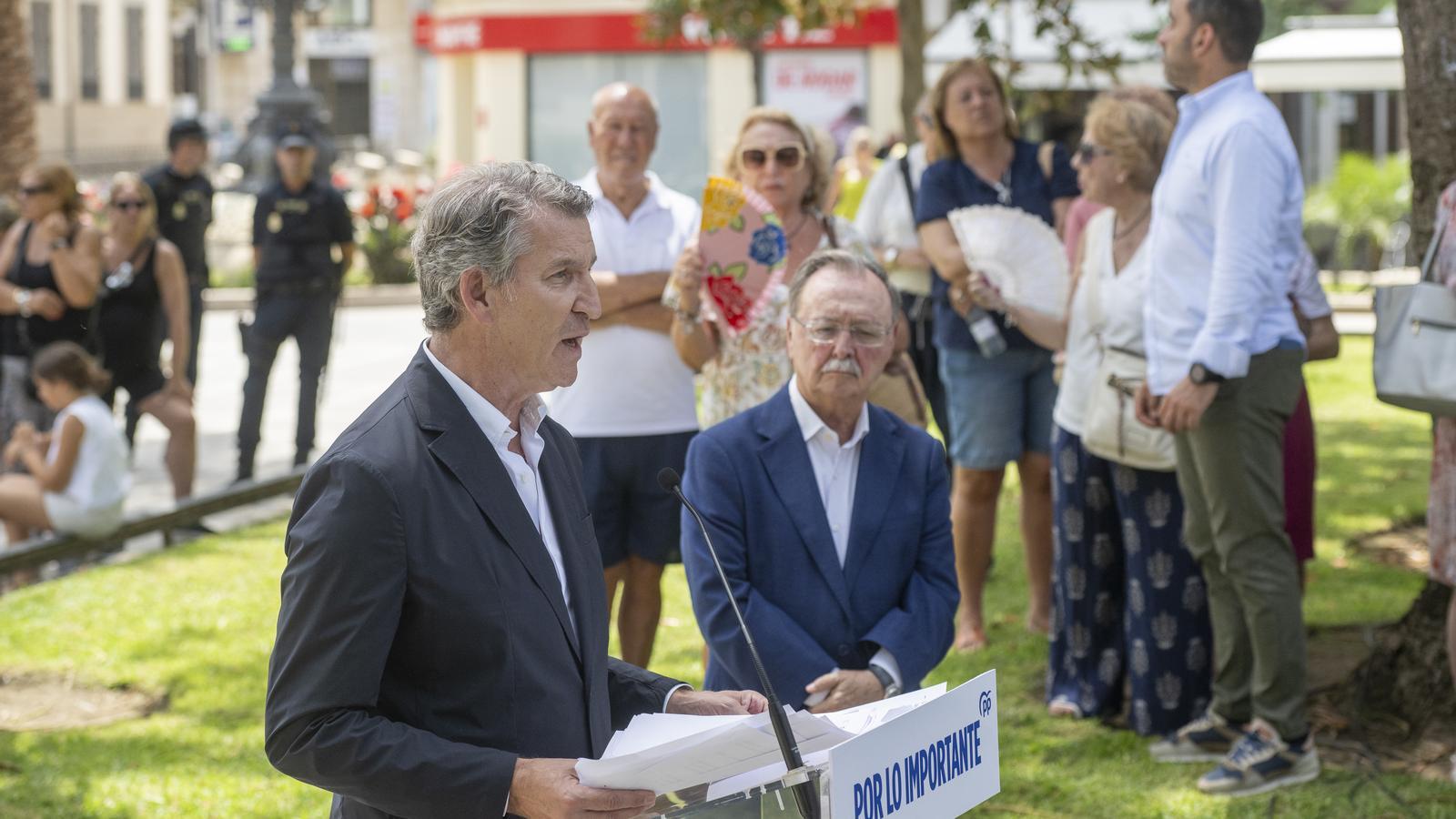
This week, the Secretary General of the PP, Miguel Tellado, referred to a "responsible analysis" by the party, which days earlier Núñez Feijóo had already verbalized: maintaining a relationship with Morocco based on "mutual respect, cooperation, and good neighborliness". But at the same time, and this is where the decibels slightly increase when compared to the Spanish government's discourse – only Margarita Robles has directly pointed at Morocco – the popular party defends that in order to speak in these terms, "reciprocity, transparency, and good faith [...] Permanent, real, and effective" are necessary. "Spain must comply and must demand that others comply," Tellado asserted. When asked at a press conference whether something has gone wrong in this relationship with the regime of Mohammed VI, which could explain the crisis in Ceuta – for example, whether Morocco fueled the influx of people or was passive at the border – the popular party again looks to La Moncloa: "Those who direct international and foreign policy are those who have the competences," referring to Pedro Sánchez and his government.
The PP acknowledges that having a solid relationship is a "strategic asset", especially with Morocco. In fact, the link with the Alawite country responds to geographical issues – it is the only Spanish, and European, border with Africa – as well as economic, migration, and security issues, as evidenced by the speeches of the popular party, but also by those of other political formations and the Spanish government itself. An example of this can be found in 2014, within the framework of the patera crisis in Cadiz. The then Minister of the Interior, Jorge Fernández Díaz (PP), made a lightning trip to Tetouan to "put a stop" to the arrival of migrants. Fernández Díaz himself has recounted in his memoirs that the events occurred due to a clash with Mohamed VI after being mistakenly intercepted by the Civil Guard.

Morocco - Algeria Balances
In the PP's last electoral program, that of the 2023 general elections, the party mentions Morocco on three occasions. One, in which it calls for a foreign policy that "makes compatible a deep and solid neighborly relationship with Morocco and Algeria." It then mentions again "the balance between Morocco and Algeria" that "the different governments" in the State "have managed to maintain." And finally, they state that Spain is expected to play "a leading role internationally, as a member of the European Union, with a deep neighborly relationship with Morocco and Algeria." Again, the two Maghreb countries, hand in hand.
It should be remembered that Morocco and Algeria maintain a historic tension mainly over Western Sahara. In this regard, the PP states in its program that it will "support the efforts of the United Nations in Western Sahara to reach a just, lasting, and acceptable political solution for the parties." They also call for "not forgetting [Spain's] responsibilities to the Sahrawi people".
The popular party does not explicitly mention returning to the historical position the State has held on the Sahara –Pedro Sánchez took a turn in 2022 by endorsing Morocco's plan for the former Spanish colony, which opened a deep crisis with Algeria. When asked, they have avoided responding forcefully and have clung to the fact that they "did not know" the substance of what Sánchez had agreed.
Be that as it may, that decision served the PP as a vein to wear down the central executive, in the same way as the crisis in Ceuta. The Minister of Foreign Affairs, José Manuel Albares, has not hesitated to accuse them of being "hypocrites and ridiculous" for their criticism of that decision. A few months ago, Albares assured that the PP was sending "emissaries" to Morocco to "support under the table" the Spanish government's stance. The minister even called them "anti-Moroccan" and accused them of practicing a policy of confrontation with neighboring countries. Margallo acknowledged a few months ago on a podcast that relations with Morocco must be handled with "silk gloves." The reason for the facts is that it is not the same to put them on when in opposition or in government. However, if they reach the Moncloa, the PP will inherit Sánchez's foreign policy and, therefore, the climate of the relationship with Morocco.
