Netanyahu insists that he will remain in Lebanon "as long as necessary"
Washington has a limited ability to influence Netanyahu and Tehran cannot control Hezbollah's military response

-
CAT -
CAST
BeirutThe memorandum that the United States and Iran have virtually signed and plan to formalize this Friday in Switzerland is presented as an attempt to extinguish several fires simultaneously in the Middle East. It is not a definitive treaty, but a framework of understanding that opens sixty days of negotiation and seeks, above all, to avoid a new regional escalation.
The text, according to known drafts, proposes an extended ceasefire on different fronts that have been open for months, the reopening of the Strait of Hormuz, and a progressive easing of sanctions on Iran. In return, Tehran would agree to sit down for formal negotiations on its nuclear program under international supervision with the International Atomic Energy Agency. The scheme also includes the partial unblocking of Iranian assets frozen abroad; the relaxation of energy exports; and a conditional timeline for lifting sanctions. All this subject to verification.
On paper, it is a clear exchange. Regional containment in exchange for economic relief and a nuclear process on track. But in the region, no one looks so much at the written text as at what is not written: who can enforce it. Because the problem is not in Geneva, but on the ground, and it is there where the decisive actors are.
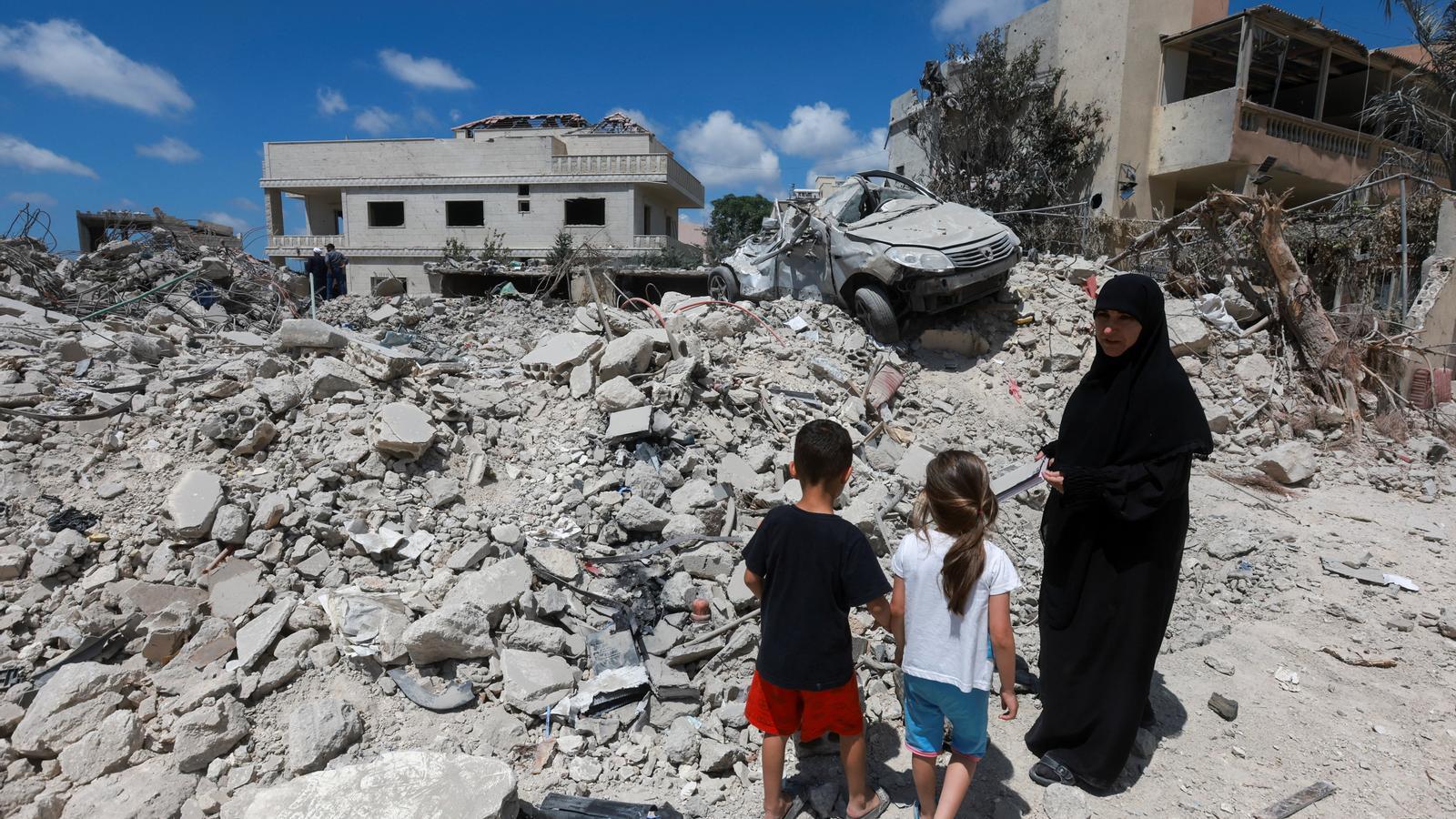
This Monday, southern Lebanon has once again recalled the extent to which diplomacy and reality go on different tracks. In different areas of the country, from Kfar Tebnit to Tyre and Bint Jbeil, new Israeli attacks with victims have been registered, which continue to increase. In Mansouri, a drone launched a stun grenade against civilians, causing one death and several injuries. The toll in the last 24 hours, according to the Lebanese Ministry of Health, is 15 dead and 82 injured in Israeli attacks. Three of the fatalities were registered this Monday, already after the announcement of the agreement. Since March, the total death toll in the country has risen to 3,798. The UN mission in Lebanon has registered over 130 launches of projectiles from Israel towards southern Lebanon during Monday night and morning. The contrast is evident. While regional de-escalation is being discussed, violence continues to set the pace in the south of the country.
Israel has no intention of withdrawing from Lebanon
The Iranian Foreign Minister, Abbas Araghchi, has argued in recent days that any real agreement must encompass all regional fronts. It is not just about the nuclear program or sanctions, but also about a redesign of the power balance in the Middle East, where Iran's network of allies is part of the security system itself.
From Israel, the message is the opposite. Defense Minister Israel Katz has reiterated that the country will maintain freedom of military action in Lebanon regardless of any understanding between Washington and Tehran. Prime Minister Benjamin Netanyahu has also insisted that his forces "will remain in security zones for as long as necessary." In practice, this leaves any automatic ground guarantees out of the agreement.
From Beirut, Lebanese President Joseph Aoun insists on the need to avoid a new escalation on the southern border, while Parliament Speaker Nabih Berri speaks of an opportunity that should not be missed. Both, however, observe a process that is decided outside the country and with very narrow margins of influence.
Hezbollah adds another layer to the scenario. The movement has said it has launched rockets and drones against Israeli forces that "were trying to advance" in southern Lebanon. It has stressed that it rejects what it considers Israeli freedom of movement in Lebanese territory and warns that any change in the balance on the ground will be decisive. Here lies the core of the problem: the agreement is signed between the United States and Iran, but its real implementation depends on actors who are not at the table.
Washington can negotiate with Tehran, but its ability to influence Israel is limited when Benjamin Netanyahu's government maintains that security on the northern border is non-negotiable. Iran can influence Hezbollah, but it cannot completely control its response if military pressure continues.
Lack of concrete mechanisms
In practice, the agreement is not played out between signatories, but between allies. Hezbollah maintains a position of containment, but conditions it on what happens on the ground. Israel insists it will continue to act to prevent the group's military reconstruction in southern Lebanon. The result is a paradox that runs through the entire negotiation. The text seeks to reduce regional tension, but does not clearly define the mechanisms that should prevent its reactivation.
In parallel, the design of the agreement shows its imbalance. The nuclear chapter is full of verifications, inspections, and concrete timelines. The regional component, on the other hand, which directly affects places like Lebanon, is much more diffuse and relies on political commitments without operational guarantees. What is verifiable remains in the nuclear sphere and what is uncertain, in the military. And here the agreement becomes fragile, because in the Middle East the distance between what is signed and what is executed rarely depends on the texts. It depends on the real capacity of the actors to discipline those who act on their behalf.
The memorandum can be sealed in Geneva this Friday. But its continuity will not be decided there. It will be decided on the margins where Israel and Hezbollah calculate their next moves and where Washington and Iran check to what extent they still control what they claim to control. And at this point the agreement does not begin as a solution, but as a test.

