The readings of an unstable world that the UN Assembly leaves behind
Wars and AI focus a good part of the debate, which leaves aside the climate emergency

-
CAT -
CAST
WashingtonThe general debate of the 81st United Nations General Assembly risks becoming a mere stage for an increasingly unilateral world. But, paradoxically, it remains the only stage that continues to exist for the 193 countries that are part of it to make themselves heard. Even if it is to threaten the "annihilation" of the other, make warmongering proclamations of "not bowing one's head" or to attempt to whitewash a genocide.
The majority of wars—which accumulate as the decade advances—seem irresolvable in the face of the Security Council's deadlock, stuck in most of its resolutions. The veto of countries like the United States, China, and Russia has allowed the body to be bent according to the geopolitical will of the moment. Beijing and Russia have long ignored the event, while Washington, on the two last occasions it has taken the podium, has done so to disparage the body. This year, despite having the opportunity, Chinese President Xi Jinping decided to deliberately ignore the event and fly directly to Washington.
Amidst an increasingly volatile world, far removed from the foundational values of the UN, these are some of the takeaways from the high-level week in New York:
Donald Trump and what he did not say

As expected, once again, the intervention of US President Donald Trump, has set the tone for the event. Although last year the leader disparaged the organization from the Assembly podium and has begun to cut funding, Washington rushed to pay the minimum necessary to maintain its vote in the Assembly. Shortly before the event, the US administration paid the United Nations about 725 million dollars in arrears for regular dues and 102 million for peacekeeping operations.
Another element is that Trump criticized the organization, but did not threaten to leave it, as noted by Foreign Affairs Council analyst Esther Brimmes. Despite having promoted his Peace Board as a kind of institution intended to overshadow the United Nations, Brimmes writes that the current White House "considers peace and security as the main and, preferably, the only axis of the United Nations." And even "attributes some value" to the Security Council. Although the Trump administration continues to try to weaken the power of the institution, it continues to show interest in participating in it.
Now, the main body of the old international order that the White House wants to dismantle is another: the International Criminal Court. The US president dedicated a good part of his attacks to the ICC, against which he has launched a campaign of total harassment by sanctioning and persecuting its members. Just as Secretary of State Marco Rubio did when he announced his war against the institution, Trump asked on Tuesday from the UN podium that the countries that ratified the Rome Statute abandon it.
Netanyahu, increasingly isolated

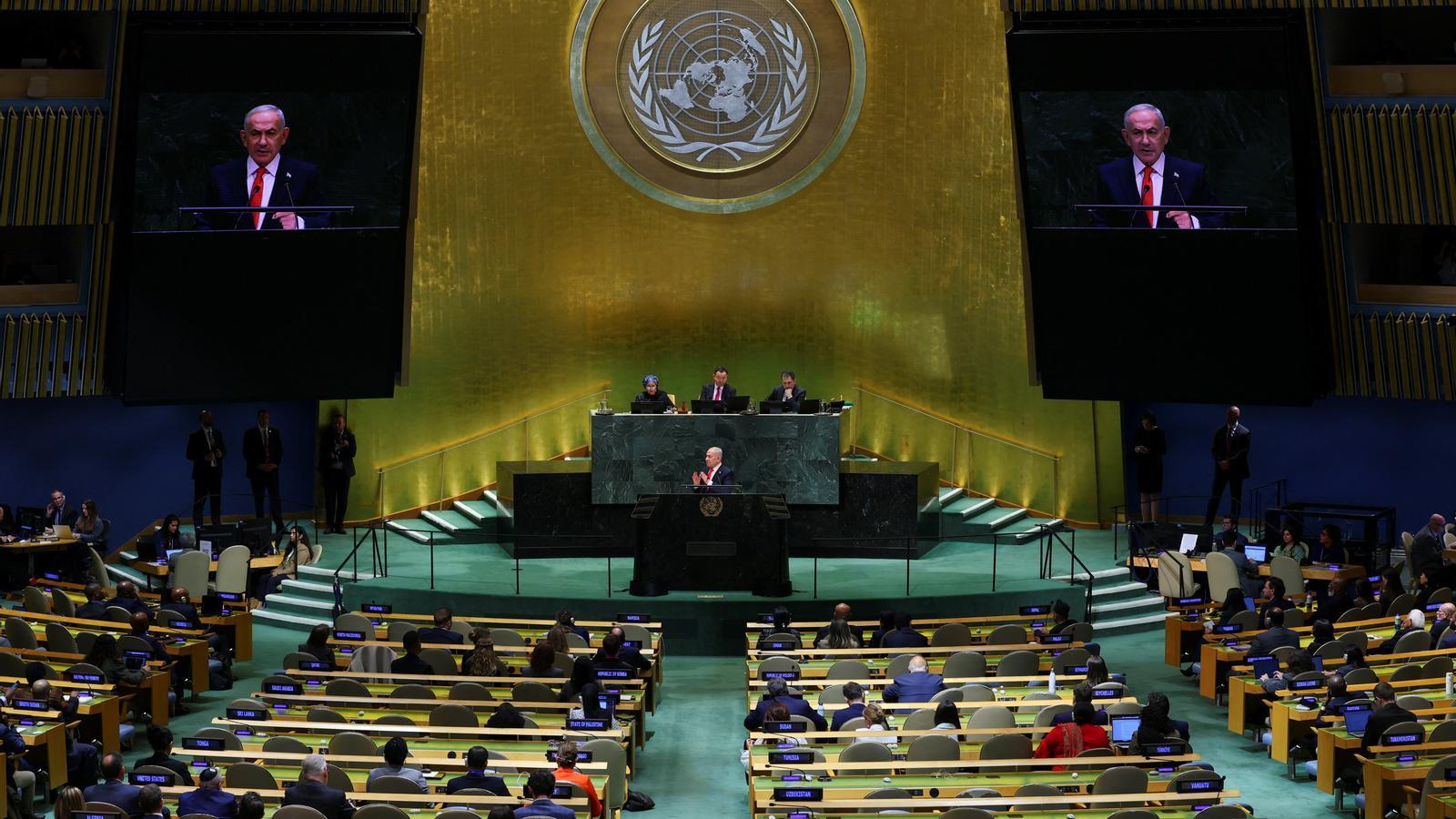
Dozens of delegations stood up the moment the Israeli Prime Minister, Benjamin Netanyahu, took the podium. One of the most eloquent images of the Assembly and one that shows how the taboo regarding the genocide in Gaza has been broken since the large-scale war began in 2023. In total, representatives from 77 countries were absent during his speech, a gesture that Netanyahu responded to with the same contempt he received: "If there is any other moral coward who has not yet left the room, let them do so now".
Beyond the void during his intervention, the conditions under which Netanyahu traveled to New York this time also highlight his loneliness and fragility. This year, his presence in the US has been intentionally brief, less than 24 hours, and there was not even a meeting with Trump on the sidelines of the assembly. Although Washington and Tel Aviv continue to proclaim themselves as great allies, the divergence of interests in the Iran war has generated friction in the relationship between the two partners.
The short duration of the visit, moreover, was framed by the calls by the mayor of New York to arrest Netanyahu following the warrant that the ICC issued against him two years ago. Mamdani, who already acknowledged that he had no authority to arrest the Israeli prime minister, returned to place the issue at the center of the agenda. Although the Israeli leader has capitalized on Mamdani's calls as an electoralist claim ahead of the elections being held in October in the Knesset, the shortness of Netanyahu's stay remains notable.
The window of opportunity for Xi Jinping

Unlike Trump, the Chinese leader, Xi Jinping, has not needed to open his mouth to express his position on the United Nations. Xi's deliberate absence from the event is a reflection of how Beijing is taking advantage of the cracks that its American counterpart has widened within the multilateral system. It has not abandoned the UN, nor has it actively disdained it as Trump has, but it does incentivize this new order where dialogue takes place between the strongest and not in a forum where the entire international community participates.
The speech given by the Chinese leader reinforced this transformation towards an order marked by spheres of influence under the control of great powers. Xi reminded Trump of the need to maintain "strategic stability", or in other words, not stepping on the other's turf. A dynamic that, in turn, also benefits other actors like Russia, which in recent weeks has escalated its hybrid war.
AI vs. climate emergency

Of the three existential threats that Secretary António Guterres placed at the top of the 2026 agenda—uncontrolled artificial intelligence, inequality, and the climate emergency—the latter is the one that has been most diluted in the week's media noise. The climate crisis has been practically buried under the rubble of wars and the dystopian futures of AI. The urgency has become so immediate in these fields that the 2030 ambitions to cut emissions in half have become blurred.
This does not mean that the UN has abandoned it entirely: the Climate Summit, convened by the Secretary-General on September 23, calculates that global energy investments will reach 3.4 trillion dollars in 2026, with 2.2 trillion allocated to clean energy—almost double that of fossil fuels—but financing for adaptation in the most vulnerable countries continues to be, year after year, the major bottleneck. Scientific urgency and political indifference have never been so much at odds.
The next Secretary-General

This was the last general debate for Guterres as secretary-general, a position that expires at the end of December. On the successor, whether man or woman, lies the challenge of restoring the organization's credibility. During his speech, the Spanish Prime Minister, Pedro Sánchez, called for the next secretary-general to be a Latin American woman, in a clear allusion to the Costa Rican Rebeca Grynspan, one of the main names currently being mentioned.
However, ultimately, the process remains in the hands of the five permanent members of the Security Council: the United States, Russia, China, France, and the United Kingdom. The American ambassador Mike Waltz has already said that the next secretary-general must be aligned with "American values and interests". The paradox is evident: the organization most in need of reform must find the new leader tasked with recovering credibility through the same mechanism —the veto of the great powers— that has led it to paralysis.
