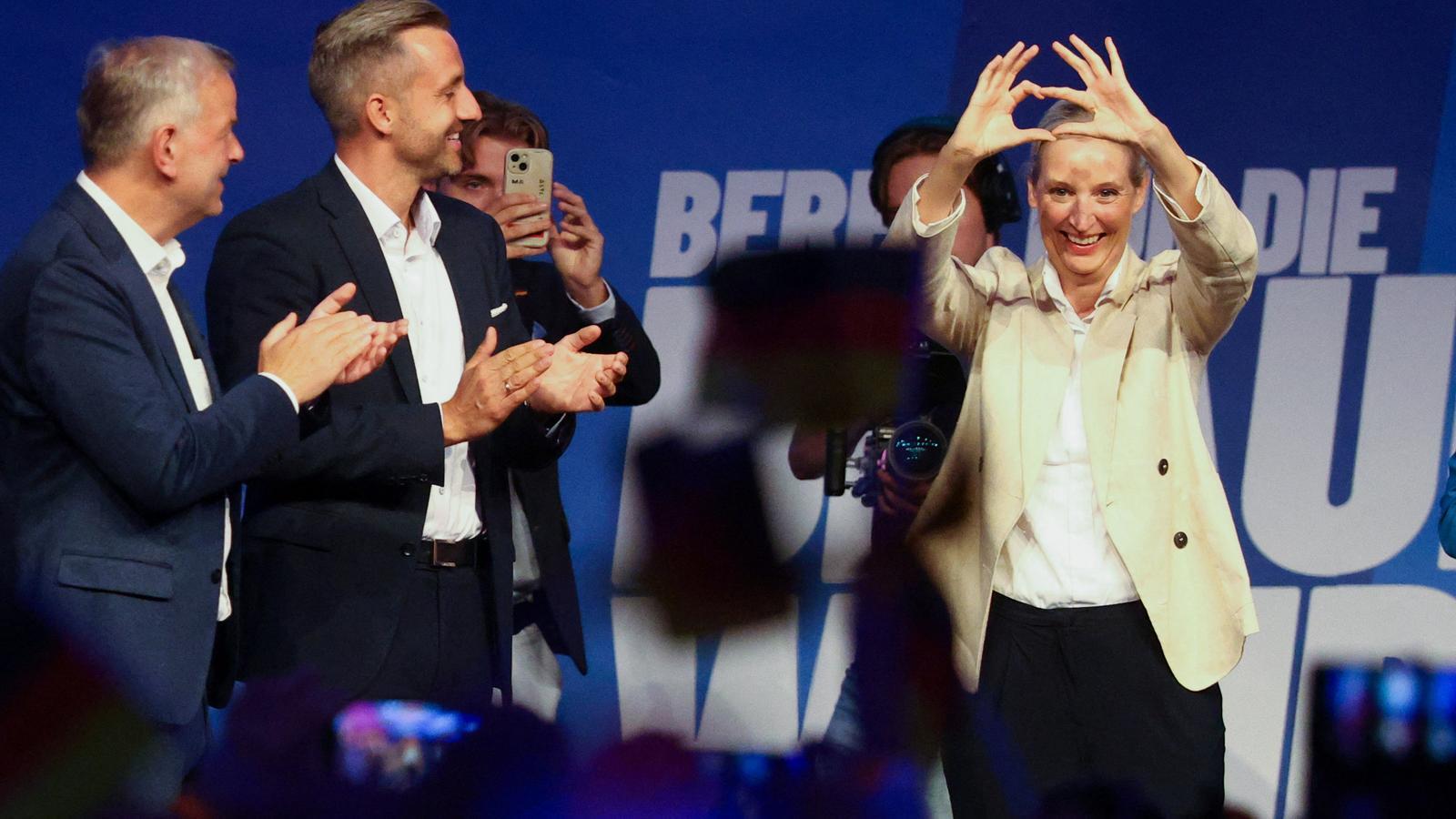
Smiles and free beer: this is how the German far-right disguises itself to win elections
The AfD makes a turn in strategy with a friendlier image while the party radicalizes from within
-
CAT -
CAST
BarcelonaThe German far-right is disguising itself as a lamb to win elections. Alternative for Germany (AfD) has changed the recipe with an image of hope to break its electoral ceiling, a turn that has allowed it to win elections in the eastern states of Saxony-Anhalt and Mecklenburg-Western Pomerania in just two weeks. The party has moved from the campaign slogan "Enough" from five years ago to "Everything is possible" and "Everything will be fine" in Saxony-Anhalt, a change in strategy with which the ultra-rightists move from a narrative denouncing the decline – which, in their view, Germany is experiencing – to selling optimism and enthusiasm. Fear and hope are combined in a perfect cocktail to reap electoral profit from the disenchantment that part of the population feels regarding the federal government of the traditional right-wing CDU and the social democrats of the SPD.
The campaign of the AfD leader in Saxony-Anhalt, Ulrich Siegmund, was a turning point in the new image that the far-right party wants to sell to voters. Siegmund has toured the towns of the state in what looked more like a rock star tour than an election campaign. On top of a blue 1975 Simson, the legendary motorcycle of the former East Germany,"the most dangerous man in Germany", as he was defined by the newspaper Der Spiegel, has shown a permanent smile, with a friendly image in interviews and campaign events.
The formula for success was reproduced in Mecklenburg-Western Pomerania, where the AfD candidate, Leif-Erik Holm, showed moderation in his demeanor but a background with ultra-right positions. Both candidates hide, behind the smiles, a harsh political agenda, especially on immigration and security. In fact, Siegmund is considered one of the leaders of the most radical wing of the AfD and in his circle there are people who actively participated in the far-right youth organization Patriotic German Youth, banned in 2009 for its affinity with Nazism.
A more radicalized party
Beyond the image, political scientist Nicolas Spohn, from the Otto von Guericke University of Magdeburg –capital of Saxony-Anhalt– warns that the AfD has radicalized and that the party's narrative remains the same, that of a country "in decline" and that of a "Germany that they will save to bring a better one". According to the expert, the possibility of winning, and even governing, is what has injected a "positive effect" into the party and a "new perspective" into the campaign. He also attributes the success to the figure of Siegmund. In some states that have been dragging a complicated economic situation since the reunification –more than 30 years ago– and the emigration of the population, the AfD candidate in Saxony-Anhalt "is the symbol of a young person who has achieved his goals and who has managed to be important".

However, the political scientist from the Otto von Guericke University of Magdeburg warns that Siegmund's case is exceptional because the AfD does not have many charismatic leaders either. At campaign events in Mecklenburg-Western Pomerania, attendees were taking photos with him and not with Holm. Furthermore, the political scientist explains, the far right has held large campaign events in Saxony-Anhalt and Mecklenburg-Western Pomerania, even in rural areas where, he says, there are often few events. With "free beer and sausages – says Spohn – everyone went, even if they didn't vote for the AfD, because it was like a festival".
Proof of the AfD's radicalism is that the German intelligence services classify the party as right-wing "extremist" and a threat to democracy, and after various internal struggles, the more moderate leaders have been displaced by the more radical ones. In the last elections in the eastern states, the AfD has maintained its ultra policies. The electoral program in Saxony-Anhalt advocates for "deportations from minute one" to expel as many immigrants "as possible," a tightening of asylum policies, and the elimination of funds allocated for the integration of immigrants. In other areas, the party opts to segregate students with disabilities in specific centers and for homeschooling children, among others.
The voters, far from all being radicals
For the expert from the Otto von Guericke University of Magdeburg, the AfD's great success in the east is explained by the fact that the population is "more frustrated" than in the west. He warns, however, that frustration is also growing in the west and that the triumphs in the east could be replicated in the west in the future. "People are very frustrated with the centrist parties," asserts Spohn, who explains that the far right has benefited from the "unpopularity" of the chancellor, Friedrich Merz. The political scientist also remarks that the effects of the cordon sanitaire against the far right also have an impact on the electoral result. The rest of the parties suffer from the wear and tear of governing and the AfD "promises to do everything differently" and argues that "it is the other parties that do not let them." "This is a problem for the centrist parties," he adds.
The rise of the far right draws mainly from this discontent: 70% of AfD voters are "very frustrated" people who "want change," 20% are "discontented" conservatives, and only 10% vote for the party because of its ultra positions. "The people who vote for the AfD are not radicals or racists. They are mostly frustrated people. It is necessary to establish, from the center, a political perspective of positive ideas about the future that attracts the attention of these people," he argues.
