Pope Leo XIV has also asked for "sincere forgiveness" on behalf of the Catholic Church for taking centuries to condemn slavery. In his document, the Pope states that AI can generate new forms of slavery and calls for it to be considered "a grave violation of human dignity." "The delay with which the Church and society condemned the scourge of slavery cannot be denied or minimized," he said, recalling that it took until the 19th century to find "a formal, absolute, and universal condemnation of slavery." Therefore, he adds, "the memory of the complicity and blindness of the past in the face of the injustice of slavery becomes a call to vigilance for us: what we have learned must be translated into discernment and responsibility in the present."
The Pope warns about artificial intelligence: "No algorithm can make war moral"
In his first encyclical, Leo XIV warns that this technology is concentrated in few hands and defines it as "an unprecedented form of colonialism"

-
CAT -
CAST
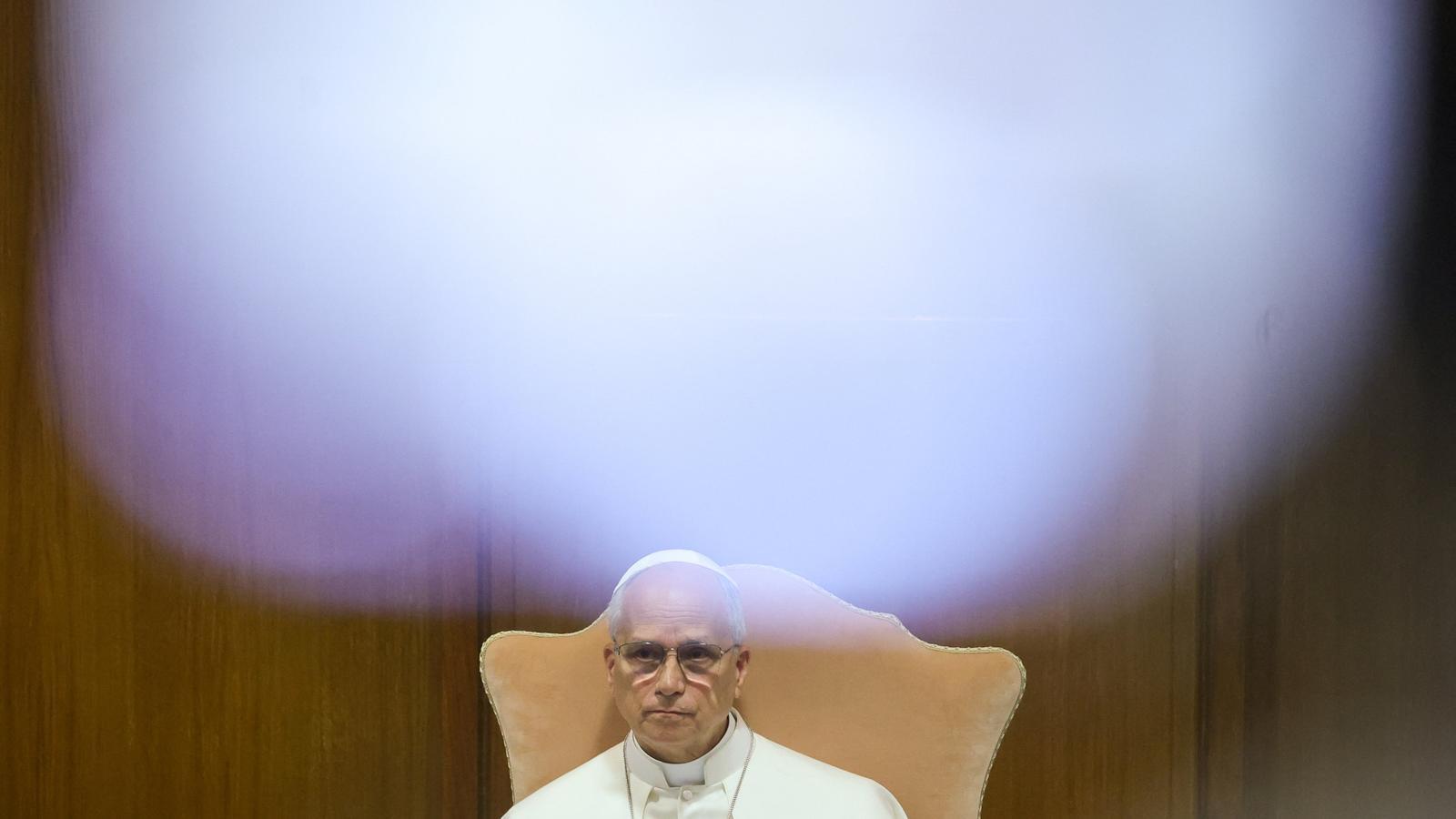
RomeArtificial intelligence (AI) "is not neutral", but rather "an unprecedented form of colonialism" that reduces victims to data to feed those behind this technology, warns Pope Leo XIV in his first encyclical, the most relevant papal document. A highly anticipated writing, which gathers the principles that will guide his pontificate and which, for the first time in history, has been presented by the Pope himself in an event this Monday at the Vatican. In the text, Robert Prevost calls for protecting “the magnificent humanity inhabited by God”, promoting truth, the dignity of work, social justice, and peace.
In Magnifica humanitas (The greatness of humanity, in Latin), the pontiff reflects on the social doctrine of the Church in the age of AI and dedicates a deep reflection to the protection of human dignity, warning of the danger that this technology "is concentrated in few hands". The Pope writes that, in the digital age, it is necessary to disarm AI and overcome the theory of "just war", advocating instead for dialogue and multilateralism to achieve peace. "There is no algorithm that can make war morally acceptable," he condemns.
Divided into five chapters, Magnifica humanitas
starts from a concrete principle: technology is not "an evil in itself" but depends directly on who conceives, finances, regulates, and uses it. "A more moral AI is useless if that morality is decided by a few," he emphasizes. For the Pontiff, it is about a new world order in which “small, highly influential groups can direct information” and “condition democratic processes”. “When power of such great magnitude is concentrated in few hands, it tends to become opaque and to evade public control, and the risk of distorted development grows, causing new dependencies, exclusions, manipulations, and inequalities,” he warns.
Following in the footsteps of Leo XIII's Rerum novarum
, the Pope wants to update the social doctrine of the Church in his encyclical and states that it is necessary to "disarm" AI to remove it from monopolies and prevent it from dominating human beings, as the alternative is not between enthusiasm and fear, but between two ways of building progress: in service of the person and peoples, or of power logics.
In his speech, the Pontiff recalled that the Church "has long been committed to nuclear disarmament, as a service to peace and the dignity of the human family" and that, similarly, "current artificial intelligence must be at the service of the common good". In this regard, the Pope proposes to establish “rigorous ethical restrictions, shared internationally, based on personal responsibility and the protection of civilians”. Recently, the Vatican approved a commission made up of members from various dicasteries to facilitate the exchange of information and projects on AI, including policies for its internal use.
Hybrid wars and digital manipulation
According to Leo XIV, technology does not make conflict less inhumane, it can only make it faster and more impersonal, lowering the threshold for resorting to violence and transforming defense into operational anticipation, thus feeding "a culture in which the enemy is reduced to a piece of data and the victim to collateral damage." Thus – the pontiff continues – "we get used to the idea that violence is inevitable and all that is needed is to optimize it".
, the Pope has invited Christopher Olah, co-founder of the

Leo XIV also warns of the risks of AI for individual freedom through massive data collection and the use of algorithms, which he says "transform personal lives into exploitable information and turn the digital environment into a 'predatory space.'" In this 110-page document, the Pope – who condemns "the close connection between economic interests, military apparatuses, and political decisions" – also warns about the use of AI-related weapons. The Pope denounces that for some rulers, war is an instrument of "cynical management" of difficulties, as well as a way to divert attention from internal problems.
In fact, at the presentation of Magnifica humanitas, the Pope invited Christopher Olah, co-founder of the start-up Anthropic —one of the most influential companies in Silicon Valley in AI— and research director on AI interpretability. North American like the pontiff, the tech mogul confronted the President of the United States, Donald Trump, by refusing to hand over the use of his technology model to the Pentagon for military purposes and for the unrestricted mass surveillance of citizens.
Olah acknowledged in his speech that the development of artificial intelligence is concentrated in a small group of rich nations. "How can we ensure that the benefits of artificial intelligence are shared globally?," he questioned, and argued that "moral voices that incentives cannot bend" are needed. "No matter how much any of us try to do what is right, we will always be influenced," he acknowledged.
Invitation to curb dehumanization
The head of the Catholic Church describes AI as “a new power” that risks discriminating against the weakest and generating new forms of slavery, such as that of those who work in the extraction of materials needed to manufacture the technologies necessary for its development. Therefore, he warns of the need to protect the dignity and value of work to combat the growing poverty and inequality caused by automated systems that have replaced man.
Robert Prevost states that the culture of power "penetrates society, modifies relationships and behaviors, expands by normalizing war, pursuing ever-increasing military power, taking advantage of the crisis of multilateralism and feeding a false realism, which repeats that there are no alternatives."
Magnifica humanitas is the second major document by Leo XIV, after Dilexit te [I have loved you], the first apostolic exhortation of his pontificate, which was in reality a text that his predecessor, the late Pope Francis, had begun to work on. The Pope also takes advantage of the encyclical to denounce those who use the name of God to legitimize war, violence, or terrorism and relaunches interreligious dialogue, inviting Christians to build “the civilization of love”, to respond to this culture of power by curbing dehumanization with small acts, and to cultivate a “sane realism” that seeks viable paths to peace with deeds, not just words.
