The EU cools Sánchez's proposal to break the association agreement with Israel
Kallas advocates for discussing pressure measures against Tel Aviv before measures that do not require unanimity, such as those of a commercial nature

-
CAT -
CAST
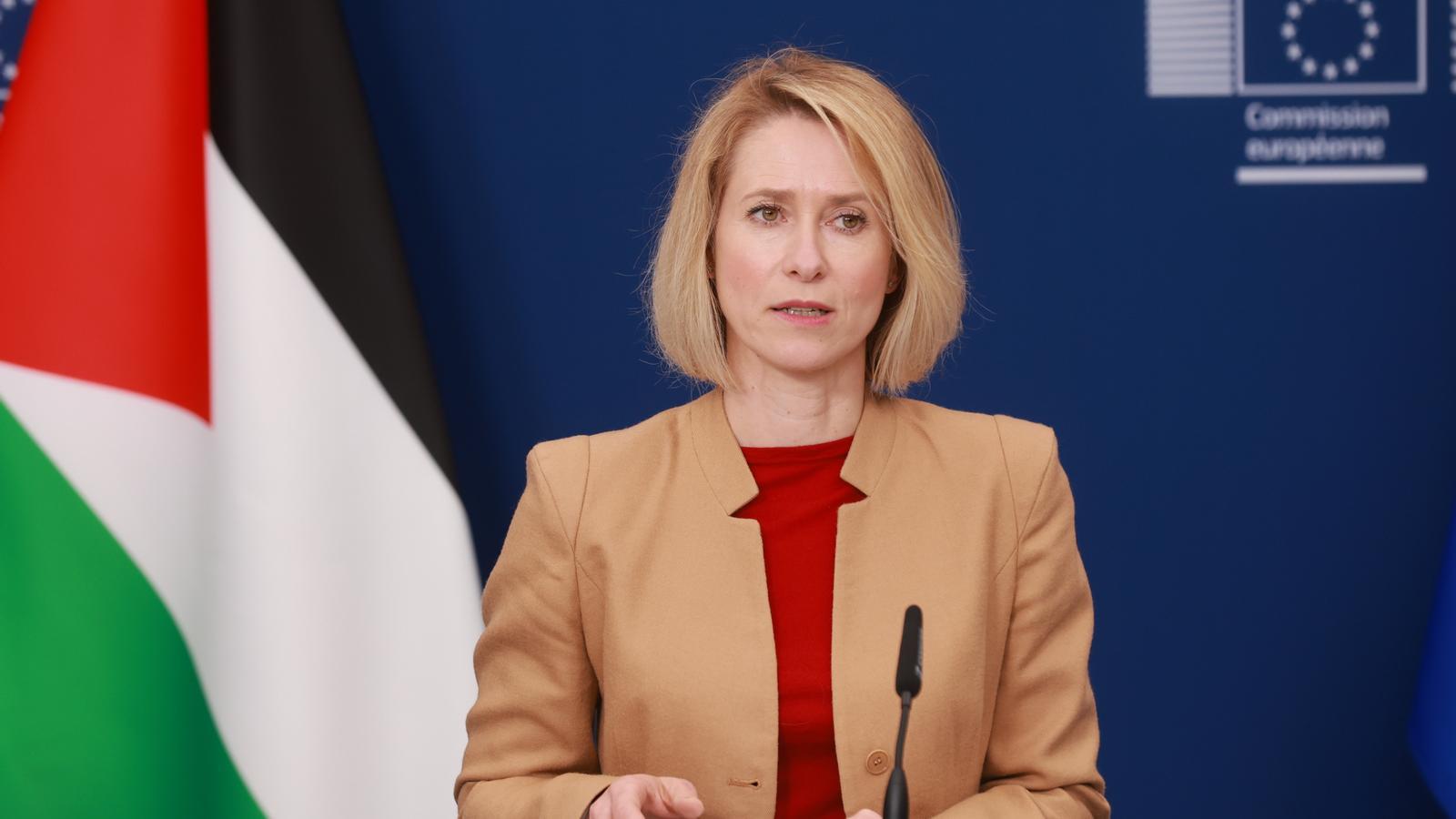
BrusselsPedro Sánchez does not stop pressuring the European Union to apply sanctions against Israel, but with rather moderate success. Kallas recalled that the approval of Spain's request, which it has submitted along with Ireland and Slovenia, is a measure that requires unanimity among member states and that, in any case, before "other measures to pressure Israel should be evaluated" that can be approved by qualified majority, which have also not obtained sufficient support so far. Among other measures, member states can opt to partially suspend the EU-Israel association agreement – which would mean an increase in tariffs or a reduction in imports – as proposed by the European Commission last September.
In fact, Brussels proposed the partial suspension after pressure from several member states, such as Spain, but the EU governments decided not to approve it due to the peace agreement in Gaza promoted by Donald Trump. Even so, they did not completely close the door to applying this sanction for fear that Tel Aviv would breach the pact and, for this reason, state governments can approve it at any time. "We have to see if the member states want to process them, we will discuss it tomorrow," added the head of European diplomacy after hosting the meeting of the Global Alliance to implement the two-state solution between Israel and Palestine.
In this regard, the Spanish government assures that it would also accept only breaking it partially to put more pressure on Tel Aviv to stop its offensives against Gaza and Lebanon. "It is not what we are requesting, but it would be a gesture," said the Minister of Foreign Affairs, José Manuel Albares, this Monday in an interview with RNE.
However, it must be remembered that the qualified majority of the EU – with which trade measures against Israel could be approved – is reached with the support of 55% of the 27 member states and that these represent at least 65% of the population of the European bloc. It is a consensus, but one that is also complicated to reach, especially if one takes into account that some member states that carry significant weight within the European Union, such as Germany or Italy, have so far shown themselves to be contrary to applying trade restrictions against Israel that would involve an increase in tariffs for the Israeli country.

And, despite the fact that Giorgia Meloni's government suspended the defense agreement between Rome and Tel Aviv last week, it has not changed its opinion regarding the relations it believes the EU should maintain with Israel, at least as of today and publicly. Furthermore, traditionally pro-Israeli European partners such as Hungary, the Czech Republic, and, among others, Austria, are also usually part of this group.
More sanctions against violent settlers
On the other hand, unanimity is required to apply sanctions against ministers of Benjamin Netanyahu's government or to expand the blacklist against violent settlers in the West Bank, which are other options that Brussels proposed last September and that are also on the table. For the moment, Kallas has only shown optimism about the possibility of punishing more violent settlers in the West Bank thanks to the change of government in Hungary. Viktor Orbán's government was the only one that was against it and vetoed it, but the head of European diplomacy expects the future Hungarian prime minister, the conservative pro-European Péter Magyar, to give the green light once the new government has been formed.
Sánchez's pressure comes after a European citizens' initiative, driven by the European Left Alliance, has gathered more than one million signatures to request the European Union to break the association agreement with Israel. Although it is the minimum number of signatures for the European Commission to evaluate the request, the community executive is not obliged to act and, in fact, in the vast majority of cases, European citizens' initiatives end up being a dead letter.
