Two fabulous interpretations by Pere Arquillué and Imma Colomer
'Denmark', by Lluïsa Cunillé, is a fantasy with a scent of Beckett's clowns and a powerful evocation of 'Hamlet'
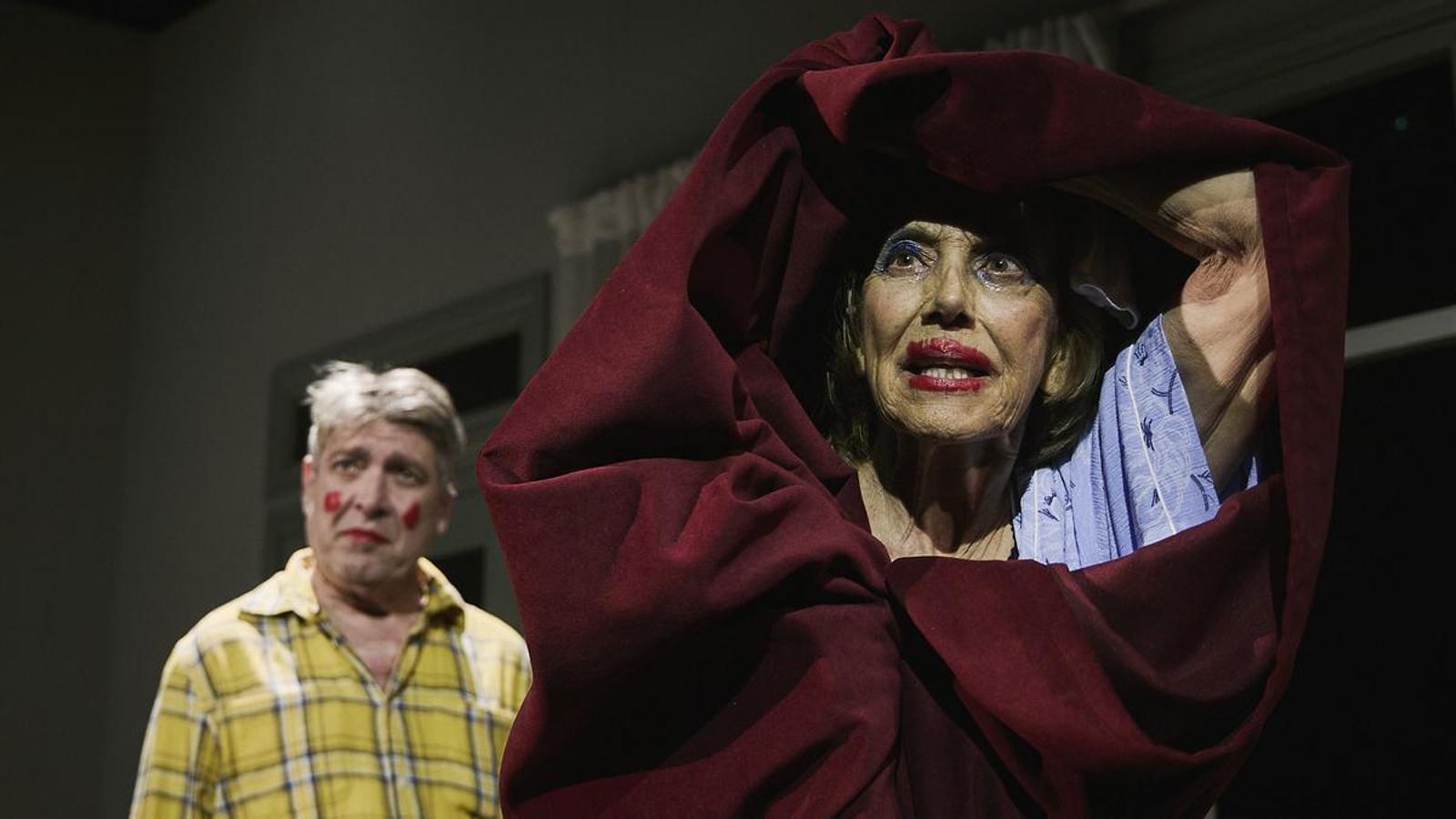
-
CAT -
CAST
- Author: Lluïsa CunilléDirection: Albert ArribasPerformers: Pere Arquillué and Imma ColomerSala Beckett. Until June 14th.
The mother and son who star in this Denmark by Lluïsa Cunillé, published in 2017 (Arola Editors) but written in 2014 — when the Spanish king abdicated to evade responsibilities with the Treasury—, are the author's classic everyday characters: nameless people who drag themselves through life expecting almost nothing from it. Cunillé mirrors them without explicitly stating it in Shakespeare's great tragedy, Prince Hamlet and his mother Gertrude. A mother and son in a humble little house in Copenhagen with a bourgeois theatre sofa in the middle and flies (something smells rotten). She sleeps in front of the television and the son arrives.
When the father died, the mother married the uncle and the son suspects that he would have murdered him to keep the woman and the business. But he has no proof, nor is there any ghost demanding revenge. In the end, this Hamlet is a poor devil still tied to his childhood, who confesses that he doesn't want to be anything, that he has accepted indecision as a way of life: “I have never wanted to be anything in particular, neither a man nor a woman, neither tall nor short, neither rich nor poor, neither young nor old, neither intelligent nor stupid,” he says. There is, therefore, no torment. There is no pain. There is, therefore, no tragedy. Only a bland everyday life, not devoid of tenderness, which faces the dilemma of whether or not to go and see the uncle admitted to a residence.
This is the starting point to enter an intense theatrical game, sprinkled with ironic humor, which Albert Arribas's direction enhances with care and without fear. Arribas emphasizes the initial false realism, approaching the absurd to the point of the grotesque. He also mostly respects the text (although he changes the beginning and the end), masterfully modulates the tension of the many pauses indicated by the author, and introduces a series of physical actions of great theatrical effectiveness thanks to two superb performances. Pere Arquillué walks between sexual ambiguity and the memory of childhood, and Imma Colomer is wonderfully possessed by fantasy. A fantasy with the aroma of Beckett's clowns that will surely fill the stalls.
