The Brazilians who escaped poverty thanks to Lula are now turning their backs on him
The new middle class opts for Bolsonaro's son and puts the president's reelection at risk

-
CAT -
CAST
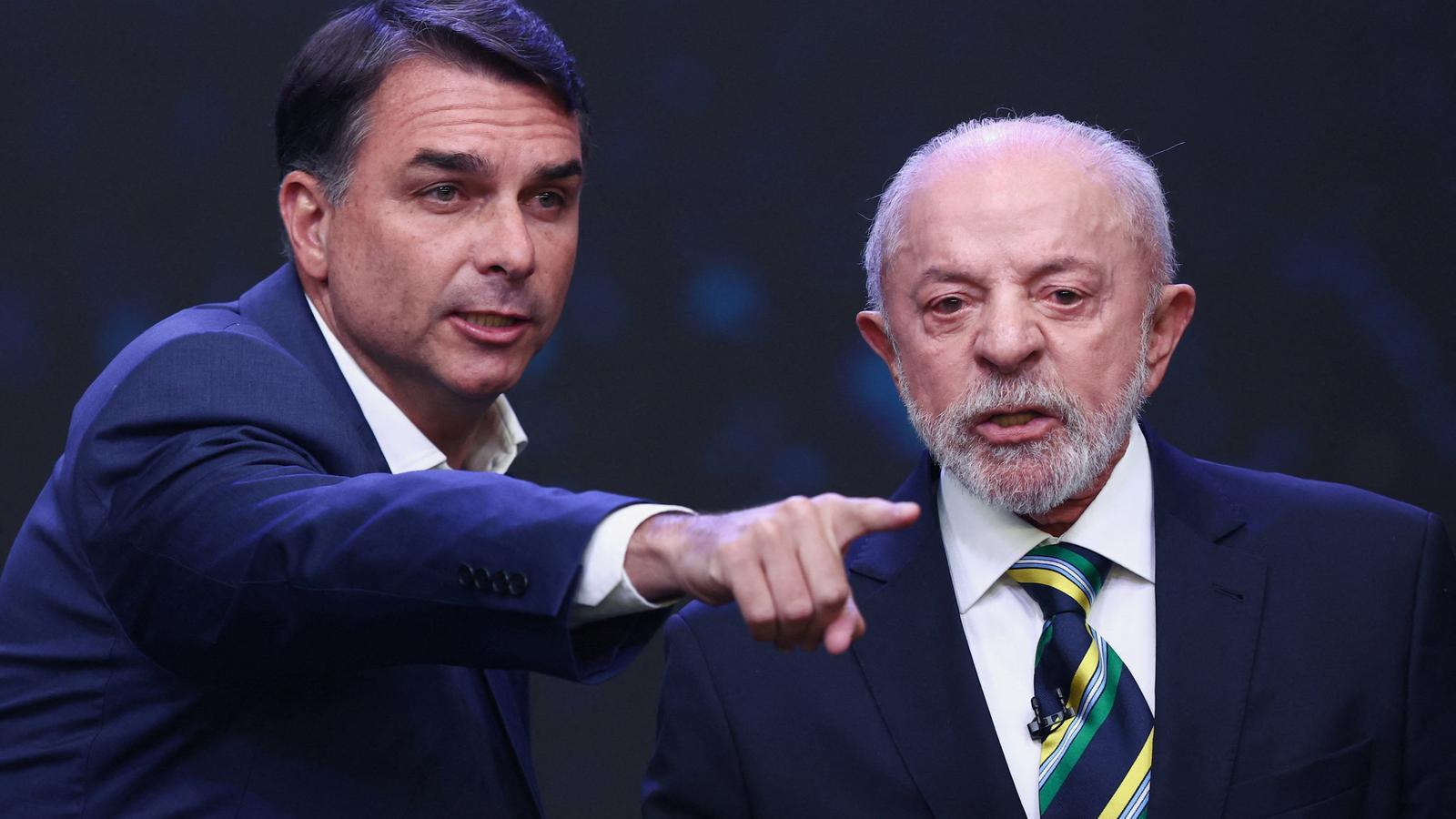
São PauloThe social sectors that left poverty behind thanks to the inclusive policies of Lula da Silva's first term in the presidency (2003-2010), now turned into the new Brazilian middle class, hold the key to Sunday's presidential runoff election. This segment, which represents 51% of the electorate, mostly supports the far-right candidate, Senator Flávio Bolsonaro, who already prevailed in the first round with 47.03% of the votes, ahead of Lula's 45.16%.
The re-election of the "father of the poor" necessarily involves attempting to recover a portion of the 3 million votes lost compared to the first round of 2022, when Lula surpassed Jair Bolsonaro, now imprisoned for the attempted coup d'état. The other possibility for growth is to convince the centrist fringes and the older voters among the 33.4 million abstainers from October 4th to go vote, 22% of the electorate in a country where voting is mandatory between the ages of 18 and 70.
For now, Lula, driven by a mobilization of the left in the streets not seen in decades, has halted the onslaught of the ultra-conservative wave. All polls point to a technical tie, but with the firstborn of the Bolsonaro clan always ahead in the number of votes. The veteran leader, aged 80, seeks an unprecedented turnaround: since the return to democracy in 1988, no candidate who lost in the first round has ever managed to come back afterwards. In a scenario of entrenched polarization, however, this time the gap between the two contenders in the first round is the shortest in history: 2,225,000 votes.
Geographically, Lula da Silva struggles in the South, Southeast and Center-West regions, which have become bastions of extremism. Regarding socioeconomic segments, the cliché that the wealthiest hate him is broken: the current president obtained 40.1% of the votes and Bolsonaro's son 48.7%, and he was very competitive in these segments in the country's two largest cities, São Paulo and Rio de Janeiro.
Between evangelical pastors and 'coaches'
The electoral fracture occurs in this emerging new middle class, formed by those with a monthly household income of between 615 and 1,460 euros. It represents the country's engine of consumption. This sector should be favored by full employment and the increase in workers' incomes. However, the indebtedness caused by predatory loans, with interest rates typical of usurious lenders, the expansion of online betting –which Lula prohibited before the first round–, the increase in the cost of living, and the frustration of not being able to experience a new social ascent have caused growing disenchantment.
It is in this middle bracket where Bolsonaro's son built his main advantage: 53.5% of support, compared to only 37.2% for Lula. Compared to four years ago, there has been a pendulum effect in the vote, which is now decisive: those who were previously poor have moved from Lulism directly to Bolsonarism, without stopping at a blurred third way. The trickle of lost votes, which Lula is struggling to recover, is concentrated in 1.2 million votes in the peripheries of large cities and 1.3 million supporters in the medium-sized cities of rural Brazil, where large agricultural and livestock producers, aligned with the Bolsonaro family, have strong economic influence.
The discourse of Lula's Workers' Party, focused on the defense of formal jobs, encounters many ideological reservations in a social segment that stigmatizes salaried work, because it sees it as a brake on social advancement. 83% aspire to be entrepreneurs and to work for themselves to have control over their own lives.
Exacerbated individualism is partly the result of the prosperity theology preached by evangelical neopentecostal churches, according to which faith in God guarantees material goods. The success of coaches like Pablo Marçal, a former candidate for mayor of São Paulo disqualified by the electoral justice system until 2032 for spreading fake news and an advisor to Flávio Bolsonaro, reinforces this trend. In the event of a far-right victory on Sunday, all social programs, threatened by budget cuts, and the Ministry of Labor – which Jair Bolsonaro abolished during his government – will be merged into a catch-all department with the suggestive name of Ministry of Prosperity, which promises to promote digital policies and measures to reduce bureaucracy and favor small business owners.
The new middle class is eminently conservative and gets its information, like the majority of Brazilians, through social media. This is an open door to the Bolsonarist fake news ecosystem structured for eight years with the complicity of the large technology companies based in the United States and which has fueled the anti-Lula and anti-PT sentiment. Digital disinformation is one of the hallmarks of the Brazilian extreme right, inspired by Trumpism.
In this context, the desire for change, which also questions the institutional system that Lula and the left claim in the face of the extremist danger, and the promise of immediate social improvement, fueled by the simplistic and infantilized messages of the far right, take precedence over the memory of the four disastrous years of the Bolsonaro government and the defense of democracy, which was precisely the central element that allowed Lula to form a broad front four years ago and defeat the far right. For this segment, social stagnation is more frightening than the authoritarianism and the implosion of the rule of law defended by the Bolsonaro family.

