“We are the only country in Europe where fascism has not been militarily defeated”
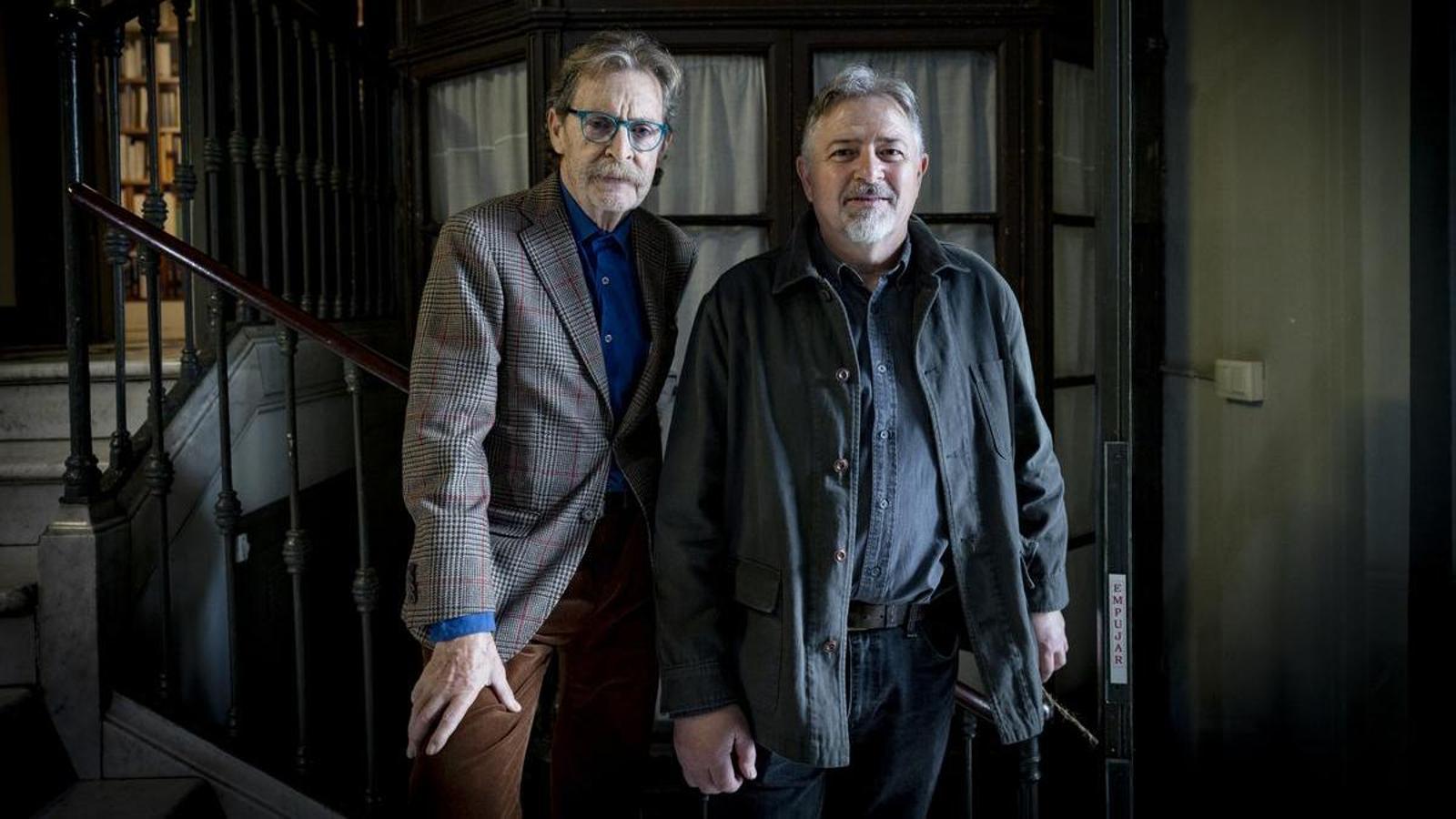
Josep Maria Fulquet and Vicent Enric Belda present the books with which they have won the latest Ciutat de Gandia literary awards

-
CAT -
CAST
Barcelona“From the deep roots of the earth / rises the voice of the dead”, we read almost at the beginning of País natal, the new book by Josep Maria Fulquet (Barcelona, 1948), which has been blessed with the 64th Ausiàs March Award of Gandia. It is one of the most veteran poetry awards in the Catalan literary landscape, and also one of the best endowed, with 20,000 euros. “I am thrilled to receive precisely this award, because my first book, Perillosa riba [1978], took its title from the fragment of a couple of verses from the Cants de mort, by March, which say: «Almost guided by false ensigns, / I have arrived at a dangerous shore» —he comments—. Now, almost 50 years later, the circle closes”.
This year, at the Ciutat de Gandia literary awards, Fulquet teams up with Vicent Enric Belda (Agullent, 1962), who after almost a dozen titles for children and young people has tried his luck with the novel for adults with Distreta solitud, which has earned the Joanot Martorell award, endowed with 25,000 euros. “My characters are victims of a historical moment, that of the first post-war period —he explains—. Distreta solitud explains the relationship by letter between Pepita, a young woman from a wealthy and deeply Catholic family, and Fernando, an orange merchant who lives between Cologne and Lisbon, much more liberated than Pepita although he depends on the decisions of his beloved”. Both País natal and Distreta solitud have been published by Edicions 62.
The poetry of Josep Maria Fulquet drinks from authors as diverse as J.V. Foix, T.S. Eliot, Pere Gimferrer and Rainer Maria Rilke, from whom he has translated, hand in hand with Eduard Santiago, the Elegies de Duino and the Sonets a Orfeu, both for Flâneur. “I don't know how many more books I have left to write. I am part of a generation that has gone unnoticed —he assures—. In País natal I reflect on memory, time, and language. All of us who belong to the Catalan linguistic domain are under suspicion and threatened with death. We are the only country in Europe where fascism has not been defeated militarily”. Structured in thirteen cantos, País natal is a single long poem marked by feelings such as “bitterness, sadness, and disappointment”. “It is the poem of someone who has seen that all the things in which they had placed illusions have been lost and have not come to fruition”, the author admits.
Fulquet grew up in the Francoist Barcelona of the 1950s, the same decade explored in the letters that Pepita and Fernando send each other in Distreta solitud, which are based on the real correspondence that a friend of the author found in a flea market in Valencia. “At first I found that turning these letters into a novel was a huge challenge, but I ended up liking it, and I have great respect for all the characters, especially for Pepita, who is at the antipodes of my ideology,” says Vicent Enric Belda.
“My paternal family had a republican tradition and was repressed: my grandfather Sebastià even became the mayor of Sant Pol de Mar,” explains Josep Maria Fulquet. “My maternal family was a supporter of Cambó and the Lliga Regionalista. The wealthy social class in which I grew up has always sold itself to the highest bidder. It has made a tabula rasa of the literary and cultural tradition it carried within.” Although the book does not establish any parallel between the world in which the poet grew up and the present day, he acknowledges that “it is not very flattering,” and adds: “I will never see either a Catalonia or independent Catalan Countries, and that distresses me. It is the world I would have liked to see and touch, but it will not be reached. On the contrary: a rather uncertain future is opening up for us. In this sense, País natal does not give rise to many hopes; it is a disenchanted poem.”
