Tens of thousands of French people return to protest in the street on a day with less serious incidents
The strong police deployment avoids major overflows despite the clashes between protesters and law enforcement forces

-
CAT -
CAST
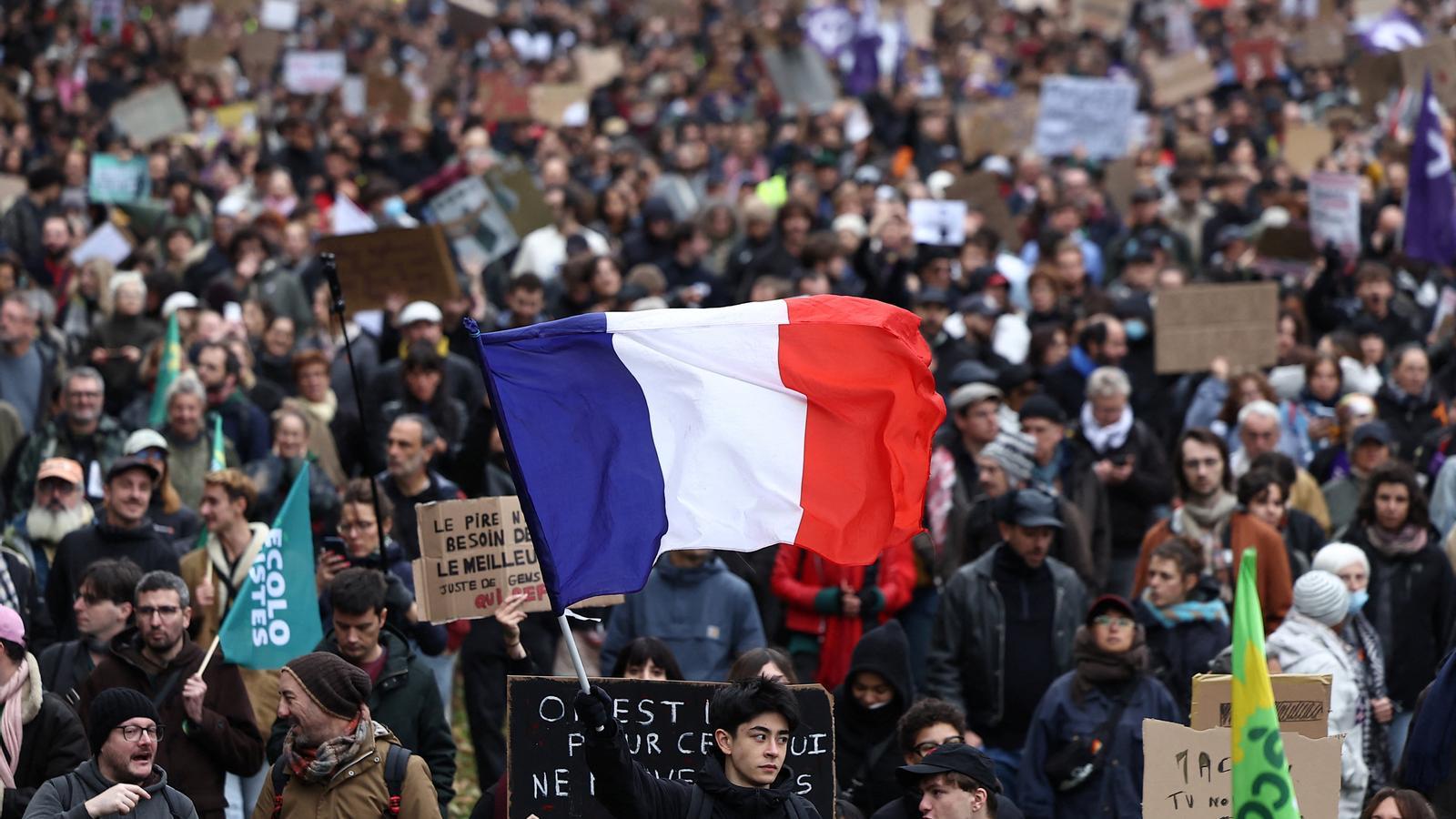
ParisTens of thousands of people have returned to the streets in France this Saturday to protest against the high cost of living and the lack of investment in education. Unlike October 17, when many cities experienced moments of chaos with fires, looting, and clashes with the police, this Saturday the citizen mobilization was calmer and clashes between the police and some protesters were only recorded in cities such as Paris, Lyon, Marseille, and Nice. In Paris, the march was massive and peaceful, and police charges only took place once it had already ended. "Most people want to make demands peacefully. Then there is a small group that wants to get beaten up, I don't know why. But what I do know is that the government is immersed in a spiral of violence, instead of providing a social response, which is what we expect," stated Jeanne, one of the participants in the Paris march.
To prevent a repeat of last Saturday's excesses, France had armored itself and demonstrations had been authorized in dribs and drabs. Following the instructions of the president, Emmanuel Macron, only protests called by the unions had been allowed. Those called by students and by the yellow vests had been banned. Furthermore, the Minister of the Interior, Laurent Nuñez, had warned that the police would be inflexible with the violent ones. The exceptional deployment of law enforcement, with 70,000 police officers and gendarmes, elite units, soldiers, and armored vehicles, has avoided a day of riots of the magnitude of October 17. By early evening, the police had already arrested nearly 1,000 people across France.
Most of the demonstrations took place this Saturday following the routes marked by the authorities, and far from urban centers. The Paris Prefecture, for example, decided at the last moment to change the capital's demonstration route to keep it away from the center: it was initially supposed to leave from the Place de la Bastille and cross the city until reaching the Place de la Nation, and it finally took place between the Porte d'Italie and the Porte de Vincennes, a route that placed the protesters almost on the periphery, far from the epicenter of last Saturday's riots. There were protests in the French capital, but also in dozens of other locations, such as Nantes, Lyon, Strasbourg, and Bordeaux. In some cities, there was some looting, but these were anecdotal episodes.
According to the police, a total of 410,000 people demonstrated across the country. The organizers, however, raise the figure to 800,000, a figure very similar to that of last Saturday. The violence is easing, but the discontent over rising prices – especially fuel – and the cuts that the executive plans to make this year, is not. The yellow vests movement, which is trying to revive after the 2018 protests, has called for a new day of mobilization for next Saturday. And, on November 5, the unions have called a general strike.
Anti-fascist protest
In Orleans, in the center of France, the police feared serious riots because a demonstration against the far right had been called, coinciding with the congress that Marine Le Pen's party, National Rally (RN), is holding this weekend in the city to launch the presidential campaign. Surveillance and the deployment of law enforcement officers have been particularly high, but the anti-fascist protest—in which left-wing leaders and union leaders participated—has taken place without incidents.
Until 1 p.m., no major problems had been registered, but afterwards the first skirmishes occurred in Lyon, in the south of France. Officers fired tear gas to clear a group of protesters, mostly students, who were protesting outside the authorized route. The Prefecture justified this by saying that, among the protesters, there were masked individuals who raised fears of possible acts of vandalism.
Also in Nice, in the southeast of the country, the authorities intervened to clear a square. In this case, they did so using water cannons. In Paris, there was only a brief moment of tension when groups of protesters tried to invade the capital's ring road, but the police prevented them from doing so.
At the end of the demonstrations there were also riots in several cities, such as Lyon, Nantes, Nice, or Toulouse. Law enforcement officers used tear gas and water cannons to disperse people who refused to leave or to prevent them from accessing areas that had been banned by the authorities. In Toulouse, a woman was seriously injured in one hand during the clash with the officers.
Banners against the government
Another difference with respect to the mobilizations of last week is that many protesters this Saturday are carrying banners with slogans against the government and the police to express their disagreement with the many exceptional measures taken by the executive to curb the riots in the country, which have even included night curfews. “We are not only protesting for our demands to the State, now we are protesting for our right to protest. It is about our freedom to go out and express ourselves in our country,” said an indignant Julian-Gabriel Dare, one of the many students who were protesting again in Paris this Saturday. Another young man was of the same opinion: “We are becoming a police state”.
The leader of the French radical left, Jean-Luc Mélenchon, is also one of the thousands of participants in the Paris march and has once again urged the French president, Emmanuel Macron, to give in to the protesters' demands. “He is still in time to give in; afterwards, there will be nothing left for him but the exit door. Give in and stop wasting our time,” he declared, referring to the presidential elections scheduled for April next year, in which he will run once again as a candidate. Likewise, he has warned that, if the social demands are not met, the demonstrations will be repeated “every week”.
