Return to the liberated zone of southern Lebanon, where Israel's explosions do not stop: "The state controls nothing"
The first "pilot zone" evidences the difficulties of the Lebanese army to regain control

-
CAT -
CAST
Zautar El Gharbiyah (Lebanon)Every few minutes an explosion interrupts the conversation. A dry crackle. Then another. And another. In the background, on Ali Taher hill, a column of smoke rises again. An Israeli drone slowly flies over the entrance to Zautar al-Gharbiyah while a small Lebanese army checkpoint regulates access to the village. It is the first "pilot zone" of the agreement negotiated between Lebanon and Israel under the auspices of the United States. On paper, it was supposed to symbolize the beginning of the Lebanese state's return to the south. On the ground, it is hard to imagine anyone living there again.
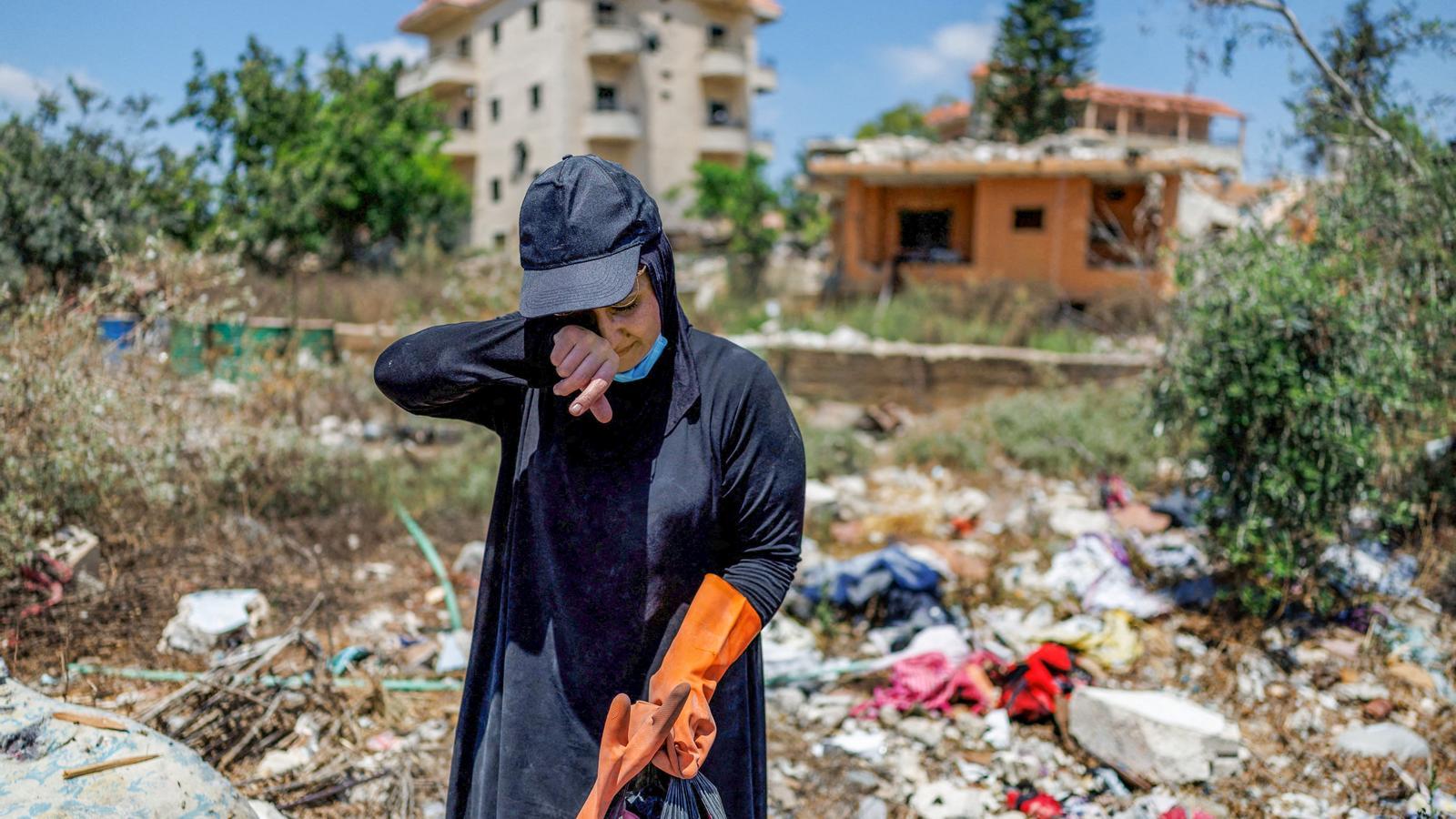
The few civilians who enter do so to check if anything is left of their homes. They collect photographs, some documents, a torn-off door, an almost intact appliance. Then they leave again. There is no electricity. There is no water. There are no shops. Nor is there a sense of security.
In Zautar al-Gharbiyah square, a group of Lebanese soldiers are installing solar panels. A few meters away, residents are searching through the rubble of their homes. It is one of the first visible gestures of the state, but the room for maneuver is limited. The soldiers control access and patrol the streets, but they have no authority, and even less to confront Hezbollah.
A few days ago, the Lebanese Prime Minister, Nawaf Salam, planted the country's flag in this very square and promised that the state's return to the south was beginning. But the village remains under Israeli fire. Israeli soldiers remain in neighboring Zautar al-Xarqiyah and maintain the capacity to attack any movement in the area. The explosions we hear are a constant reminder.
La Ruwaiya awaits us in front of what was once her home. In reality, it is difficult to recognize it among the rubble. It was destroyed during the 2024 war. Now, after the last combats, hardly any wall is left standing. She picks up her mobile phone and shows us several photographs. One shows the living room before the war. Another, the same place reduced to rubble. "I don't trust the Lebanese army," she says without raising her voice. "The state controls nothing. If it weren't for the resistance, the situation would be even worse."
El Hussan has also returned to his village for only a few hours. He is a pharmacist, and here he lost his pharmacy and his home. He now lives in Nabatiyeh and has come solely to recover some valuables before they disappear forever in the rubble.
Mahasen made a different decision. She is one of the few people who have spent the night in the village. For months she was displaced in Chouf, in the mountains. Going back and forth every day no longer made sense. Her house is half-destroyed, but still has part of the roof. However, sleeping has been almost impossible. "The explosions haven't stopped all night —she explains—. There was artillery fire, continuous detonations, and drones."

His account coincides with what the inhabitants of the area document every night. Although the pilot zone process has officially begun, Israel maintains bombings, controlled explosions, and artillery fire on different points in the south. Especially around Ali Taher, the strategic hill that dominates a large part of the region near the medieval castle of Beaufort, where military tensions have increased again in recent days.
An imperfect laboratory
All this turns Zautar al-Gharbiyah into an imperfect laboratory. Precisely because the Israeli army never had a particularly significant presence here, the deployment of Lebanese troops has been relatively easy. It is probably the most favorable scenario Beirut could have found to launch the project. Nevertheless, even under these conditions, problems arise from the very first moment.
The army needs more technical capabilities to locate weapons, more resources, and, above all, legal cover to search private properties. Without this instrument, it will hardly be able to respond to one of the main Israeli demands: to verify that Hezbollah has withdrawn its weapons from the future pilot zones. Israel also maintains that even the return of ambulances linked to Islamic health organizations is an indication of Hezbollah's return. Beirut rejects this interpretation and fears that any verification mechanism in which Israel has decision-making power will end up stripping the Lebanese state itself of legitimacy.
This will be the real debate in the negotiations between Israel and Lebanon. Rather than opening new pilot zones, the talks should address the obstacles that continue to block the implementation of the agreement, such as the verification mechanism, the Lebanese army's legal authority to act on the ground, and the timetable for an eventual Israeli withdrawal. Because Zautar al-Gharbiyah does not yet demonstrate that the plan is working. Rather, it highlights the extent to which it will depend on political decisions that remain unresolved.
Meanwhile, residents continue to enter their village for a few hours to check what remains of their lives before leaving again. Explosions continue to set the rhythm. Drones continue to fly overhead. And the first pilot zone resembles a precarious pause in the war much more than the beginning of peace.

