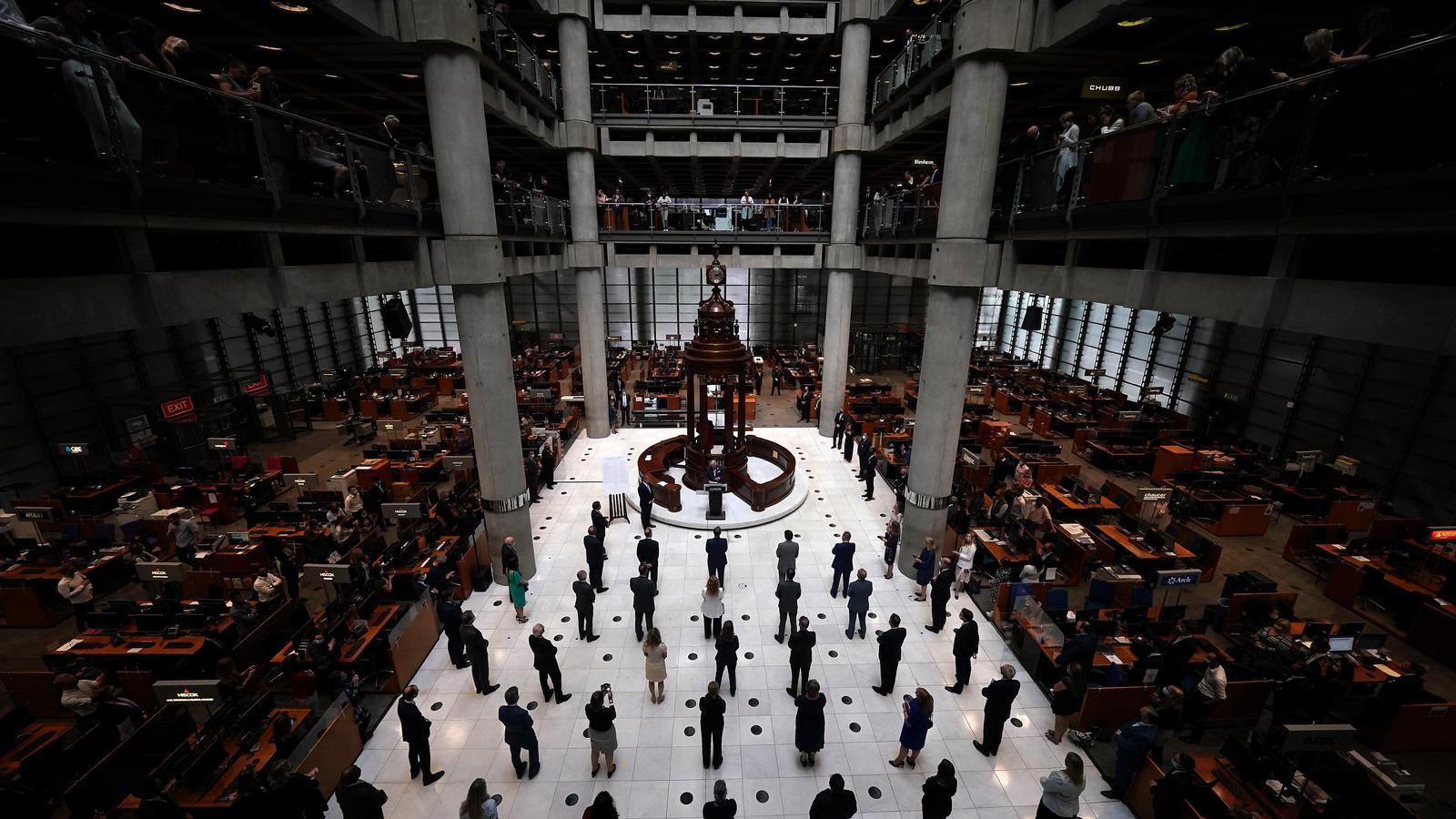
The power to stop or activate global trade has its roots in the modest coffee house that Edward Lloyd opened on Tower Street in 1688. Merchants and sailors would gather there to share information and divide the risks of the sea. Today, despite Richard Rogers' futuristic architecture, the institution's soul remains tied to that tradition. In the center of the Underwriting Room, the Lutine Bell, salvaged from a frigate that sank in 1799, still presides. In the past, its ringing announced news about ships: one peal for bad news (shipwreck) and two for good news (arrival at port). This insurance trading room, on the ground floor, has a historical projection on the eleventh floor of the building, where the Adam Room is located. This is where the Lloyd's board of directors meets. It is a space designed in 1763 by the neoclassical architect Robert Adam, which was acquired at auction in 1956 and moved piece by piece (1,500, all numbered) to London: first to the corporation's former headquarters at 56 Lime Street, and later to the current building. The persistence of the past in the 21st century is also evident in the Loss Book, the large ledger where, by tradition, shipwrecks and total losses are still recorded by hand. The book is written with a quill pen and ink, in impeccable calligraphy. The head waiter at Lloyd's is responsible for the fine handwriting; they wear a distinctive and traditional uniform known as livery. The tradition of the attire dates back to Edward Lloyd's aforementioned 17th-century coffee house. The current book is over a century old and serves as a reminder of the fragility of maritime trade. If a tanker's name is recorded there, the loss is absolute.
Oil is locked down in Lloyd's of London, not the Strait of Hormuz
The British capital's insurance market is one of the key thermometers for measuring the extent of the paralysis in crude oil trade in the Persian Gulf

-
CAT -
CAST
LondonWithout insurance, there are no ships to sail. That is why, at number 1 Lime Street, in the heart of the City of London, Donald Trump's words have a relative impact. He can say one thing or the opposite. Either that the war will end in "the next two or three weeks", after sending Iran "to the Stone Age, where it belongs." Or that the navy's aircraft carriers will protect the passage of oil tankers through the Strait of Hormuz. Or even more: that it will be the Western allies who will have to do it, either by warlike or diplomatic means, such as those discussed on Thursday by the thirty-five countries that, with the United Kingdom as host, met virtually to analyze the alternatives to the blockade of oil flow in the Persian Gulf.
But if the President of the United States believes that the problem will be solved with the deployment of an invincible armada or equivalent in those waters, he is mistaken. At least, that is what some sector specialists consider, such as Kathryn Rooney Vera, chief strategist at StoneX Group Inc., a global financial services company specializing in maritime and cargo risk coverage.
Rooney Vera stated in a briefing at the end of March that what "determines whether crude flows resume is insurance." And, borrowing the famous Zen root metaphor – the one that says when the wise man points to the moon, the fool looks at the tip of his finger – the analyst maintained that to have a reliable thermometer of the current crisis, "one should not look at the price of the Brent barrel [whether it rises or falls], but at the war risk premiums of Lloyd's of London." In summary, she argued that "the crisis will be resolved when Lloyd's says that the strait is again insurable."
Richard Meade, editor-in-chief of the prestigious Lloyd's List,one of the oldest and most influential publications in the world in the maritime transport sector, also summarized it with a complementary phrase on his reference podcast: "It's not that the market has closed, it's that the risk has become incalculable."
Lloyd’s List analysts recall that more than twenty ships have already suffered the effects of the war. The drop in transit has been such that last Wednesday only twenty-five ships sailed through the Strait of Hormuz; usually, between one hundred and fifty and two hundred passed each day.
Immediate impact
What does the current conflict situation in the Gulf imply? For a VLCC ("very large crude carrier) tanker, valued at 100 or 110 million dollars – depending on age, for example –, a premium of around 0.02% or 0.05% of the vessel's value meant an additional cost of about 20,000 to 50,000 dollars per voyage on February 27. But within 48 hours of the attacks and the Iranian response beginning, Lloyd's Joint War Committee (JWC) reassessed the rate upwards, and percentages skyrocketed to 1% or 1.5% of the asset's value.
In some cases, although figures are estimates that vary depending on the vessel, route, and risk, they could reach peaks of 5% or 7%, according to insurance brokers McGill & Partners. An exponential leap that, translated into money, implies tens of millions of additional dollars per voyage. The cost of chartering the oil tanker and for civil liability insurance also increased.
Before continuing, however, it is necessary to have an overall, even if simplified, view of how the oil transport business works, who owns the vessel, the cargo, and so on. Basically, it is a rental service: large oil companies charter vessels from independent shipowners to save costs and avoid legal liabilities. The most common method is to pay for specific routes according to market price. However, the stability of the system depends on insurance, as most of these vessels are mortgaged to banks. Without insurance covering the tanker's value ("
hull insurance
), no shipowner dares to sail, because an incident would mean total bankruptcy before financial institutions.
When London insurers sharply increase the risk premium price, the conflict becomes latent. As this extra cost usually falls on the party sending the oil, the price of transport per barrel increases so much that it ceases to be profitable. If the insurance cost is prohibitive, the vessels remain in port: the shipowner cannot move them because they have no coverage for their mortgage, and the oil company cannot rent them because "the numbers don't add up".

The figures for the risk premium are not born in a vacuum. They are negotiated in the so-called Underwriting Room of the Lloyd's market, located in the basement of the iconic Inside-Out building, with external elevators and pipes, designed by Richard Rogers. A futuristic architecture of the eighties of the last century hosts an insurance negotiation method that retains elements of a liturgy typical of the 18th and 19th centuries. Lloyd's is not the only key player in the global maritime insurance market, but it is the one with the most history. Others are Munich Re, Swiss Re, or Hannover Re.
In any case, as far as London is concerned, it is in this room (Underwriting Room) without closed offices, but with wooden tables and benches, where underwriters sit waiting for insurance brokers to bring them the slips: leather folders with the details of the vessels that require coverage: whether for navigating the Indian Ocean or, in the case at hand, for crossing the Strait of Hormuz. Brokers and insurers share the risk in real time. And no single company assumes the entire burden, but rather multiple syndicates of insurers take fragments of a transport, and thus – collectively – fix the final amount of coverage. The price, therefore, is not determined by a single insurer alone.
Despite the increase in the war premium, three weeks later – and the situation has not changed – the Lloyd's Market Association – the professional body representing the interests of all agents operating in the Lloyd's insurance market in London – reported, through one of its top officials, Neil Roberts, that "insurance continues to be available at the right price." But the "right price" is too high, and the risk of losing vessels, due to the impact of a drone, is also too high. Ergo, oil is not flowing as before.
Not only oil trade has stopped. Dry bulk vessels and fertilizer transports have been reduced to a minimum. Apart from 20% of crude oil trade, the Strait of Hormuz is also the vital conduit through which a third of the world's fertilizer supply circulates. Cargo insurers have followed the trend of vessel insurers by increasing premiums, so that the price of the final product has skyrocketed in international markets. Major container carriers, such as Maersk or Hapag-Lloyd, have suspended their operations in the area, not only for the physical integrity of the crew but because the reinsurance of their fleets has become economically unviable.
Given this situation, the United States government's response of attempting to create a kind of public syndicate for $20 billion in re-insurances through the International Development Finance Corporation (DFC) has been met with skepticism by the City of London. This mechanism is designed to act as a safety net for insurers and to absorb part of the losses in the event of a catastrophic scenario.
In fact, British underwriters insist that the problem is not a lack of capital, but a lack of physical security in the Persian Gulf. Because a ship does not sail if its insurance costs more than the profit it generates or if the risk of doing so is incalculable and not profitable.
The insurance industry has made it clear that the normalization of premiums will only come when there are guarantees of effective naval escort or verifiable diplomatic de-escalation. And until Lloyd's reduces its risk assessment in Hormuz, the oil blockade due to prohibitive insurance contract prices will remain. Some are already calling it the "paper blockade." In these circumstances, maritime traffic through the strait will continue to be entirely impassable. As much or more so than if its waters were full of mines or its skies were continuously overflown by drones with great destructive capacity.
