Mass evacuations in the heart of Donbas: "I said goodbye to my husband in five minutes"
Russian pressure on the Ukrainian fortress belt in Donetsk causes the exodus of its inhabitants
-
CAT -
CAST
Kramatorsk (Ukraine)"The main defense against drones is eyes and ears," says Bogdan Zuyakov, a Ukrainian volunteer who has evacuated over five thousand people from the Donetsk province since the beginning of the war. At only 26 years old, Bogdan explains that the worst scars are left in memory, not on the body, when he recalls the number of evacuees and volunteers who have died along the H20 national road, which connects the towns of Kostiantynivka, Druzhkivka, Kramatorsk, and Sloviansk, in the known belt of fortresses where the Ukrainian army is fiercely defending the quarter of the Donetsk region it still holds. the well-known belt of fortresses where the Ukrainian army is fiercely defending the quarter of the Donetsk region it still holds.
"The Russians already control with drones all the roads that are key to the logistics of the Ukrainian army. They attack any type of car, be it white, green, or with humanitarian markings, they don't care," comments Bogdan. Before each mission, he prepares the route well and prefers to go with only one other companion so that the extraction doesn't get complicated. He also records the evacuations to publish them on social media and attract the attention of donors to help with funding. "A little while ago we lost two armored vehicles because of drones, it has been a hard blow for the Kramatorsk Volunteers Association where I work, because we have to repair them and re-equip them with anti-drone technology." He is now constantly traveling to Druzhkivka, twenty kilometers from the devastated and disputed Kostiantynivka, where a handful of thousands of people still remain. The evacuation teams take about fifty people out each day.

In the north, in the neighboring cities of Kramatorsk and Sloviansk, the situation begins to worsen daily and the regional administration has ordered the mandatory evacuation of children in certain neighborhoods and streets that are close to the line of contact. This is the case of Bilenke, a neighborhood north of Kramatorsk that is only ten kilometers east of the war front. The city looks half deserted, with burned-out cars in its ditches and anti-drone nets covering the roads. No one uses headphones because they would prevent them from hearing the buzzing of drones, nor do they fasten their seatbelts in case they have to jump out of the car. An anxiety that has become unbearable for those who go to humanitarian points to embark on the uncertain journey to a new home. As Bogdan says, who knows cities like Toretsk, Bakhmut or Pokrovsk well, now under Russian control, "people accumulate a lot of suffering until they can no longer bear it, they leave and then total destruction begins".
Mass evacuations
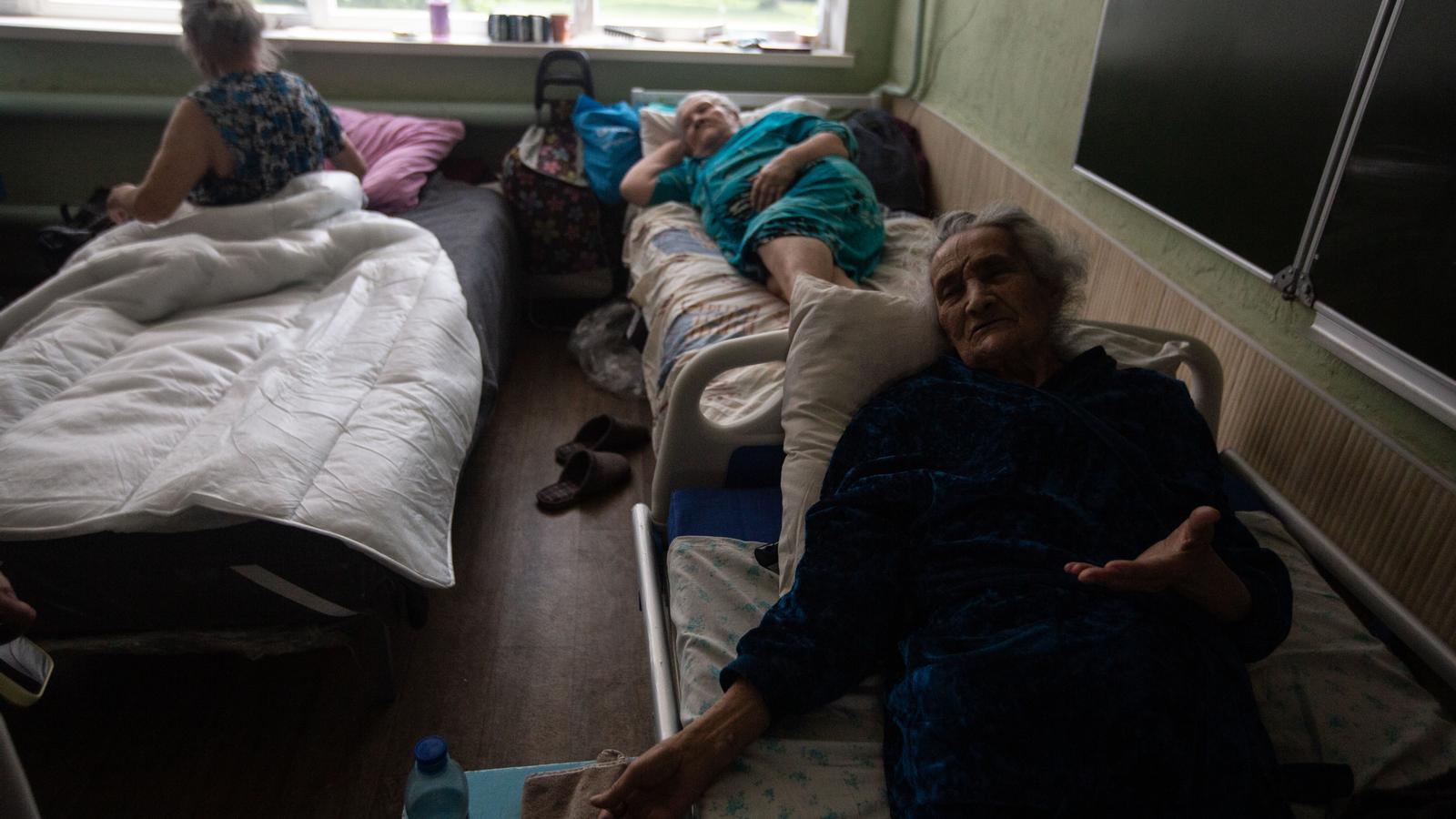
Svetlana is at the evangelical church Ark of Salvation in Kramatorsk with her teenage son, Stas. She is seven months pregnant and has decided to leave because the maternity hospital closed a month ago. She doesn't know the baby's sex yet. "My husband is a soldier and I said goodbye to him in five minutes. He got in the car and left. We only took the essentials, laptops, clothes, and the two cats." Stas was the only one of his group of friends who hadn't left yet: they have all been scattered across the country. Now he and his mother will start a new life in Irpin, near Kyiv, where Russia is launching ballistic missile attacks that in recent weeks have left dozens of victims. For Svetlana and her son, the war is a probability equation, and they anticipate being more protected in a conurbation of almost four million people in the country's capital than in Kramatorsk, where the presence of FPV drones – from first person view, equipped with cameras that allow the drone operator to see in real-time to shoot at any target – and guided bombs has been exponentially increasing in recent months over a population of fifty thousand people.
The church where Svetlana and Stas are waiting with twenty-five more people to be evacuated to Lozova, the transit center for internally displaced persons in the Kharkiv region, which receives about two hundred people daily from the Donetsk and Dnipropetrovsk provinces, is run by evangelical pastor Evgeni Pavenko. "We recently learned that about thirty people are still living in a basement in Kostiantynivka. They provide their own bread on a bonfire and suffer from starvation. They are elderly, but also men who are afraid of being mobilized and prefer to stay there." Pavenko says that communication has been lost for four months with these people, into whom the Russian army has infiltrated. "Since December, evacuations have been drastically reduced. People were walking from there, grandmothers were carried in carts on a thirty-kilometer road, and sometimes they died on the route. If you take this road, you have to do it alone, because if the Russians see a group, they kill them all."
Evgeni has just turned 45 and promised his family he would reunite with them in western Ukraine if his life was in danger. He explains that two drones have already fallen in his yard, fortunately for him, without exploding. The pastor admits that his relationship with his wife is cooling and that he is in a dilemma, but it seems his commitment leans more towards the nearly 700 refugees who have passed through his parish this year. About ten thousand since the start of the invasion. "Two weeks ago a drone destroyed a church car; perhaps it's a mistake not to leave with my family".
