Leo XIV: a year of pontificate turned into the nightmare of populism
The defense of peace has led the pontiff to confront Donald Trump

-
CAT -
CAST
Rome“An unarmed peace that serves to disarm”. With this wish, the North American cardinal Robert Francis Prevost inaugurated his pontificate on May 8, 2025. That afternoon, from the balcony of St. Peter's Basilica, in the Vatican, the new elected Pope Leo XIV presented himself to the world with a plea to end all wars at a time rife with conflicts and growing tension, unaware that the worst was perhaps yet to come.
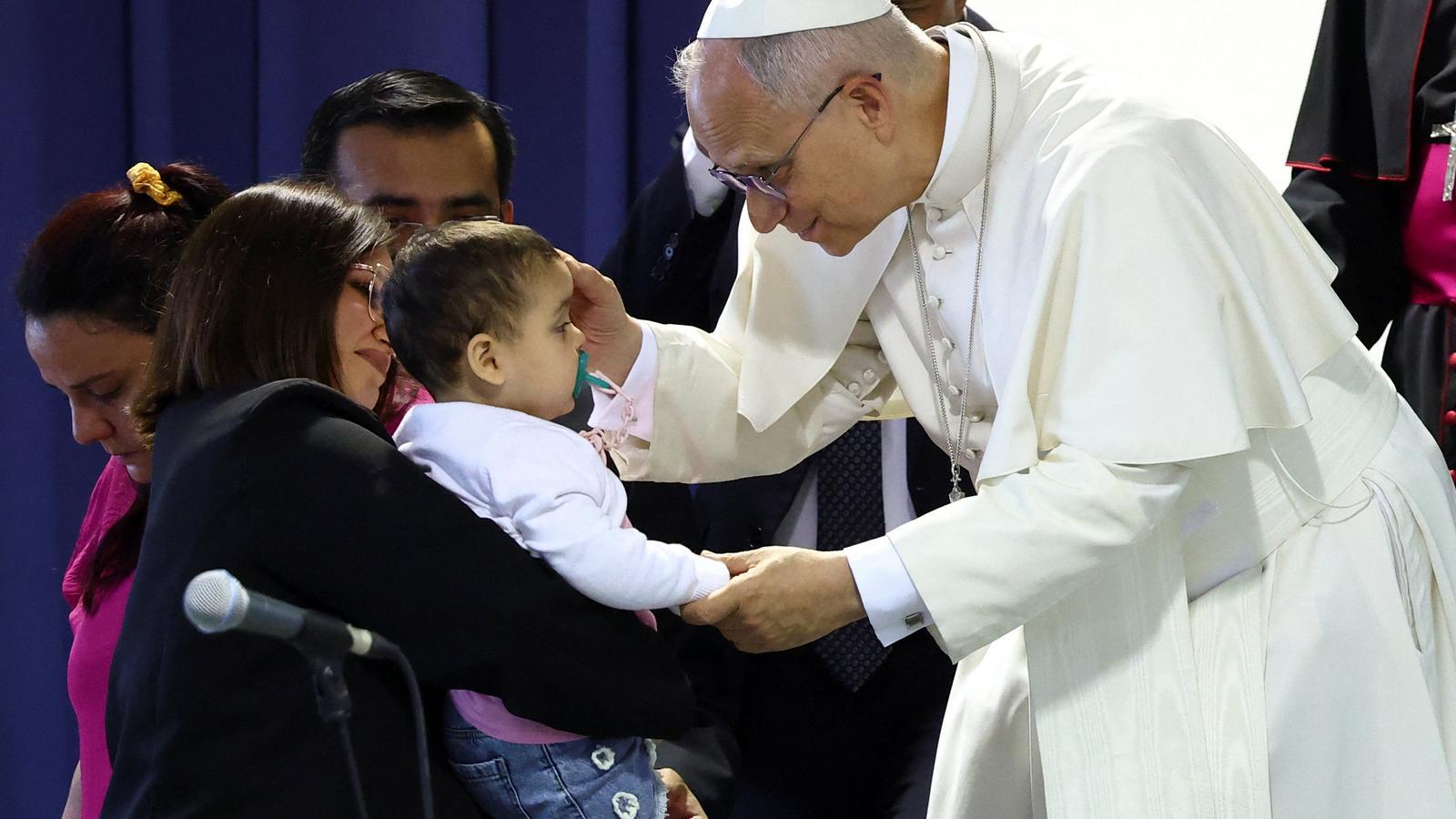
In these twelve months, Prevost, a former missionary in Peru for almost two decades —a country of which he even acquired nationality—, has placed the incessant search for peace and the defense of the most vulnerable as the compass of his pontificate. “The dignity of every human person must be respected now, not tomorrow”, he wrote in his first apostolic exhortation titled 'Dilexi te' (I have loved you), a document that emphasizes that “the commitment to the poor and with the aim of removing the social and structural causes of poverty, despite being important in recent decades, continues to be insufficient” worldwide.
This defense of peace and human dignity marks an element of continuity with his predecessor, Pope Francis, from whom he is separated by a much more orthodox and discreet character, which contrasts with the spontaneity shown by the Argentine pontiff, who even improvised some of his speeches despite having them written.
Leo XIV, on the other hand, has taken his time for appointments in key positions of the Roman Curia and has made clear his intention to involve the cardinals more in the governance of the Church. “I am here to listen”, he told the cardinals summoned in January for the first extraordinary consistory of his pontificate. An openness that was applauded by the majority of the cardinals, especially by those who lamented the lack of collegiality during Francis's pontificate.
On the international stage, his discreet but firm diplomacy has included contacts with the president of Ukraine, Volodymyr Zelensky, and with the Russian Vladimir Putin; but also with the prime minister of Israel, Benjamin Netanyahu, or the Venezuelan opposition leader María Corina Machado. A sober prudence that for months has disoriented a large part of Catholics, who expected more assertiveness on some issues from the first North American pope.
The turning point came in April, with the Vigil for Peace in St. Peter's. The Pope denounced the "illusions of omnipotence" of the powerful and, amid negotiations between the United States and Iran, sent a clear message: .Clashes with Trump
“I don't want a Pope who thinks it's okay for Iran to have a nuclear weapon. I don't want a Pope who thinks it's terrible that America invaded Venezuela. I don't want a Pope who criticizes the President of the United States, because I am doing exactly what I was elected to do by an overwhelming majority,” Trump snapped. These criticisms the American leader has repeated this week, accusing the pontiff of “endangering many Catholics” due to his alleged lack of firmness in the face of the Iranian nuclear threat.
“The mission of the Church is to preach the Gospel and peace, not weapons,” immediately responded Leo XIV from Rome. And he added: “Therefore, if anyone wishes to criticize me for announcing the Gospel, let them do so with the truth, since the Church has spoken out against all nuclear weapons for years and there is no doubt about it”.
Trump's attacks have created a rift among American Catholics. This Thursday, the Pope received Secretary of State Marco Rubio, who traveled to the Vatican and Rome precisely to try to mend the strained bilateral relations. But it doesn't seem easy while the magnate remains at the head of the White House.
The experienced Italian journalist Massimo Franco, author of the recent book 'Popes, Dollars, and Wars', maintains that the conflict between Trump and Leo XIV is unilateral; it is the American president who constantly attacks the pontiff because, according to Franco, the leader built his political power on the basis of divisions, while the Pope's primary objective is to unite a deeply divided Church. Something he has already achieved for now among the polarized episcopate of the United States, which after the 'Trumpians' attacks has closed ranks with him.
But beyond his war with the President of the United States, at home, Leo XIV has several pending challenges, such as bringing order to the Vatican's finances and, probably most urgently, ending the scourge of sexual abuse within the Church, an issue on which he has not yet taken significant steps. His first encyclical will be dedicated to the risks posed by artificial intelligence. Its publication is expected in the coming months and promises to be one of the most influential documents of his pontificate.
