What do former Spanish presidents do? The business career of Aznar and González
The Zapatero case opens the debate on the use of the contact book of former heads of the executive in the State

-
CAT -
CAST
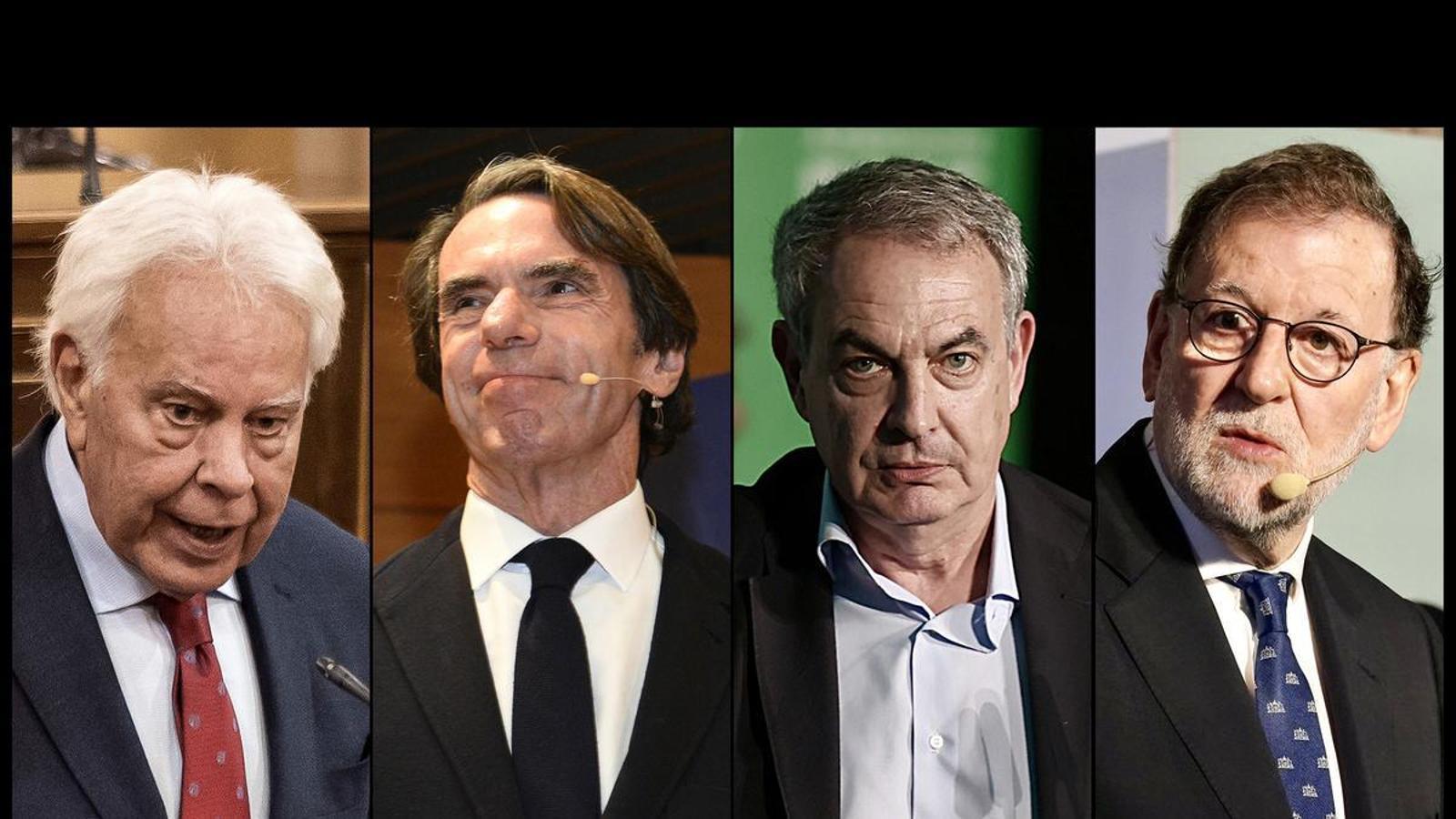
MadridThe Zapatero case has opened a parallel debate: what do former presidents do? Do they have any limits in the private sector? One of the arguments used by those around the PSOE to respond to the ruling of Judge José Luis Calama is that Zapatero – president from 2004 to 2011 – has used his contact list to carry out consulting or lobbying tasks, as other former Spanish presidents have done. This, they emphasize, is legal, although the experts consulted warn that there is a legal vacuum regarding the activities that former heads of state can undertake and that there is also no specific regulation for lobbying because it is stalled in Congress.
ad hoc lobbying because it is stalled in Congress.
How is the figure of former president regulated?
The figure as such is regulated in decree 405/1992, which was approved during Felipe González's penultimate government, but minimally:
- When they cease office, they have the right to receive 80% of the president's salary for a maximum of two years, with a regime of absolute incompatibility with any other public benefit or private income. There is no lifetime pension. However, state budgets do cover their office expenses, which is why they can create two jobs at their discretion among people they trust, and they have a car from the general administration of the State and security. It has been quantified at around 80,000 euros per year for the infrastructure of former presidents, which Adolfo Suárez and Leopoldo Calvo-Sotelo also received.
- According to the media outlet Newtral, which filed a transparency request in 2022, over 22 years they have received 6.5 million euros for office expenses, and the two-year compensatory pension was received by González (116,643 euros), Aznar (135,740), and Zapatero (33,706 euros).
The other option that former presidents have is to request admission as ex officio members of the Council of State, a lifelong position, for which they can receive 128,598 euros. Only Aznar and Zapatero requested it, and they later renounced it (Aznar was there for little more than a year and Zapatero for three and a half years). The regulations are different from the Catalan ones, which stipulate that former presidents of the Generalitat receive a pension of 80% of the president's salary –incompatible with other income– for half the time they have held the position (at least four years), and when they retire they have a lifelong pension.

Towards the private sector
Since there is no lifelong pension, former Spanish presidents can dedicate themselves to the private sector without limits. Besides Zapatero, Aznar and González have done so. In any case, all former Spanish presidents are already past retirement age.
Felipe González (1982-1996)
After losing the elections in 1996, Felipe González did something exceptional for a former president: he remained a member of Congress until 2004. Meanwhile, he created a family business, Ialcon Consultoría (2001), based in Pozuelo de Alarcón, which he has shared with his three children and in which María González Romero appears as sole administrator. The former president owns 78.2% of the shares, according to the Informa portal. According to the same platform, jewelry and precious materials are also listed as a secondary activity. It is not González's only company. He also founded Tagua Capital in 2013, a venture capital fund company dedicated to the "intermediation" of various products. According to various media such as El Confidencial, he also bills his activity as an international consultant, meaning he also works as a lobbyist, especially in Latin America. In fact, he is one of the main advisors to the Mexican magnate Carlos Slim, one of the richest people in the world.
. He still holds this position – it was renewed last year – for which according to José María Aznar (1996-2004)
Beyond still setting the political agenda from FAES, Aznar has a very active business side as a former president. In 2006, he left the Council of State to join Rupert Murdoch's media empire, News Corporation, owner of major media outlets like Fox and the Wall Street Journal. He still holds this position – he was reappointed last year – for which, according to El País, he has earned 4 million euros. At the same time, in 2011, he also joined Endesa, whose privatization was initiated by González and completed by himself. He served as an external advisor to this multinational with a salary exceeding 200,000 euros annually (according to the press at the time) to expand the company in Latin America. In other words, to act as a lobbyist.
He has also been hired by the multinational Afiniti, which specializes in technology and artificial intelligence associated with call centers, where his son, Alonso Aznar, has held relevant management positions. In parallel, he has promoted his own companies. Just a few months after leaving Moncloa, he created a family business with his wife, Ana Botella, Famaztella, through which he channels his businesses. In fact, in 2016, he was the subject of controversy with the Tax Agency for paying less tax than he owed. According to Informa, he currently has 77,000 euros in profit.
In his family circle, his son-in-law is Alejandro Agag, a business magnate in the world of Formula 1 and Formula E. Immediately after Aznar's presidency ended, Agag bought the TV rights for F1 in Spain and later, with the boom of this sport, sold them to Telecinco and Mediapro. But the most controversial management was in Valencia. During the investigation of the Gürtel case, Agag was identified as the intermediary with Francisco Camps to bring the races to the city.
Towards the public sector
Mariano Rajoy (2011-2018)
Mariano Rajoy, on the other hand, has opted for a different type of life, far from the business world. After being ousted by a no-confidence vote in 2018, he returned to his original position as a property registrar in Santa Pola (Alicante), as he was a civil servant. Just one month later, he secured a position in Madrid, at the Mercantile Registry, on Paseo de la Castellana, one of the most sought-after. With a salary that doubles that of when he was president – according to various media outlets, the average salary of a registrar is around 15,000 euros per month, which can be doubled depending on the Registry's activity.
