The death of Ali Larijani and the escalation in Lebanon worsen the uncertainty in the Middle East
Iran confirms the assassination, which represents the biggest blow against the regime since that of Ali Khamenei


BeirutAli Larijani, former speaker of Iran's parliament and a key figure in the country's Supreme National Security Council, has been killed in an airstrike on Tehran, Israeli Defense Minister Israel Katz announced Tuesday, a statement later confirmed by Iran's Supreme National Security Council. His death represents a significant step in Israel's strategy to eliminate high-ranking Iranian officials: it marks the assassination of the most important figure in the regime since Ali Khamenei on the first day of the US-Israeli war against Iran. Larijani, secretary of Iran's Supreme National Security Council, held several prominent positions in the Iranian political system throughout his long career. It was precisely because of his experience and expertise that Ali Khamenei had entrusted him with managing negotiations with the US, bypassing the country's president, Masoud Pezeshkian. Following the Supreme Leader's assassination on February 28, several media outlets pointed to Larijani as the likely culprit. as the new strongman of the Iranian regime.
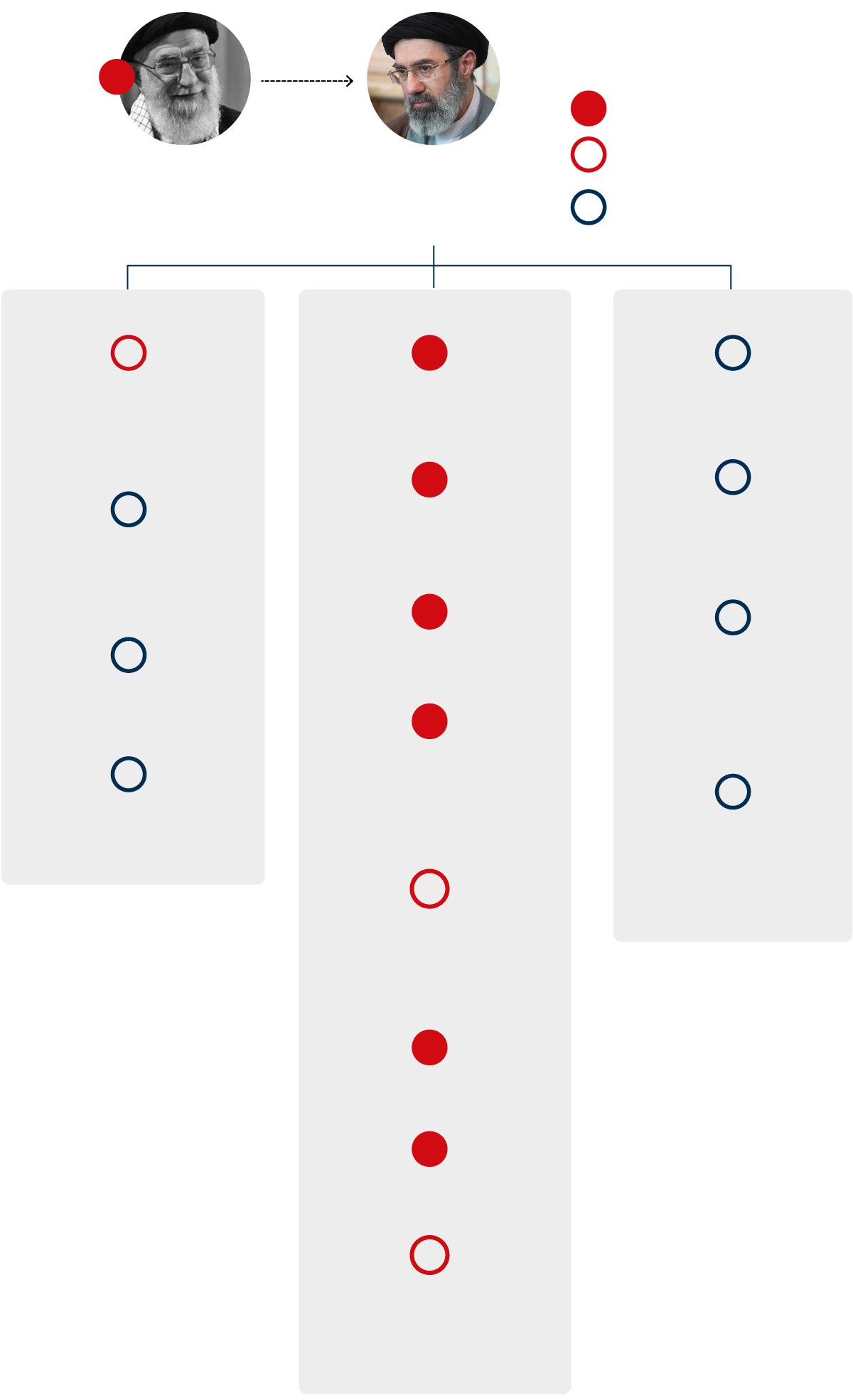
Morts confirmats per l'Iran
Morts segons Israel
Ali Khamenei
Anterior líder suprem
Mojtaba Khamenei
Fill d'Ali Khamenei
i actual líder suprem
Membres destacats
del règim
ALTRES LÍDERS
DEFENSA
CERCLE PROPER
Masoud Pezeshkian
President
Ali Shamkhani
Cap del Consell de
Defensa Nacional
Ali Larijani
Secretari del Consell Suprem de Seguretat Nacional
Gholam-Hussein
Mohseni Eje’i
Cap del poder judicial
Mohammad Pakpour
Comandant en cap de la
Guàrdia Revolucionària
Mohammad Bagher Ghalibaf
Portaveu del Parlament
Aziz Nasirzadeh
Ministre de Defensa
Mohammad
Movahedi
Cap de l’Assemblea d’experts de l’Iran
Yahya Rahim Safavi
Assessor
Sayyid Abdolrahim Mousavi
Cap d'estat major de les forces armades
Ali Asghar Hejazi
Assessor
Hassan Khomeini
Net del fundador de la República Islàmica de l’Iran
Gholamreza Soleimani
Comandant de la força paramilitar Basij
Mohammad Shirazi
Cap de l’oficina militar
Salah Asadi
Cap de la intel·ligència
Hassan Jabal Amelian
Cap del programa avançat d’armes de l’Iran

Morts confirmats per l'Iran
Morts segons Israel
Membres destacats del règim
Ali
Khamenei
Anterior líder
suprem
Mojtaba
Khamenei
Fill d'Ali
Khamenei
i actual líder
suprem
DEFENSA
Ali Shamkhani
Cap del Consell de
Defensa Nacional
Mohammad Pakpour
Comandant en cap de la
Guàrdia Revolucionària
Aziz Nasirzadeh
Ministre de Defensa
Sayyid Abdolrahim Mousavi
Cap d'estat major de les forces armades
Gholamreza Soleimani
Comandant de la força paramilitar Basij
Mohammad Shirazi
Cap de l’oficina militar
Salah Asadi
Cap de la intel·ligència
Hassan Jabal Amelian
Cap del programa avançat d’armes de l’Iran
ALTRES LÍDERS
CERCLE PROPER
Masoud Pezeshkian
President
Ali Larijani
Secretari del Consell Suprem de Seguretat Nacional
Gholam-Hussein
Mohseni Eje’i
Cap del poder judicial
Mohammad Bagher Ghalibaf
Portaveu del Parlament
Mohammad
Movahedi
Cap de l’Assemblea d’experts de l’Iran
Yahya Rahim Safavi
Assessor
Hassan Khomeini
Net del fundador de la República Islàmica de l’Iran
Ali Asghar Hejazi
Assessor

Morts confirmats per l'Iran
Morts segons Israel
Membres destacats del règim
Ali
Khamenei
Anterior líder
suprem
Mojtaba
Khamenei
Fill d'Ali
Khamenei
i actual líder
suprem
DEFENSA
Ali Shamkhani
Cap del Consell de
Defensa Nacional
Mohammad Pakpour
Comandant en cap de la
Guàrdia Revolucionària
Aziz Nasirzadeh
Ministre de Defensa
Sayyid Abdolrahim Mousavi
Cap d'estat major de les forces armades
Gholamreza Soleimani
Comandant de la força paramilitar Basij
Mohammad Shirazi
Cap de l’oficina militar
Salah Asadi
Cap de la intel·ligència
Hassan Jabal Amelian
Cap del programa avançat d’armes de l’Iran
ALTRES LÍDERS
CERCLE PROPER
Masoud Pezeshkian
President
Ali Larijani
Secretari del Consell Suprem de Seguretat Nacional
Gholam-Hussein
Mohseni Eje’i
Cap del poder judicial
Mohammad Bagher Ghalibaf
Portaveu del Parlament
Mohammad
Movahedi
Cap de l’Assemblea d’experts de l’Iran
Yahya Rahim Safavi
Assessor
Hassan Khomeini
Net del fundador de la República Islàmica de l’Iran
Ali Asghar Hejazi
Assessor
This morning, just minutes after the Israeli Defense Minister's remarks, a message was posted on Larijani's X profile paying tribute to the sailors killed in a US attack. The post added to the uncertainty surrounding his death. At the time, it was not confirmed; the regime confirmed it late Tuesday.
Larijani was considered a pragmatic figure within the Iranian regime, and her death could strengthen the hardliners linked to the Revolutionary Guard, thus reducing the scope for any eventual de-escalation. According to Israel, its forces also killed the commander of the Basij paramilitary force, Gholamreza Soleimani—confirmed by the Revolutionary Guard—along with other important Basij figures.
The attack comes against a backdrop of escalating regional tensions. In the Persian Gulf, Iran has carried out missile and drone attacks against positions allied with Israel and the United States, while The Strait of Hormuz remains a flashpointCommercial shipping continues to be intermittently hampered due to the threat of attacks on ships, driving up transport costs and increasing international concern about a potential escalation that could affect global energy trade.
The war intensifies in Lebanon
Meanwhile, on the ground, the war continues to escalate in Lebanon. Israel has intensified both its bombing and land pressure in the south of the countryThe strategic objective remains to push Hezbollah north of the Litani River and establish a security buffer zone that reduces its attack capabilities, although the cost to the Lebanese population and forces continues to rise.
Since March 2, at least 912 people have been killed and 2,221 wounded in Lebanon, according to the latest figures. Among the victims are three Lebanese soldiers killed and two wounded in a drone strike in the south. Although Israel insists it is not deliberately targeting the Lebanese army, it considers the country an active theater of operations where such casualties are inevitable.
In Beirut, the attacks have impacted various neighborhoods, beyond the southern suburbs. The extent of the bombing intensifies the sense of vulnerability and forces thousands of people to move within the city in search of shelter.
This military pressure is compounded by international concern. The UN Human Rights Office has warned that some Israeli actions in southern Lebanon could constitute war crimes, particularly attacks on medical personnel, ambulances, and displaced people. In recent days, paramedics have been killed while carrying out evacuations, a stark reminder that even emergency teams have become victims of the conflict. The humanitarian impact continues to worsen. More than one million people have been displaced, including 350,000 children. Evacuation orders now affect nearly 14% of Lebanese territory north of the Litani River, accelerating internal displacement and further straining the state's already fragile response capacity.
Hezbollah vows to continue the fight
In response, Hezbollah Secretary General Naim Qassem addressed the fighters in the south of the country, praising their "heroic" struggle against Israel and their "preparedness" to continue confronting the aggression. Qassem argued that the Lebanese militia had waited 15 months—since the implementation of the ceasefire in Lebanon—to give diplomacy a chance, but warned that now "the final word will be spoken on the battlefield." "We have no choice but to resist the enemy," he insisted. Meanwhile, ground operations are advancing. The Israeli army is reinforcing its presence in the south and consolidating a more structured deployment, with progress on the ground and not just based on airstrikes. From Beirut, the perception is that war is imminent. The attacks are no longer seen as something distant: the extent of the bombings and the ground advance paint a picture in which the conflict is taking deeper root and eroding security and the fragile internal balance. The uncertainty extends beyond Lebanon, and the military escalation threatens to drag the entire region into a deeper crisis.
