Iran appoints Mujtaba Khamenei to succeed his father as new supreme leader
The Revolutionary Guard is threatening oil facilities in the region after Israel bombed fuel depots in Tehran.

-
CAT -
CAST
BarcelonaIran has appointed Mujtaba Khamenei as its new supreme leader, just over a week after the assassination of his father, Ayatollah Ali Khamenei, in US-Israeli attacks that have plunged the entire region into a far-reaching war. Khamenei, who will now have to lead the Islamic Republic through the biggest crisis in its 47-year history, was named his father's successor by the assembly of clerics on Sunday.
A father-to-son succession is unprecedented, especially in a republic born from the overthrow of a monarchy in 1979. For many analysts, the appointment could be a symbolic move intended to simulate that the regime remains strong and determined not to yield to Western pressure. Mujtaba Khamenei had never put himself forward, but he is considered an influential figure at the heart of the regime's political power and also has deep connections with thein the Revolutionary Guard, its praetorian guardHis election could mean that the regime's hardliners retain power and will decide whether and on what terms to negotiate with the United States and Israel. Mojtaba Khamenei, 55, is considered one of the most influential figures within Iran's ruling system, though he rarely appears in public or has held formal political office. For years, he operated behind the scenes from the Supreme Leader's Office, acting as a key intermediary and power broker for his father. This role gave him influence within the regime's political, security, and religious institutions, most notably the Revolutionary Guard. He is also considered one of the architects of the regime's systematic repression of protest movements in the country.

During the Iran-Iraq War of the 1980s, the new supreme leader served in the Habib Battalion, a unit composed mainly of volunteers linked to networks that emerged from the Islamic Republic. Many of the men who fought alongside him later rose to senior positions within Iran's security and intelligence apparatus. Over the years, opposition figures and political rivals have accused Mojtaba of playing a role in manipulating election results and coordinating the crackdown on dissent.
Doubts about his religious credentials
The new leader was appointed by the Assembly of Experts, composed of 88 clerics, but he is not considered a religious authority. Iran's constitution requires that the supreme leader have a deep understanding of Islamic jurisprudence and be recognized as a top-tier religious authority. Ali Khamenei already lacked the same religious credentials as the founder of the Islamic Republic, Ruhollah Khomeini, and his son has even less. He studied at seminaries in Qom with several prominent conservative scholars but lacks the rank of ayatollah. Last week, Trump stated that he should have a role in choosing the successor and pointed to the US involvement in installing a new president in Venezuela after the ouster of Nicolás Maduro, suggesting it could be a possible model for Iran. Trump added that the election of Khamenei's son would be "unacceptable." Trump said in an ABC interview on Sunday that Iran's next supreme leader "won't last long" without his approval. The Israeli military went further, threatening to attack "anyone who considers participating in any meeting to choose the new leader" and the chosen one, whoever that may be. With each passing day, it becomes clearer that the United States' objectives don't entirely align with Israel's: one wants to subordinate the Iranian regime, the other to overthrow it.

Threat to oil facilities
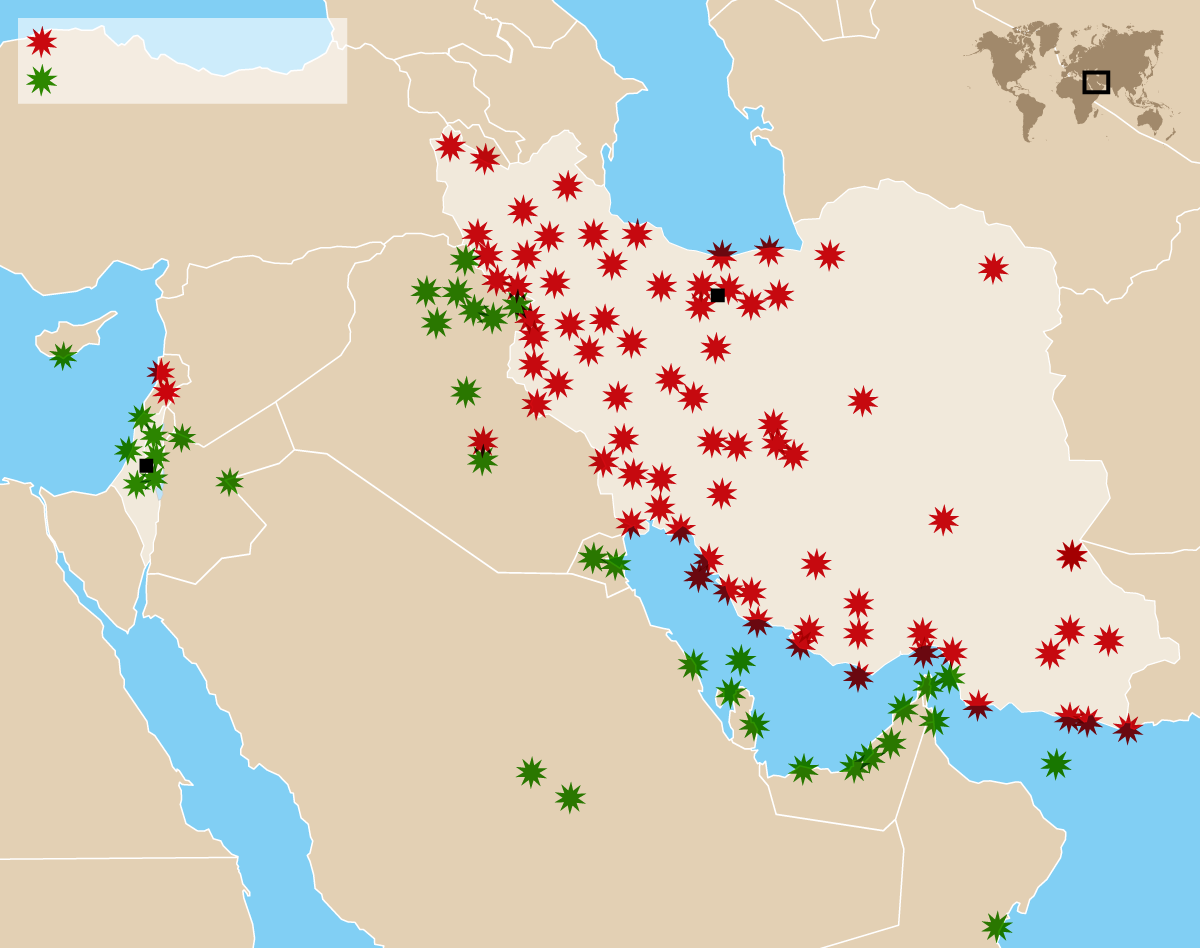
On the military front, Iran has once again struck Gulf states: Saudi Arabia, the United Arab Emirates, Qatar, Bahrain, and Kuwait all reported attacks throughout the day. In Saudi Arabia, where a projectile killed two and injured 15 in a residential area, 15 drones were intercepted, while attacks on Bahrain damaged a desalination plant. These attacks against the petro-monarchies highlight internal tensions within the Iranian leadership: on Saturday, President Masoud Pezeshkian apologized to the Arab neighbors and suggested that Iran would cease attacks if they did not allow the use of their territory—their airspace or the US bases that host them. The more conservative sectors reacted with outrage, and Pezeshkian had to clarify that he had been misinterpreted. In any case, the military command is in the hands of the Islamic Revolutionary Guard Corps, the regime's praetorian guard, which operates in a decentralized manner, and has continued to launch intermittent salvos of ballistic missiles throughout the day also towards Israel, where one person has died.
Atacs dels EUA i Israel
Atacs de l’Iran
mar Caspi
TURQUIA
Teheran
XIPRE
SÍRIA
líban
IRAQ
IRAN
Jerusalem
ISRAEL
kuwait
JORDÀNIA
bahraIN
QATAR
ARÀBIA SAUDITA
golf d’Oman
EGIPTE
EAU
mar Roig
OMAN
Atacs dels EUA i Israel
Atacs de l’Iran
TURQUIA
SÍRIA
IRAQ
IRAN
ISRAEL
kuwait
ARÀBIA
SAUDITA
EGIPTE
EAU
OMAN
Atacs dels EUA i Israel
Atacs de l’Iran
TURQUIA
SÍRIA
IRAQ
IRAN
ISRAEL
kuwait
ARÀBIA
SAUDITA
EGIPTE
EAU
OMAN
The Revolutionary Guard Iran threatened at the last minute to attack oil facilities in neighboring countries in retaliation for Israel's attacks on five fuel depots in Tehran, which was engulfed in thick black smoke. The Iranian oil distribution company reported the deaths of four workers, while explosions were also heard in the neighboring city of Karaj. "If you can tolerate oil above $200 a barrel, continue this game," a spokesperson for the company warned. The United States has tried to calm markets amid rising oil prices by promising not to attack Iran's energy infrastructure.
Trump considers seizing uranium
Donald Trump is considering deploying special forces to Iran to seize weapons-grade enriched uranium, Bloomberg reports, citing diplomatic sources. The United States and Israel attacked strategic Iranian nuclear facilities during the 12-day war in June. Experts estimate they were severely damaged, but the origin of the more than 400 kg of uranium that Tehran is believed to have enriched to over 60%—very close to the level needed to manufacture nuclear weapons—remains unknown. The uncertainty has intensified because UN inspectors have been unable to access the country since then. "They haven't been able to get there, and at some point, maybe we will," the Air Force One president has said.

Meanwhile, Israel has continued its war on another front, Lebanon, launching intense attacks that have left four dead in a Beirut hotel and twelve more in the south of the country, bringing the death toll this week to 394, according to Health Ministry figures. The Norwegian Refugee Council estimates that some 300,000 Lebanese have been forced to flee their homes. In the West Bank, a group of settlers killed three Palestinians (bringing the total to six this week), and an Israeli airstrike killed two people in Gaza City, the deadliest attack in the past week.
