They discover intact an air-raid shelter from the Civil War under the Mercat de l'Abaceria de Gràcia
The structure has been located on Torrijos street in Barcelona during urbanization works, and will be protected and sealed once documented
-
CAT -
CAST
BarcelonaBarcelona's underground is dotted with air-raid shelters, and they all have a story behind them. 1,322 have been located, but there could be many more. The latest to be discovered could be shelter 230 of the Passive Defense Board and would connect to the area around the Abaceria Market.
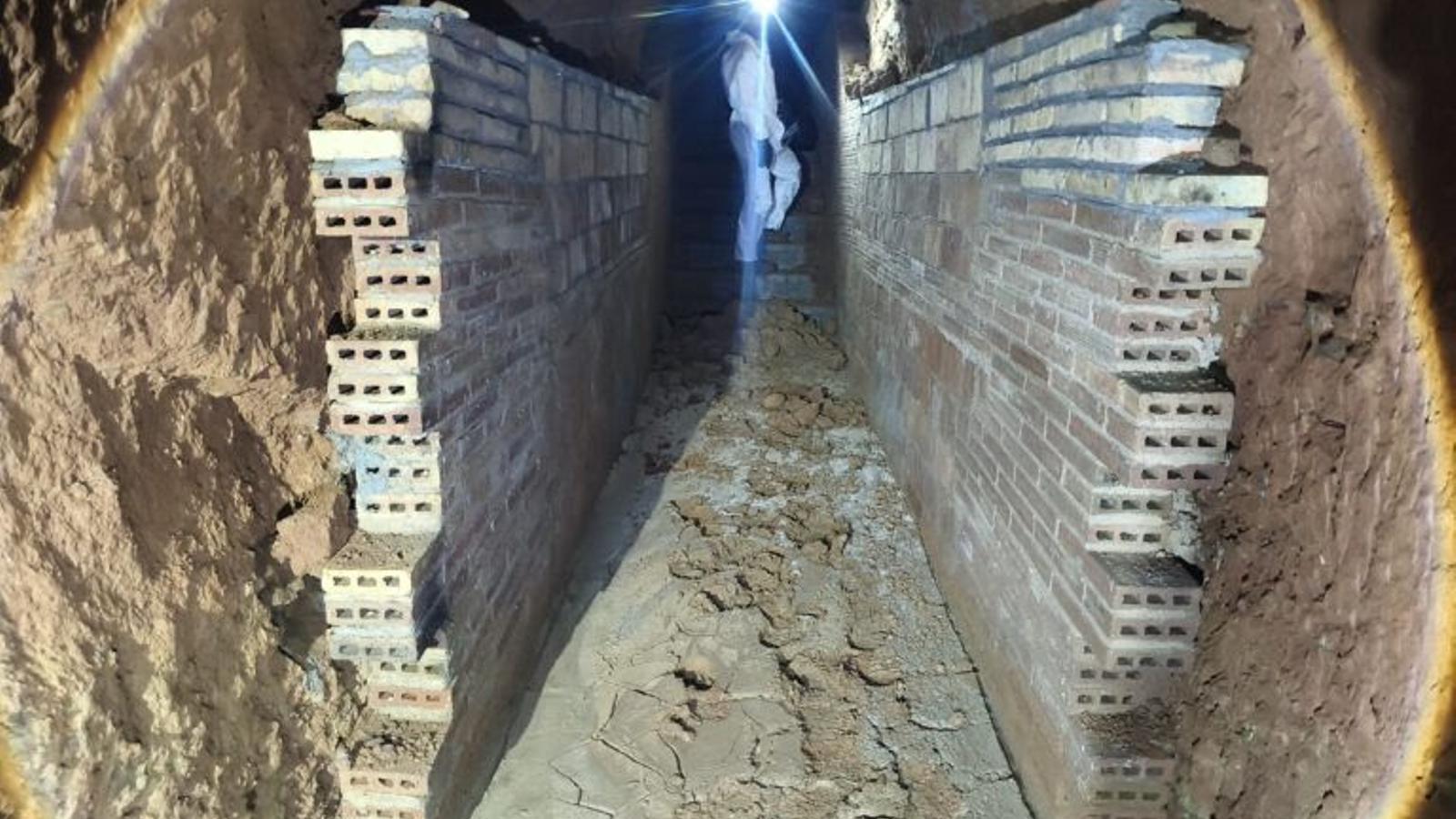
The redevelopment and paving works in the surroundings of the Mercat de l'Abaceria Central, in Barcelona's Gràcia neighborhood, have brought this shelter to light. Specifically, an entrance has been found at number 2 Torrijos street and, according to initial working hypotheses, it would correspond to air-raid shelter number 230.
So far, a section of about 68 meters in length has been documented, with an approximate width of 1.10 meters and a height close to 2 meters. The constructive characteristics of the gallery lead archaeologists to believe it is an unfinished work: most of the route shows bare earth walls, without lining, although some specific sectors with already built walls have been identified.
This March, a shelter was also discovered in Sants. The interior of the gallery and the lighting systems have been preserved practically intact. Several iron hooks have been found on the walls which were used to place oil or carbide lamps. On the other hand, an original ventilation shaft located near the access opening is also preserved. The walls are like a time capsule: there is a small set of inscriptions ranging from technical marks and construction measurements to a proper name, a direct testimony of the workers or residents who participated in its construction.
Municipal reports prepared between 1939 and 1940 indicated that this shelter originally had three access points distributed between the old Roque Barcia square (current Raspall square) and Puigmartí, Torrijos, and Voltaire streets (currently Siracusa street). Archaeologists have confirmed that this structure is completely independent of the one detected a few years ago under the Abaceria Market itself through an endoscopic inspection, and that it would correspond to shelters cataloged under numbers 1195 or 0008.
The shelter will be closed
According to the Barcelona City Council, given that the structure is unfinished and that in some parts the clay of the ceiling and walls has collapsed, the current priority is to guarantee the safety of the public highway. Once the archaeological documentation work is completed, the shelter will be closed. The space will remain protected and sealed under the new pavement, but will remain accessible for future inspections or studies by authorized personnel.
The majority of the shelters, according to the documentation, were built between 1937 and 1938. In 1937, 111 were made and in 1938, 1,177. In 1936, only ten were built, and in 1939, only one was made. Of the 48 for which the capacity is known, more than half were designed to accommodate a maximum of 200 people. There were larger capacities. Of the shelters that have been documented, three had a capacity of between 1,000 and 2,000 people, and the Francesc Magriñà shelter, in Barceloneta and intended for soldiers, could house 6,000 people. The shelters were built, above all, between Plaça de les Glòries and practically the bank of the Besòs river: there were many in Clot and Sant Andreu, neighborhoods where many refugees from all over Spain had arrived. The other area most dotted with shelters was between Moll de Barcelona, Paral·lel, Poble-sec, and Sants. Gràcia was also well equipped: there was one under each square. This March, a shelter was also discovered in Sants.
