From Ormuz to the Mediterranean: the new energy corridor that aims to redraw the Middle East
Faced with the war uncertainty, Iraq, Syria and Lebanon want to recover an old infrastructure to bypass the strait under Iranian control

-
CAT -
CAST
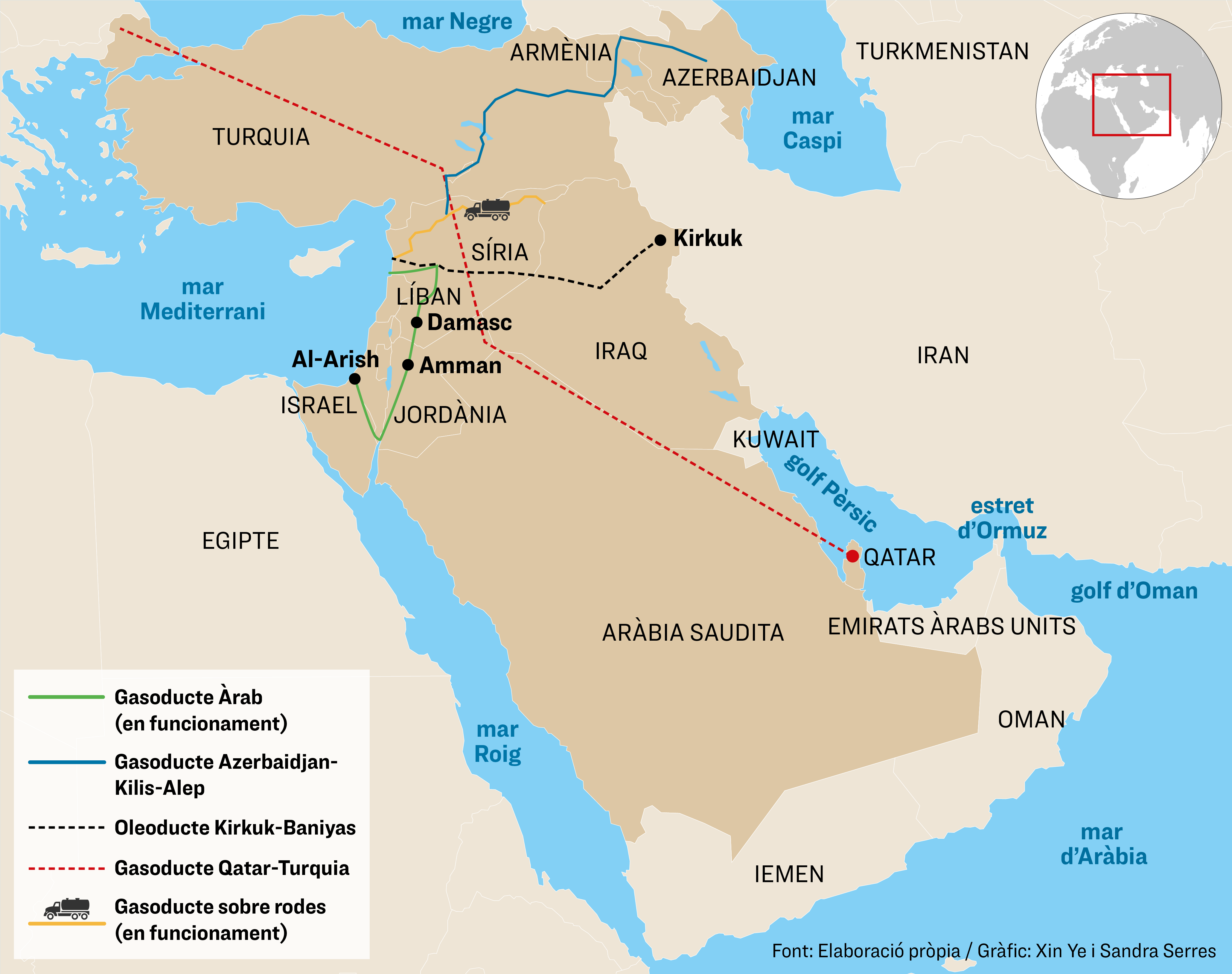
BeirutFor more than twenty years, the pipeline connecting Kirkuk in northern Iraq and Banias in Syria has been out of service. Built in 1952, it used to transport 300,000 barrels of oil daily, but it stopped working after the US invasion of Iraq in 2003. Now it has regained new prominence. The crisis around the Strait of Hormuz has reopened interest in recovering a route that allows Iraq to export its oil to the Mediterranean without depending exclusively on the Gulf.

- If you want to investigate the graph in more detail, open the high-resolution version in another tab.
For Baghdad, the need is evident. As the second-largest OPEC producer, Iraq derives most of its revenue from oil, and around 95% of its crude exports typically pass through the Strait of Hormuz. The disruptions experienced during the recent crisis have demonstrated the vulnerability of relying on a single exit route.
Baghdad has been trying to diversify its routes for years. The pipeline connecting Kirkuk to the Turkish port of Ceyhan remains an important part of this strategy, but security issues and political tensions between the Iraqi federal government, Iraqi Kurdistan authorities, and Turkey have limited its capacity. The Syrian route thus makes sense again.
The project goes far beyond repairing an old pipeline of about 850 kilometers. The idea is to rebuild an energy corridor capable of carrying Iraqi oil to the Mediterranean without crossing the Gulf. If successful, it would reduce dependence on Hormuz, offer a new route to international markets, and once again turn Syria into an energy transit country. But the pipeline is just one piece of a much larger movement.

New economic axis
Washington seems to have found an opportunity to promote a new economic axis between Iraq, Syria, and now also Lebanon. The coincidence does not go unnoticed. Ali al-Zaidi governs in Baghdad; Ahmed al-Sharaa in Damascus; and Joseph Aoun in Beirut. They are three leaders seeking to strengthen the role of the State, attract foreign investment, and normalize relations with the West after years of isolation, conflict, or political paralysis.
Donald Trump's administration, with his special envoy Tom Barrack as the main driver of the regional strategy, sees them as interlocutors with whom to try to reduce Iran's influence without having to become more militarily involved. The objective is no longer solely to contain Tehran through security alliances, but to create a network of economic interests that makes regional integration more attractive.
This change in focus is significant. For years, influence in the Middle East was measured by military bases, militias, or corridors used to transport weapons and fighters. Now Washington is betting on economic corridors: pipelines, ports, infrastructure, and reconstruction projects capable of connecting countries that until recently were separated by war.
But the region is as it is. Zaidi governs an Iraq where militias close to Iran continue to hold enormous political and military weight. Al-Sharaa is trying to consolidate a state that does not yet fully control all of Syrian territory. And Joseph Aoun faces the challenge of rebuilding a Lebanon deeply weakened by war, with Hezbollah still present on the political and military scene and with Israel occupying a strip of the country's south that extends up to ten kilometers into Lebanese territory. All three need Washington's support, but they also have to manage internal balances that enormously limit their room for maneuver.
In this context, Beirut's latest move is understood. During Prime Minister Nawaf Salam's visit to Baghdad, Lebanon offered to become a new outlet for Iraqi oil towards the Mediterranean. The proposal includes studying the recovery of the old pipeline that connected Syria with the port of Tripoli, using existing storage facilities, and even analyzing the construction of a refinery. For a country immersed in a serious economic crisis, positioning itself as an energy platform would mean revenue, jobs, investment, and the interest of major powers in its stability.
For now, it's only on paper. Technical studies are just beginning, and the rehabilitation of the pipeline will require billions of dollars, years of work, and political agreements between various governments. No one expects the infrastructure to be operational in the short term.
But even if the project takes years to become a reality, the message is already clear. The Hormuz crisis has changed how the region thinks about its energy security. The strait remains an essential artery for global trade, but it is no longer perceived as the only possible option.
The possible reactivation of the old Kirkuk-Banias pipeline, Lebanon's interest in joining this route, and the support of the United States point to a more profound change. After the recent escalation, the Middle East is not only redefining its alliances. It is also beginning to redraw the path along which its oil will flow.