The glory that Florentino Pérez has not been able to buy
The 7-0 of the women's classic shows that with money it is not enough to make a winning project

-
CAT -
CAST
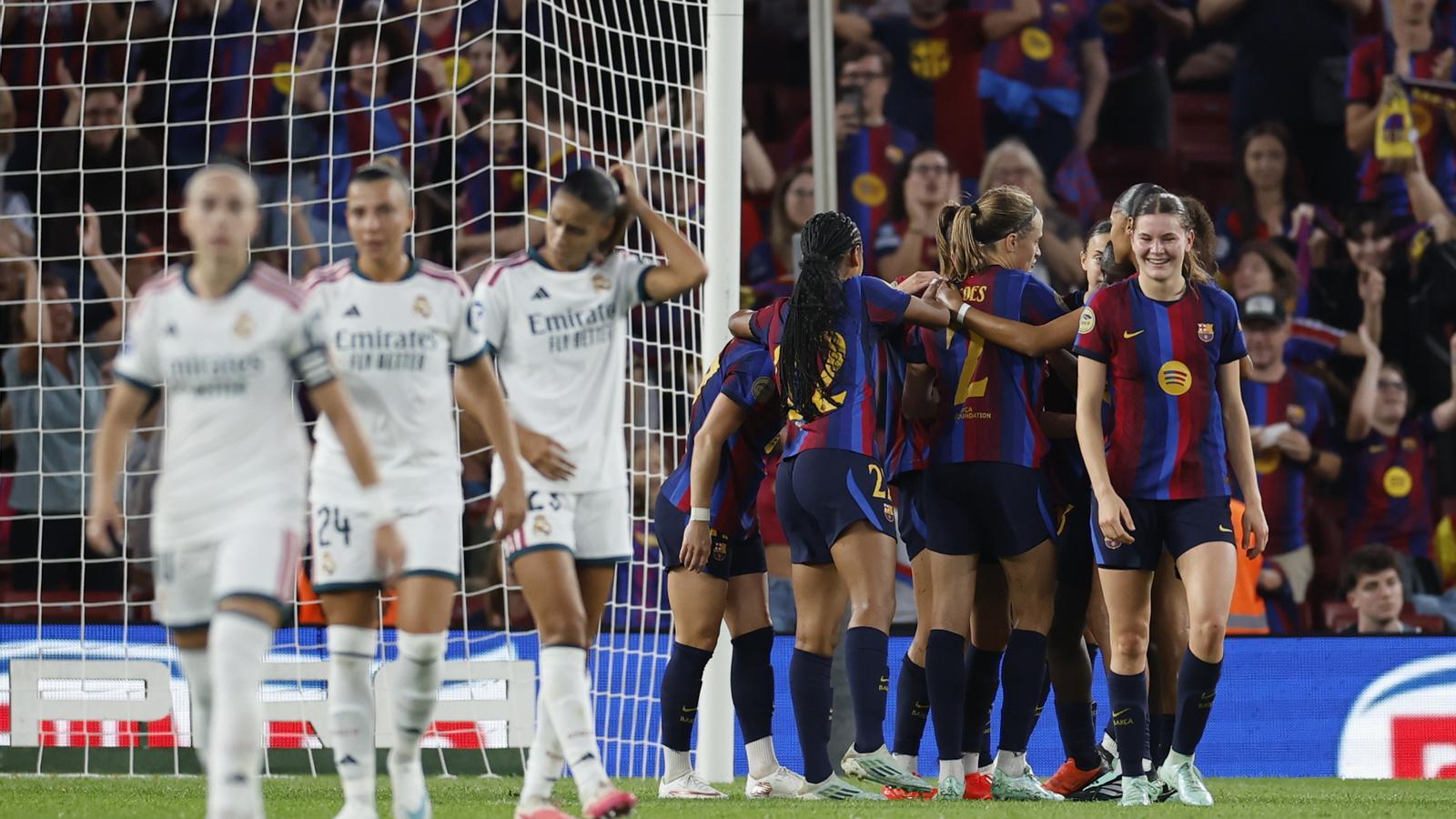
BarcelonaAt the 2019 assembly of delegates, Florentino Pérez argued for the purchase of CD Tacón as "the moment to build a team capable of competing and of which you can all feel proud." As of July 1, 2020, that Madrid club became Real Madrid Club de Fútbol Femenino and began to enjoy better facilities and an increasing budget that was supposed to catapult it to the elite. The reality is that, six seasons later, the team still cannot overshadow a Barça that continues to win everything. Sunday's 7-0 at the Camp Nou, with 40,000 fans in the stands despite the weather conditions, a balance of 25 Azulgrana victories and only one for Madrid, and the 99 goals for and 12 against are the perfect proof of this.
In fact, the Madrid president's inner circle says that Florentino never really believed in the women's team, and that if he ended up incorporating it, it was because of popular pressure and the insistence of his closest advisors. "They made him see that many girls, especially young ones, who came from families with a Madridista tradition were growing up watching Barça matches because they could not look up to Real Madrid." In the end, he gave in, although the commitment has not been entirely decisive. While Barça decided some time ago to open the Camp Nou and let in more than 90,000 people to watch a women's football match – it even broke the attendance record in a Champions League duel, against Wolfsburg (91,648) –, the Madrid president continues to refuse to open the Bernabéu. According to what former Madrid player Melanie Leupolz explained on the podcast Kicker FE:male, Florentino himself told the players they would play there "when they won a title." For now, there is no trophy in the display case.
Everything that is glory for Barça represents a burden for Madrid that also affects the prestige of the Liga F and the tournaments held in Spain. Since 2020, the blaugranes have won every league title (7) and six of the seven editions of the Spanish Super Cup played to date, as in 2021 they lost in the semifinals against Atlético de Madrid in a penalty shootout. They have won six editions of the Queen's Cup, which might have been seven had they not been disqualified for fielding an ineligible player in the 2022-23 season. Such an abysmal difference makes the barcelonismo smile while simultaneously generating criticism, even from the blaugrana footballers themselves. "We want to compete; everyone would like to see a competitive league. No matter how much I speak, nothing changes. Everyone should take responsibility for what they can do," said Aitana Bonmatí, captain and reigning Ballon d'Or winner, bluntly.
The business model that works in Barcelona
Aitana is not the only voice critical of the Spanish competition model. In fact, it is enough to see the exodus of players to leagues like the English, French, or German ones to confirm that the Liga F has stagnated. Another good example of this is the television rights, which were put up for sale hoping for a record turnover, but the auction ended up deserted. Finally, a lower-value agreement was closed with DAZN. Despite everything, Barça continues to invest in it and last season it reaped the fruits once again: it reached a turnover of 23.8 million, 17 of which were obtained through ticket sales –two Champions League matches were at the Camp Nou– and advertising. Of all the entity's sections, it is the only one that generates profits.
The 23.8 million budget for the blue and garnet team is far from the little more than 13 that Real Madrid allocates to it. From a salary perspective, in Barcelona about 13 million are invested in salaries, while the Madrid players are around 7.5, according to data from 2Playbook. The figure is evidently lower, although it notably exceeds the 6.8 that Manchester United, the highest-paying club in the English league, allocates to it. In any case, this difference in budgets is not the only reason to explain the imbalance that is evident on the pitch between the blue and garnets and the Madrid players. The reason lies in the sporting project.
The Madrid women's team started with only 2 million euros allocated to salaries. With the goal of catching up, it began to incorporate footballers by checkbook, and has since invested 30 million euros in salaries. Money that only served to achieve league and cup runner-up finishes, and to reach the European knockout stages. Today, only five players are homegrown. At Barça the number of footballers trained at La Masia is not excessively higher (7), but the two benchmark players of the last five years are: Alexia Putellas –who said goodbye this summer– and Aitana Bonmatí, winners of the last five Ballons d'Or. The recruitment policy has been surgical, always thinking about a style of play and not a collection of stickers. In Europe, it has reaped the fruits: it has achieved four Champions League titles after reaching seven of the last eight finals played. As Patri Guijarro said, "this is achieved with work and sacrifice". "We don't want to stay on the same step, we don't want them to catch us. This is our secret, our DNA, and our demand".

