Student protests escalate in France and the disturbances spread through the country
The executive promises improvements to educational centers, while it works on a budget that opts for austerity and new mobilizations are being prepared
-
CAT -
CAST
BarcelonaFrance is experiencing this Tuesday the day with the most student protests since the mobilizations began three weeks ago, with 1,800 high schools without activity and demonstrations in the country's main cities. The protests focus on criticizing the precariousness of the education system, but in recent days, and especially in this Tuesday's call, they have taken on a more global dimension and some also gather the unrest of the population following the worsening of living conditions. For this reason, in this afternoon's mobilizations in Paris, in addition to students and educational staff, firefighters and farmers can also be seen.
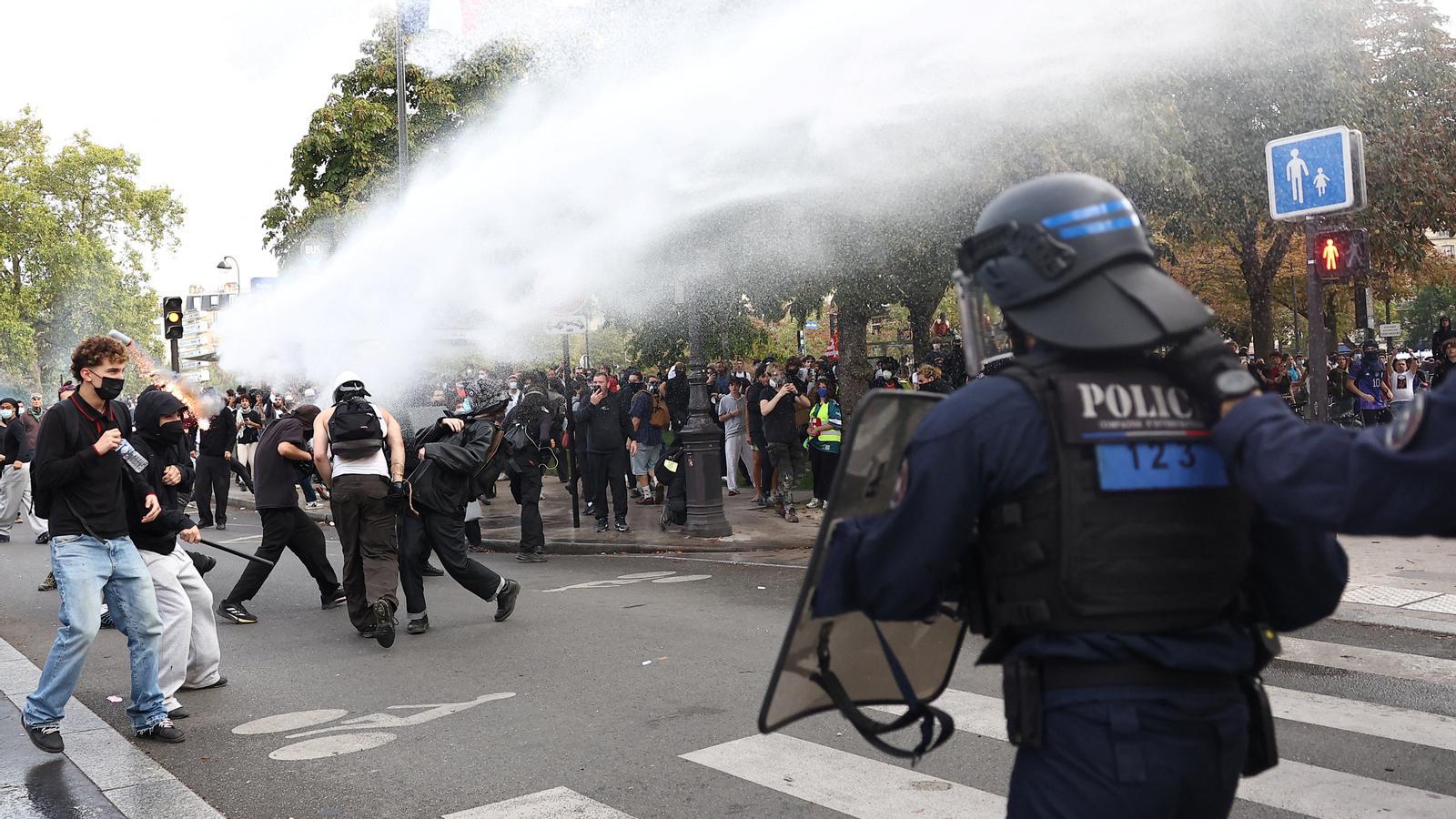
About 266,000 people have participated in the demonstrations that have been held throughout the day across the French state, in cities such as Marseille, Strasbourg, Nantes and Lyon, according to the Ministry of the Interior. The unions and the organizations calling the protests raise the figure to 450,000 participants. In Strasbourg and Lyon there were moments of tension and clashes between the police and the students, who formed barricades with dumpsters. The main demonstration took place in the afternoon in Paris, where clashes were also recorded between police and protesters, whom the agents tried to contain and disperse with baton blows, tear gas and water cannons.
With flares and banners reading "Resources, not stumps" and "Under the books, rage", the students have demonstrated again in a day of mobilizations —which ended with 488 detainees— marked by the explosion this Monday of a police grenade that left a fifteen-year-old student in Lens, in northern France, without his left hand and part of his forearm. Although the Minister of the Interior, Laurent Nuñez, has assured that there are ten internal investigations open for accusations of police brutality, the French Prime Minister, Sébastien Lecornu, has defended the police's actions in general terms, and has rejected that some political forces speak of "police violence".

However, the French Human Rights League has denounced the use of disproportionate methods against protesters, and this Monday a police officer was charged for having fractured the jaw and broken the teeth of a 14-year-old student last week in Saint-Ouen-l'Aumône, near Paris. Faced with the cases of alleged police excesses that are coming to light, the Socialist Party has announced that it will present a bill to ban the use of mutilating weapons, such as grenades and rubber bullets, during demonstrations involving minors. Since the mobilizations began, 215 students and 85 teachers have been injured, and 715 police officers have suffered injuries.
More than 6,000 detained
Since the beginning of the protests, which started on September 17th in the outskirts of Paris and have spread throughout the country, 24 schools have been burned or looted and the police have arrested 6,547 people, the vast majority of them minors. More than 1,800 people are being prosecuted, also almost all of them minors, as reported by the French Ministry of Justice, which does not specify what crimes they are being investigated for.

Faced with what he described as "unprecedented" violence, the French Interior Minister, Laurent Nuñez, has assured that the government has the situation "under control," amidst criticism regarding the police's actions against protesters. In Paris, the socialist mayor, Emmanuel Grégoire, has opened town halls to mobilized students so that they can meet and organize the movement. "You cannot lament the lack of organization of this youth in struggle and, at the same time, close the institutes and the places where they hold their assemblies," said Grégoire, who has asked the executive to "prioritize de-escalation" in this Tuesday's demonstrations.
While applying a hard line against the protesters, the French government has assured that it wants to address the students' demands. Lecornu has promised to address the protesters' claims, who criticize overloaded schedules, the absence of teachers, and that school buildings are deteriorated and inadequate in the face of rising temperatures.
However, the French executive is against the ropes and faces, like other European countries, a dilemma: it promises young people more resources for centers while imposing an austerity budget on the country. Amidst the protests, the French executive presented a budget project for 2027 focused on savings to bring the fiscal deficit closer to the 3% limit set by the European Union.

The draft budget expects the education budget to increase by 1.2 billion euros in 2027. Conversely, it cuts about 5.5 billion euros in pensions and also lowers the healthcare budget. However, the future of the accounts is currently uncertain because the government does not have a sufficient majority in Parliament and depends on the votes of the opposition.
More mobilizations on the horizon
Given the cuts provided for in these accounts and following the momentum in the mobilization that the student protests have drawn, the French authorities have feared for days that the protests will widen and become chronic. With fuel prices skyrocketing and the cost of living on the rise, on October 17th the yellow vests have called for a protest, also against the cuts provided for in the new accounts. The Communist Party and the radical left of La France Insoumise support the mobilization, just as they also do with the educational protests.
In this sense, Lecornu has once again reproached Jean-Luc Mélenchon's party this Tuesday for supporting the protests, and has accused his party of taking advantage of the indignation to strain the country a few months before a key date with the polls: the 2027 presidential elections. La France Insoumise, with a significant presence and support on the outskirts of Paris, where the student protests broke out, is the only parliamentary party that has joined this Tuesday's mobilizations. Mélenchon has asked the protesters for "prudence," but has assured them that what they are doing is "incredible." "No one dares to tell you that you are wrong because you are completely right," he asserted.
