Is the middle class in decline?
In terms of income, the middle class has not become impoverished, although it has not progressed either

-
CAT -
CAST
BarcelonaWho and what makes up the middle class? It is often stated that in recent years the bulk of people who make it up has shrunk, but defining the collective is complex: organizations like the OECD define the middle class as being formed by people who have an adjusted net income of between 75% and 200% of the median in their country or region. This formula, however, does not take into account the purchasing power of wage earners. If life is more expensive and wages do not evolve in the same way, in practice, consumption capacities are reduced.
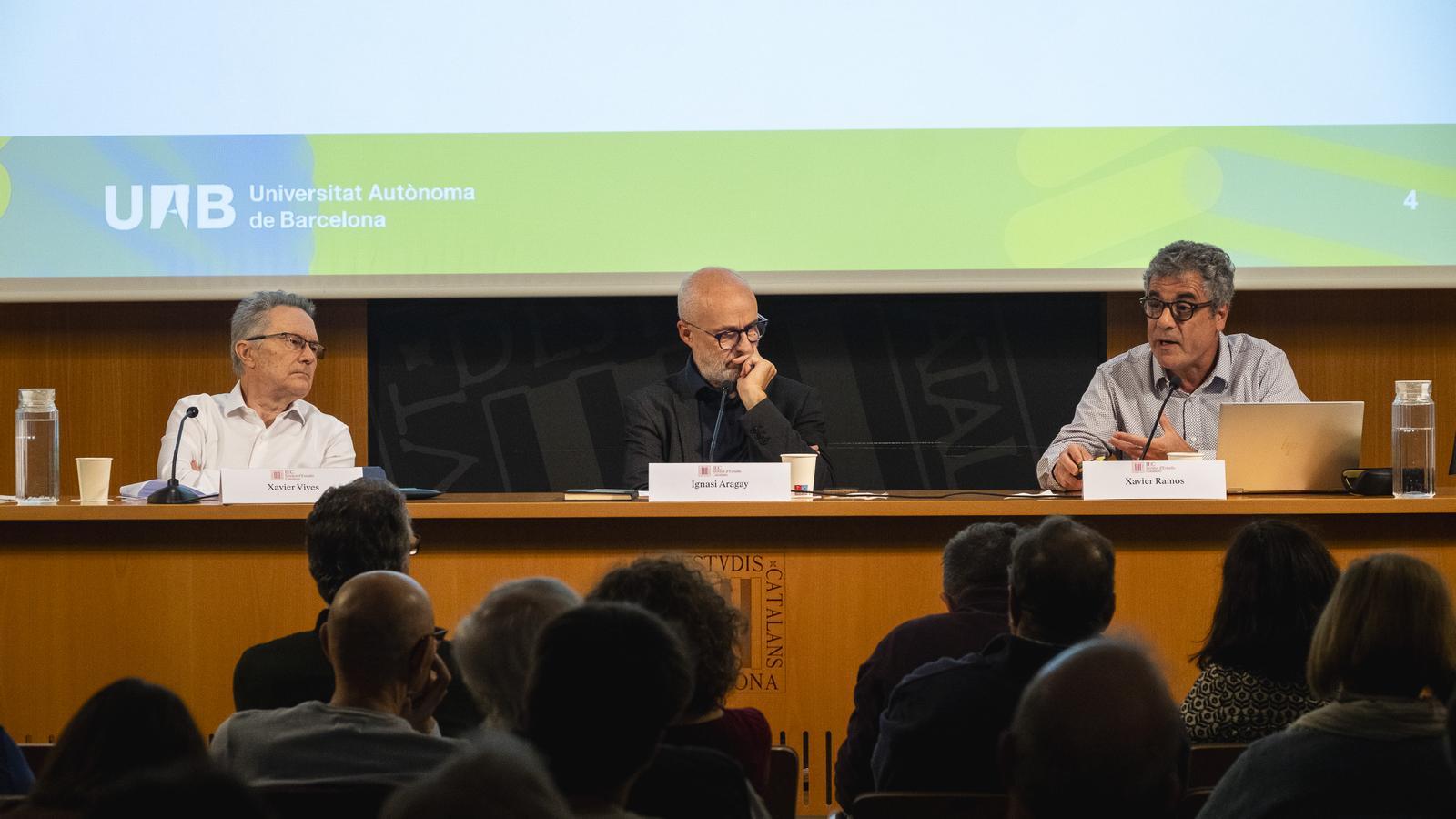
In this line, Xavier Vives, economist and member of the Institut d’Estudis Catalans, explained during a new session of the ARA-IEC Cycles that “what has been perceived as a loss has really been a lack of real income gain”. Thus, Vives added that in terms of income the middle class has not become impoverished, even if “there has been no progress”. During the debate, moderated by the deputy director of ARA, Ignasi Aragay, under the title The crisis of the middle class, Xavier Ramos –from the department of applied economics of the UB and member of the Catalan Society of Economy (SCE)– added that the living conditions of the middle class “have changed” in recent years.
Ramos, for example, explained that the consumption patterns of the lower layers of the middle class increasingly resemble those of the working class, even though previously these same layers consumed in a way more similar to people richer than them, and not the other way around. For his part, Vives added that the current rising cost of housing falls more on young people and the lower classes, and explained that if previously rent was an expense associated with lower incomes, now it also falls on the middle classes. Regarding the definition of the middle class, the vice president of the IEC, Andreu Domingo, focused on the “shared values” of the people who compose it.
Productivity, at the center
Apart from housing, the two experts have agreed on pointing out social policies, the country's productive model, and Catalan infrastructure as the main priorities to turn the situation around. In other words: more productivity as a recipe. Vives also remarked that "improving education" is the country's main pending duty: "Education is what must increase productivity, improve the economic model, and protect jobs from threats such as artificial intelligence". The situation of Rodalies was also pointed out as a major burden.
During the debate, Ramos and Vives highlighted new factors to take into account when looking at the middle class, such as their qualifications. "Nowadays, to be middle class, one must have a higher level of education than ever before," said Ramos. Furthermore, as the experts explained, after a decade of frozen wages, workers also have to face the non-deflation of personal income tax, which "in practice" translates into a "tax hike".
According to Ramos, if we take the definition of the middle class used by the OECD in Catalonia, it would encompass people earning from 18,000 to 45,000 euros per year. Just this Tuesday, the Spanish government increased the interprofessional minimum wage (SMI) to 18,004 euros.

