France shields itself to avoid another day of chaos in the streets
70,000 police officers, gendarmes and soldiers will be deployed and the government warns that they will act with "forcefulness"

-
CAT -
CAST
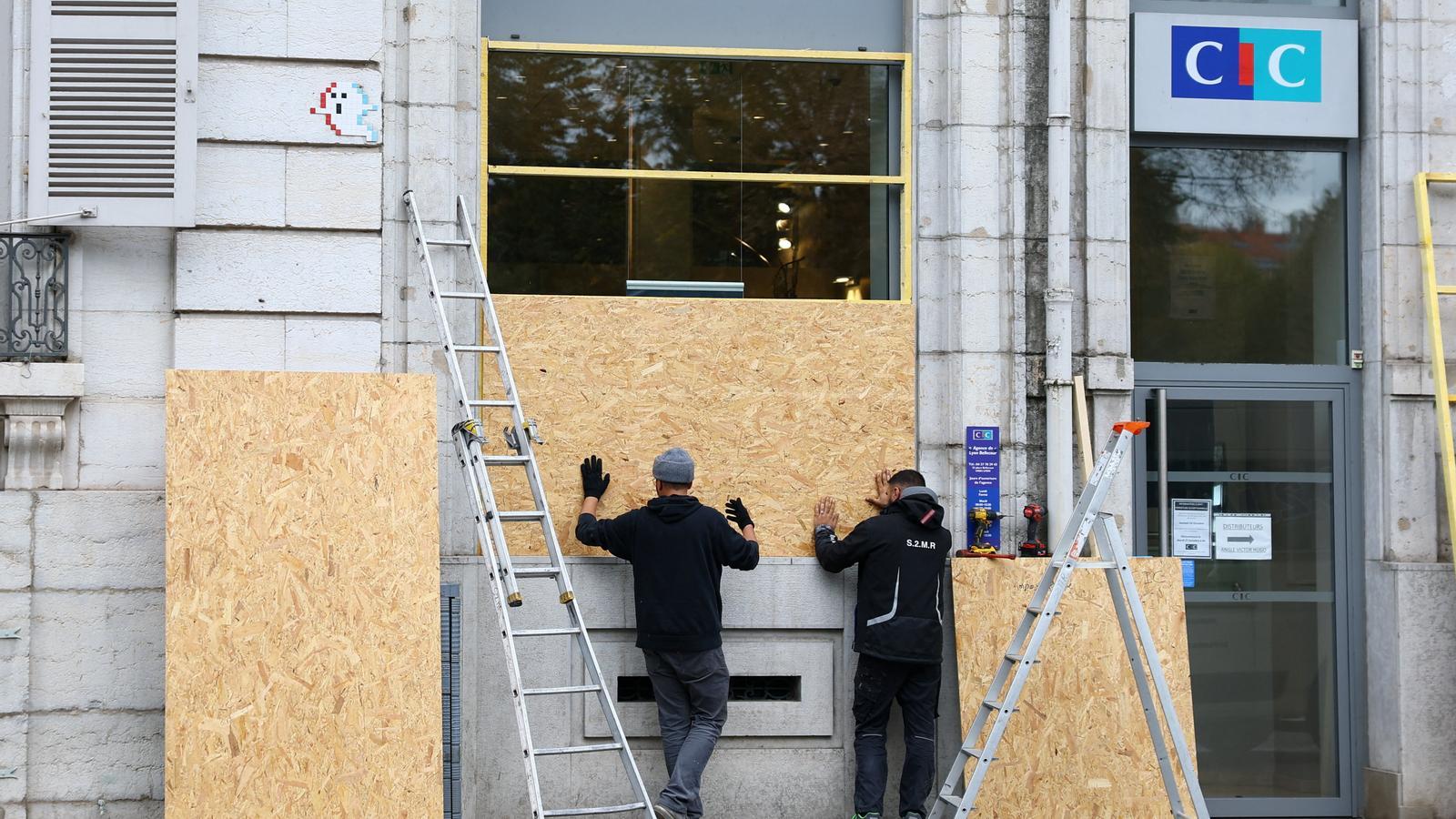
ParisThe Gendarmerie has placed three-meter-high fences that seem impassable on the streets of Paris leading to the Elysée. During the riots that France experienced last Saturday, groups of violent individuals tried to storm the seat of the French presidency. They stopped just over a hundred meters away. This time it will be more difficult to approach the presidential palace. French cities have shielded themselves to prevent a repeat of the scenes of looting, fires, and violence of October 17th with exceptional and highly criticized measures: banned demonstrations, curfews, shielding of official buildings, exceptional deployment of law enforcement, elite units, soldiers, and armored vehicles. "We will be absolutely ruthless" against the violent, warned the Minister of the Interior, Laurent Nuñez, this Friday.
After the criticism regarding the lack of police officers on October 17th, the deployment for this Saturday will be more significant, with 70,000 police officers, gendarmes, and soldiers who will act "with great forcefulness," the minister assured. It is an exceptional mobilization. "There is a very high risk of public order disturbances," revealed Nuñez. According to the Interior Minister, in recent hours calls to commit violent acts during Saturday's mobilization have been detected through social media, and the government fears a day with "far-left" groups and vandals committing acts similar to those of a week ago. The suspension of social media this Saturday, to avoid the mobilization and coordination of violent groups, is one of the measures that the French government has on the table and could decide to apply if violence breaks out.
Following the request by the President of the Republic, Emmanuel Macron, to generally ban demonstrations this weekend and only exceptionally allow those called by unions, some cities like Lyon, Montpellier, and Nancy have not authorized any demonstrations to avoid public disorder. The Marseille prefecture, which announced on Thursday that it was banning all demonstrations and suspending all public transport services for 24 hours, backtracked this Friday. It finally authorized a demonstration called by unions and decided not to suspend public transport. Nevertheless, Marseille, Lyon, Paris, and dozens of other municipalities have decreed a nighttime curfew in city centers.
Curfew in the capital
In Paris, the City Council has asked residents not to take their trash bins out to the street on Saturday – as collection is done door-to-door – and a nighttime curfew will be in effect until Monday for all citizens, but only in the area of the Place de la République and the Les Halles shopping center, the epicenter of last weekend's riots. In the French capital, the demonstration called by the CGT at 2:00 PM has been authorized, which will go from the Place de la Bastille to the Place de la Nation.
Another hot spot for this Saturday's mobilization is the city of Orléans, located in the Centre-Val de Loire region, where the party led by Marine Le Pen, National Rally (RN), is holding its congress to launch the presidential campaign. A demonstration against the far-right has been called there, where between 20,000 and 30,000 people are expected, according to some estimates. The first secretary of the Socialist Party, Olivier Faure, has announced that he will participate in the protest. About 3,000 police officers will ensure that the demonstration takes place without disturbances.
Faced with Macron's directive to ban demonstrations, the anti-globalization movement Attac France has published an op-ed signed by heads of NGOs, unions, student associations, environmental organizations, and by lawyers, economists, activists, and figures from the world of culture, which calls for protesting this Saturday despite the ban on dozens of protests. The signatories warn that "a new threshold of authoritarianism in power has been crossed, that democratic freedoms are being questioned as never before, and that a covert state of emergency is being established".
Macron meets with students
More than a month after the start of the secondary school students' protest, which has led to a large-scale social crisis, the President of the Republic has received the student unions for the first time this Friday. The meeting, however, has not served to find a way out of the crisis. At the end of the meeting, the unions thanked Macron for having listened to their demands – linked to the lack of investment in Education – but they called for the mobilization to continue. "We are not satisfied," summarized a student spokesperson.
