Ferran Torrent: “Like many of my generation, I was deflowered in the Chinatown”
Writer

-
CAT -
CAST

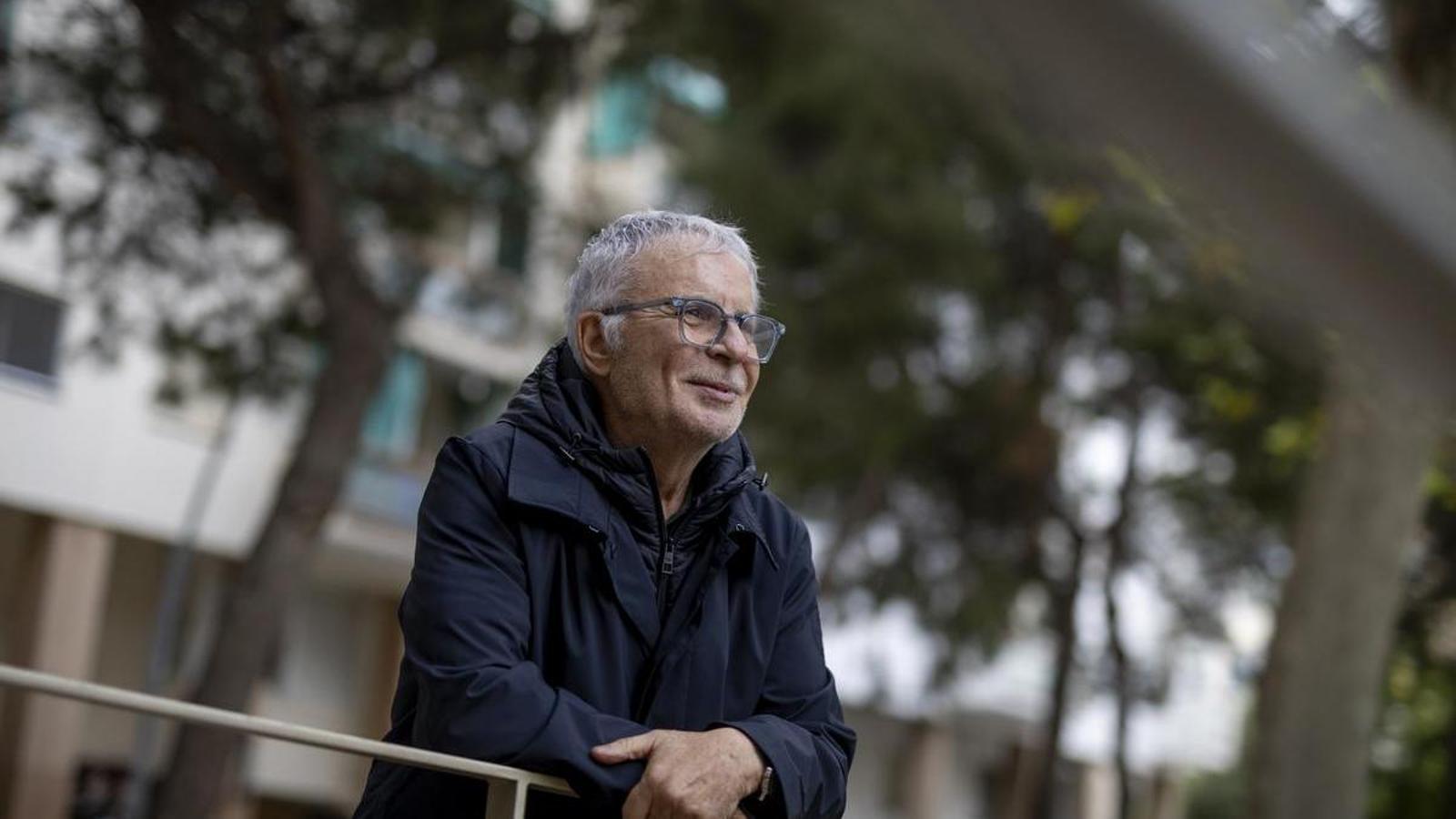
I haven't started the recorder and I'm already hooked on the conversation with Ferran Torrent, who lives up to his surname. He radiates a spirit of fun, a lack of solemnity, and the sense of justice found in his novels. His WhatsApp status says: “Playing xamelo”. It is the domino game he usually plays, in which you can lose 300, 400, or 500 euros, but never the small fortune of the wild clandestine matches he will tell me about. He has turned 75 and has agreed to have a biography published (written by Salvador Ortells Miralles with Columna) and for the Institució de les Lletres Catalanes to pay him tribute.
— I have come out of cancer feeling better than I was before. For two years I didn't say anything about it, but now I think it might be useful for people to get tested. Now I think that every day is a bloody great day. I am a skeptic, but that does not stop me from living with joy.
You have been dedicated a tribute and a biography. When they throw these parties for you, do they flatter you or make you suspicious?
— I am grateful, but it is not my habitat. I always remember someone from my town who had to ask for his girlfriend's hand and they told him: “Just be yourself!” And another one replied: “No, don't be yourself, because you are a complete idiot.” I try to be myself without acting like an idiot.
Friends, journalists and now your biographer say that when you were young you navigated the Valencian underworld. What exactly was there?
— When we left the Jesuits to catch the bus, we passed through the Barrio Chino. I know that now they would cancel everything on me, but when we were young, you either got a French girl, who were the first ones to arrive, or you went to the Barrio Chino. And I, like many of my generation, lost my virginity in the Barrio Chino. One Sunday night, when there were few people, three or four cars of young people went there. The village priest found out and, from the pulpit, he said the names of those of us who had gone. I know that doing those things is not correct, but the fact is that in 1968 or 69 life was like that, there was no other opportunity.
There are atrocities that would not pass a review made from the morality of today.
— No. That is why I like writing novels set in the 70s. But I don’t have any trauma from that. I am anti-trauma.
Why do you say that?
— I had a mother who did not want children. I do not remember my mother ever kissing me, neither me nor my sister. In fact, I would go to another house and see that the mother kissed her child and thought "how strange they are here".
And this is not a trauma either?
— I remember a very funny scene from when I was 58 or 59 years old. I was in a relationship, we were arguing and she said to me: “You have to get over that about your mother”. Girl, but I don't even remember it! Maybe I could be more affectionate? I am with dogs and cats, with humans I have reservations.
Before being a writer you worked as a gardener, deli worker, salesman, liquor smuggler and semi-civil servant. Did you find there the people who would become the foundations of your literature?
— At that moment I didn't think so, but later it turned out that way. Being a furniture representative, I hung out with a group that was a disaster, alcoholics, they were fed up with marriage, they went to prostitutes, it was a terrible school. At the meat company, one guy had separated and married a prostitute from a bar. Damn, they were fascinating lives. I did my military service at the Captaincy General, which was full of fascists. As a civil servant, I was a total slacker. I just root myself in all kinds of environments, and that gives you a holistic view of society. Being from a small town gives you that too.
Does staying in Sedaví give you literary material?
— I have met many characters. And I have kept the habit of meeting abnormal people. If I meet an abnormal person, I ask them for their phone number.
And are you staying?
— Yes, I have dinner with them from time to time. I had an informant who wanted to meet me following Societat limitada. He was very right-wing. And very intelligent, huh? He told me extraordinary things. He had a very good phrase: “Information is for having, not for using”. And it is true.
Desire is one of the driving forces of your characters. Also of your life?
— I will explain it to you with a metaphor. I like to reach the abyss and stay at the edge taking note of all those who are falling. I like danger, but I always have the habit and the precaution of staying at the threshold. I have also been attracted to strange women. Opus Dei women. From the upper class. I have had variety, eh, it hasn't all been like that. The world of culture hasn't attracted me much...
It holds no mystery for you.
— I leave the house so that I can be told things that are not in my life, both by men and women. That is why I have many people under indictment on my phone; one day the judge will call me! It is just that I am drawn to knowing why they do it: I do not understand why there are rich people who are corrupt. But I never have moral superiority over them: I am not corrupt because I have not had the opportunity. I do not know if I would be.
Has solitude been a condition for being able to write? Isn't that a very high toll to pay?
— No. Because it is sought after. It's just that since I was a child I was already looking for it, because at home I didn't get along. I like the pleasure of solitude. For example, being alone at home for New Year's Eve.
In the biography you say that the only book that has changed your life is your family record book.
— It is a boutade. Look, I have a very small family. I have a son I adopted at almost 11 years old, and he is now 40, two nephews, my sister, who has advanced Alzheimer's, and me. The day she is gone it will be very sad, we will have to call in female props for Christmas dinner, because we will be four single guys.
You have spoken little and late about your son, haven't you?
— Yes, because I have seen people who have adopted children who explain it as if because of that they were good people. I explain it if necessary. We made a gesture of solidarity, because with a kid that big it is difficult to act as a father and mother, even though he considers us his parents.
Do you regret not being more of a family?
— It doesn't bother me. And I don't worry about the future, let them take care of me. It would have been impossible to have written with two children. I, if there is someone at home, I do not write.
You are one of the few writers with a contract at a publishing house, at Columna. Is it a liberation or a form of slavery?
— Both things. I have two horrible novels published and one that I haven't published. But I have published 22 novels in 40 years and I don't have a schedule, for me that is fabulous. I hope that when I retire they give me a pension.
Since Thanks for the tip, your success renewed the Valencian novel and, in the process, boosted Catalan. Are you worried about the situation of the language?
— I never think about this problem when I write, I already have enough work. History is unpredictable, we do not know what will happen. We Valencians have been written off as dead many times. I use Valencian habitually, except if I catch someone who is very annoying and acts like an idiot.
But there were expectations of normalization that have not been met.
— The thing is, dreaming is dangerous. I try to be very realistic, even though I am imaginative. One of my fantasies is to keep my house in Valencia and have a house in a village of 500 inhabitants, with animals, a donkey, dogs, and cats.
