Common front against Sánchez in the EU for the regularization of immigrants
Spain and Italy reach an agreement to lift border controls
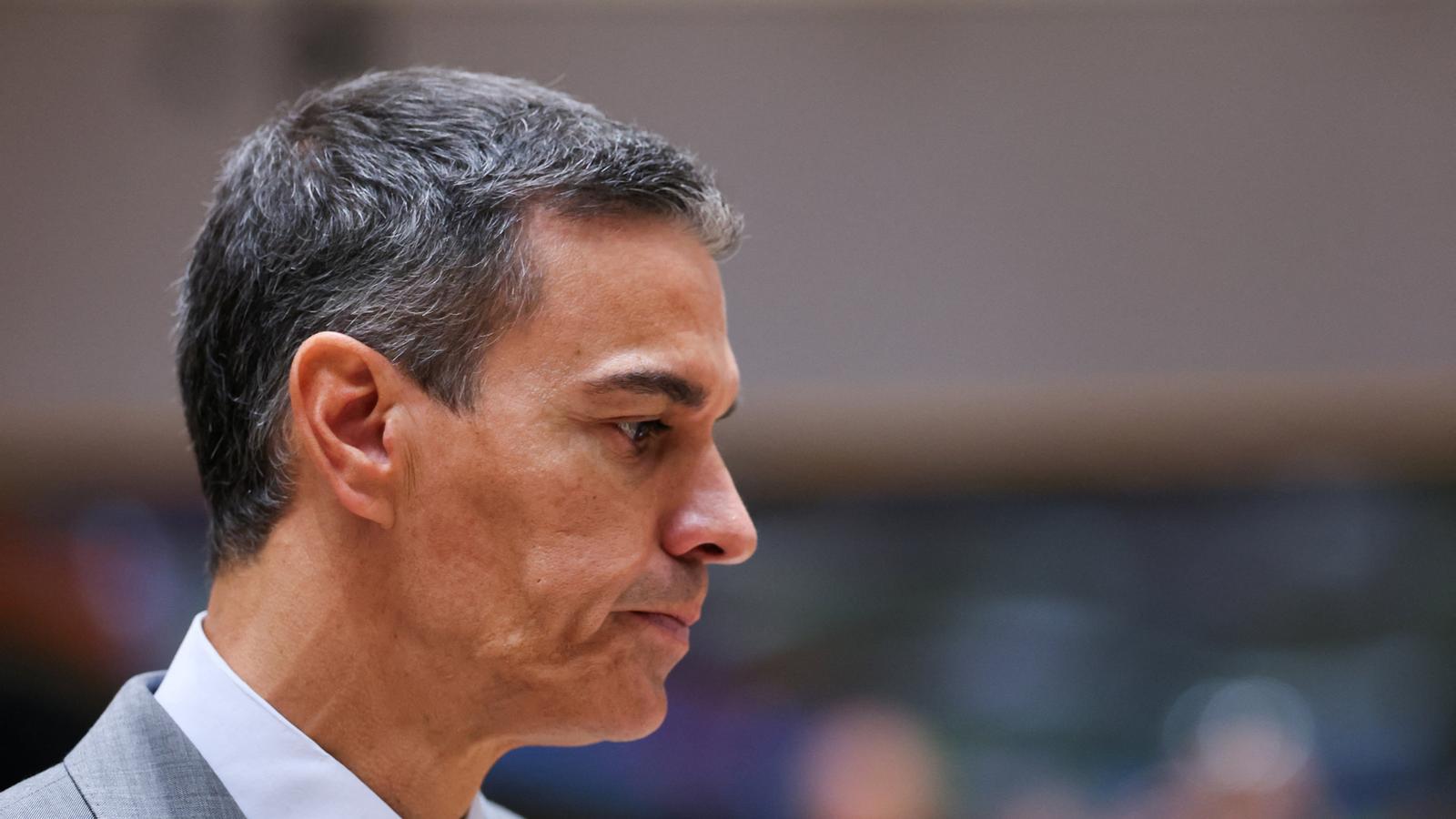

BrusselsIf Pedro Sánchez's stance on immigration was already dissonant with the rest of the bloc, his distance from the other partners has widened following the Ceuta migration crisis. This Friday, the president of the Spanish executive was the target of new criticism from Denmark, Italy, and Poland. Italian Prime Minister Giorgia Meloni, Danish Prime Minister Mette Frederiksen, and Polish Prime Minister Donald Tusk have lashed out at Sánchez's decision to regularize thousands of immigrants. According to diplomatic sources, the three countries have suggested to the other leaders that the measure is a "pull factor" for immigration to the continent.
Upon arriving at the leaders' summit, Frederiksen asked Brussels to examine the bloc's migration policies. "I have asked the European Commission to examine the case of a country that does practically the opposite of the rest. That is to say, one arrives illegally in a country and, on top of that, is allowed to stay legally," insisted the Dane, who considers that Spain's policy "contradicts" European immigration policy and maintains that it has broad support within the bloc.
This support for a tougher migration policy was staged by the eighteen countries that attended a breakfast promoted by Meloni, Frederiksen, and their Dutch counterpart, Rob Jetten. In this informal meeting, which Spain did not attend, they sought mechanisms to further harden migration policy with instruments that would allow, for example, suspending the right of asylum in emergency situations.
Some member states, including Denmark, Italy, and Poland, have proposed amending the conclusions of the European summit to include criticism of the Spanish regularization policy, which they consider a "pull factor" for immigrants. These states' proposal is for the text to recognize that immigration is a concern for citizens and that work must be done to reduce "incentives for irregular migration." They also ask for mechanisms of "cooperation" to be found between states when one country's migration policies can affect the rest.
"It has been a blame game against Spain," assure diplomatic sources close to the meeting. Regarding the Ceuta crisis, which was a subject of debate, Meloni highlighted the need "to maintain a high level of surveillance at the EU's external borders."
Some leaders have not refrained from making reproaches in public. The Prime Minister of the Czech Republic, Andrej Babis, for example, has even defended the imposition of controls at his borders to prevent immigrants from Spain from entering. "We see what is happening in Spain, some politicians are willing to replace the population just to cling to office and stay in government," the ultra-conservative leader criticized. He lamented that "it is already too late" for some of these countries and urged to "defend the borders to prevent immigrants from arriving" in their countries (in the east) from Western Europe. "We are prepared to do it," he insisted.
In the same vein, the Austrian Chancellor has spoken, who reproached that Spain's policy is not going in the direction of Europe and that it "has an effect" on the rest of the states. "Spain has sent a signal by legalizing the status of many irregular migrants and that is not a good signal, because here in Europe we are trying to combat irregular migration," asserted Christian Stocker.
Goodbye to controls with Italy
The migration reproaches towards Sánchez arrive on the same day that the Spanish president has agreed to a truce, precisely, with Giorgia Meloni. The two leaders have agreed to work to soon lift border controls at ports and airports, two months after the Ceuta crisis. The decision was made by the leaders at a meeting on the sidelines of the leaders' summit in Brussels, in the first face-to-face meeting of the two leaders since the summer, as confirmed by Spanish diplomatic sources to ARA.
However, the Italian government has decided to extend the suspension of the Schengen zone with the Spanish state for one week. During this period, in which the Spanish controls will still be in force, the interior ministers of both countries will work to eliminate them, according to the same sources. Meloni's executive suspended the free movement of people with Spain at the end of July, following the massive entry of migrants into Ceuta, a measure to which the Spanish executive responded with reciprocity.
Meloni staged these differences with a dance of reproaches towards Sánchez at the last meeting held in June. Both she and the Danish prime minister, Mette Frederiksen, reproached him that the massive regularization of immigrants promoted by the Spanish executive was a pull factor for other immigrants to travel to Europe.
