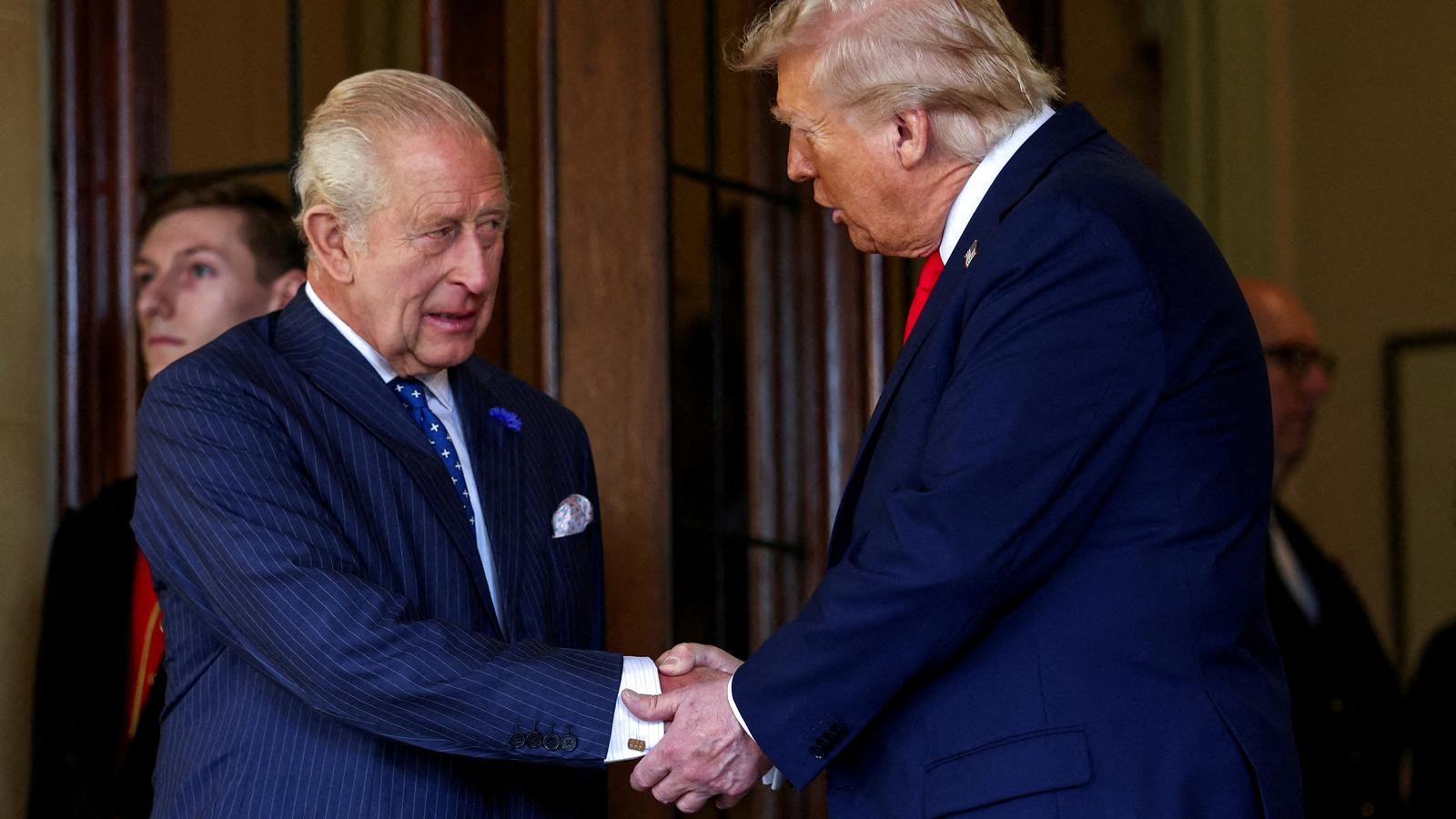
Charles III visits Trump on the most uncomfortable trip since he has been monarch
The king's visit to the United States arrives at a moment of great diplomatic tension between Downing Street and the White House

-
CAT -
CAST
LondonDonald Trump and Charles III will coincide up to five times between this Monday and Thursday on what is possibly the monarch's most uncomfortable official trip The visit, overshadowed by the alleged assassination attempt, takes place just seven months after the King bid farewell to the American president at the gates of Windsor Castle, where the monarchy offered the Republican all its usual pomp and ceremony. That second invitation – an exception in itself – had been conceived to smooth relations between Prime Minister Keir Starmer and the ever-unpredictable Trump. When Air Force One took off from Stansted Airport, the impression at Downing Street was that the mission entrusted to the crown had been successful.
Recent weeks have contradicted that perception. A royal carriage parade and a gala banquet are not enough to temper the president's character. Since the outbreak of the war in Iran, Trump has increased his criticism of Starmer, who has been reluctant to get involved in Washington's military escalation. The British management has oscillated between prudence and rectification, including permission for the limited use of an airbase in England and that of Diego Garcia island for "defensive" operations.
A more hurtful Trump than ever, and also his Defense Secretary, Pete Hegseth, have repeatedly belittled His Majesty's army. The Pentagon has ignored British deaths in Afghanistan during the two decades of the country's occupation. And there have also been repeated jibes at the Royal Navy: "Your ships are toys", said the US president.
The cherry on top of the offenses arrived on Friday, when an internal Pentagon email – in which the suspension of Spain from NATO was hinted atwas hinted at due to its lack of collaboration in the war – also suggested that the United States could review the recognition of British sovereignty over the Falkland Islands. Argentina claims the archipelago, and its president, Javier Milei, maintains a close relationship with the White House. Downing Street responded forcefully: "Sovereignty belongs to the United Kingdom and the islanders' right to self-determination is paramount." But Washington's new slap in the face to British pride did not go unnoticed.
A crisis worse than Suez
The result is a distancing that some analysts place at its lowest point since the Suez crisis of 1956, when the United States forced the British withdrawal from the joint military operation with France and Israel to control the canal. The comparison is not minor: it highlights the extent to which the transatlantic relationship, traditionally defined as "special", has been subjected to very different interpretations on both sides of the Atlantic amidst enormous tension.

For London, this link continues to be a central strategic piece, heir to the cooperation of World War II and the Cold War. But Trump's Washington understands it in much more transactional terms, at a time when the United Kingdom's global weight is no longer that of a former imperial power.
And it is in this context that Charles III's speech before the United States Congress – which will take place this Tuesday – takes on particular relevance. The monarch's words will be analyzed with a magnifying glass. And both in Washington and London they will be interpreted as an indicator of the degree of tension between the two governments. The text, jointly prepared between Buckingham Palace and the Foreign Office, will have to navigate between two symmetrical risks: excessive confrontation and servile submission.
The trip has created much unease in some sectors of the British establishment. Some voices in the House of Commons – the leader of the Liberal Democrats, Ed Davis, or the Scottish nationalists – have called for its cancellation. Downing Street did not even consider it, however. In fact, in the Buckingham Palace statement announcing the royal tour, it was explicitly highlighted that it was carried out "at the government's proposal".
A few days ago, one of the most prestigious BBC journalists, David Dimbleby, now retired, but still in charge of a documentary series on the future of the monarchy, made his displeasure explicit on a channel program: "It is not the time and I cannot disagree more [with the royal trip]. We are dealing with a president who is a narcissist and a bully, and he has been bullying the United Kingdom. It is a very bad political time to give [Trump] the king's gift with all the pomp that entails." Dimbleby also accused the Pentagon officials of being "lunatics".
The Epstein case
Known for the president's devotion to the British royal family, refusing the White House invitation would have meant an open declaration of war by Starmer on Trump. And the premier, at his lowest point of popularity, always cautious, would never have taken that step. This is confirmed by historian Craig Presscot, author of the book his lowest point of popularity, always cautious, would never have taken that step. This is confirmed by historian Craig Presscot, author of the book Modern monarchy: "It may seem that Keir Starmer's flattery strategy has not fully paid off, but within the British government the idea has prevailed that, despite everything Donald Trump does, it remains of interest to the United Kingdom to stay close to the United States". The Love actually route, in relation to the film in which Hugh Grant as prime minister gives a very harsh speech against the President of the United States is, only, a fiction with no replica in the real world.

The minefield that Charles III will have to cross in the coming days has one with a name of its own: Jeffrey Epstein. Because the shadow of the pederast scandal affecting his younger brother, Andrew,, will also loom over him.
The victims requested an audience with Charles III, with the implicit intention of asking him to pressure Andrew to testify before the United States Congress. But Buckingham Palace argued that there is an ongoing police investigation against the former prince, and that little more could be added. The King, moreover, has expressed his solidarity with the victims in a recent statement. Andrew had to face a humiliating arrest for twelve hours on February 19.
Aware of the risks of the trip derailing for any of the reasons stated, and also of the popularity of the British royal family in the United States, Donald Trump has rushed to soften them, in his own way. Last Thursday he spoke to the BBC for five minutes by phone, in a conversation that was not recorded, but which perfectly met the president's objectives.
The minefield that Charles III will have to cross in the coming days has one with a proper name:
