Black rain, pollution and contaminated water: the ecological disaster of the war in the Middle East
The bombings of oil facilities in the capital of Iran condemn the health of the inhabitants and the ecosystems of the area

-
CAT -
CAST
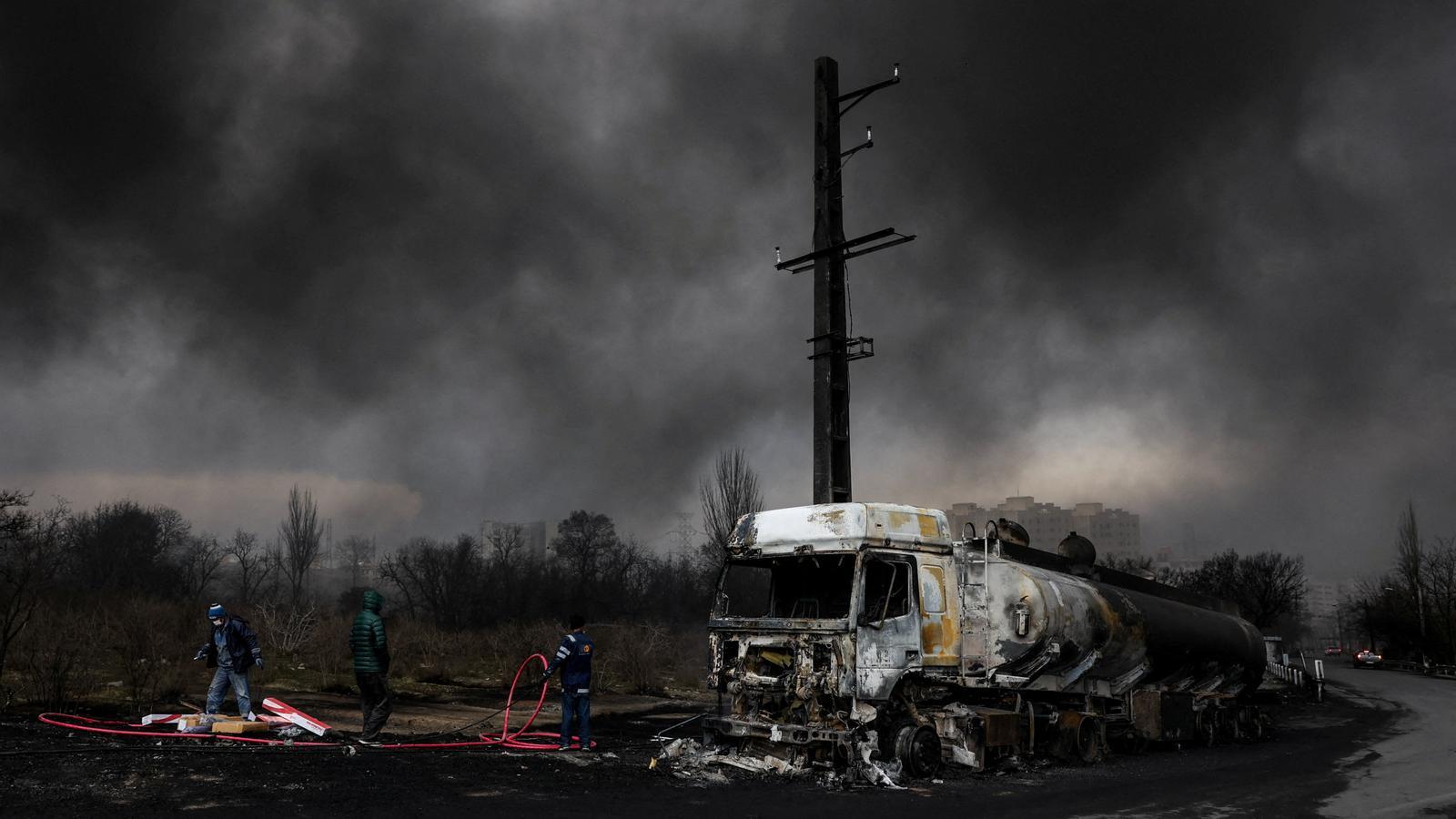
It has not yet been a month since the conflict in the Middle East broke out, and in this time thousands of deaths, losses of cultural and historical heritage have been mourned, and the growing fear of a stalemate in the conflict, with potential – already demonstrated – to destabilize the world order. But while concern for the humanitarian crisis grows, the conflict has already established itself as one of the biggest environmental disasters in history, with implications that will last for decades.International organizations are observing the Tehran area with particular concern following the quadruple Israeli bombing on the night of March 7 –three in oil storage areas and one in a refinery–. Of the four facilities attacked, the one furthest from the Iranian capital is a mere 20 kilometers from the city center. At this time, it is still difficult to assess the consequences of these attacks because there is no data on the affected terrain and satellite information is hard to interpret. However, Tehran's demographic and physical characteristics make it particularly vulnerable: an urban area of over 10 million inhabitants and the natural barrier of the Elburz mountain range, which hinders the entry of clean air currents.Different experts agree in pointing out that the impacts on health and the environment are difficult to equate with previous catastrophes of this type. “It is especially worrying due to the contaminants that have been and continue to be emitted by the bombed storage centers. It is very different from attacks on refineries or export centers. In deposits of untreated oil there are very high concentrations of oils, heavy metals, energetic compounds and polycyclic aromatic hydrocarbon (PAH),” explains the scientific communicator and professor of environmental chemistry at the University of Barcelona Xavier Giménez. The government of Iran, aware of the threat posed by the bombing of these facilities, has also followed a similar strategy by attacking these types of extraction and storage bases in the Middle East.The World Health Organization (WHO) hurried to warn that attacks on oil facilities represented a serious problem for the inhabitants. But isolating oneself from the smoke is practically impossible. The city of Tehran was immersed in a dark, dense, and opaque cloud in the days following the bombings. However, as Giménez points out, the most harmful particles are those that are not seen: “Since particles of 2.5 microns or smaller are not seen, there is no perception of danger, but, on the other hand, they have direct entry into the alveoli, the bloodstream, and even the brain.” The inhalation of benzene particles and PAHs are directly related to the risk of serious diseases such as cancer and leukemia.This type of pollution is completely different from that which is usually recorded in cities like Delhi or Beijing, both in terms of particle composition and its effects on health and ecosystems, assures the doctor in chemistry. It is also different in its scale. According to the Observatory of Conflicts and Environment, the smoke cloud reached Afghanistan, and some regions of China and Russia, due to air currents that displaced the pollution eastward. Beyond the dispersion of pollution worldwide, the wind-borne smoke has been found to increase soot accumulation at high altitudes and accelerate the melting of glaciers. Giménez does not rule out that some of these particles may also have reached Europe, although they are almost imperceptible.Water, Iran's Achilles' heel
The large amount of suspended particles condensed and ended up precipitating in the form of black rain shortly after the bombing, a combination of acid rain and other elements from the oil combustion. The roofs blackened, the sewage system became saturated, and it is feared that the supply of drinking water may also have been contaminated, as unofficial Iranian sources assure through tests of acidity of the PH of the running water. This fact is especially serious considering that Iran has been suffering from a drought since 2020, aggravated by the climate crisis.
“It is not unreasonable to think that water sources and crops have been contaminated by the smoke and black rain. It is not the same to have a leak in an oil facility as an explosion, which generates a much higher expansion capacity of contaminants”, explains the professor of environmental chemistry. Martínez does not hesitate to assure that it is an environmental attack, considering the affected territory, the impact on the food chain and the persistence over time that this multiple attack can have. “The effects on ecosystems are slower: they take longer to arrive and also to leave. It can take decades before the remnants of contaminants disappear”, points out Giménez.The main ways to guarantee the potability of water in Iran, at this point, are mainly two: either the intense filtration and treatment of the water supply, or the desalination of all the water that reaches homes. Both options are complicated and, at present, there is no record that the government has opted for either of them. The process of treating and filtering running water requires a lot of energy. According to the International Energy Agency, Iran's energy source comes mainly from natural gas, at 58%, and oil, at 29%, two resources that have been diminished by continuous attacks by the United States and Israel. On the other hand, desalination plants have also been a target in the operation of North American and Israeli forcesin different areas of Iran, such as Qeshm Island. This war strategy has also been adopted by Iran, which in recent weeks has been accused of attacking different similar facilities in Gulf countries.
