Andy Burnham wins a seat in the Commons and puts Starmer on the ropes, who bunkers down in Downing Street
The Mayor of Greater Manchester strongly defeats the Reform Party of ultra Nigel Farage and says it is "the last chance for change" for Labour

-
CAT -
CAST
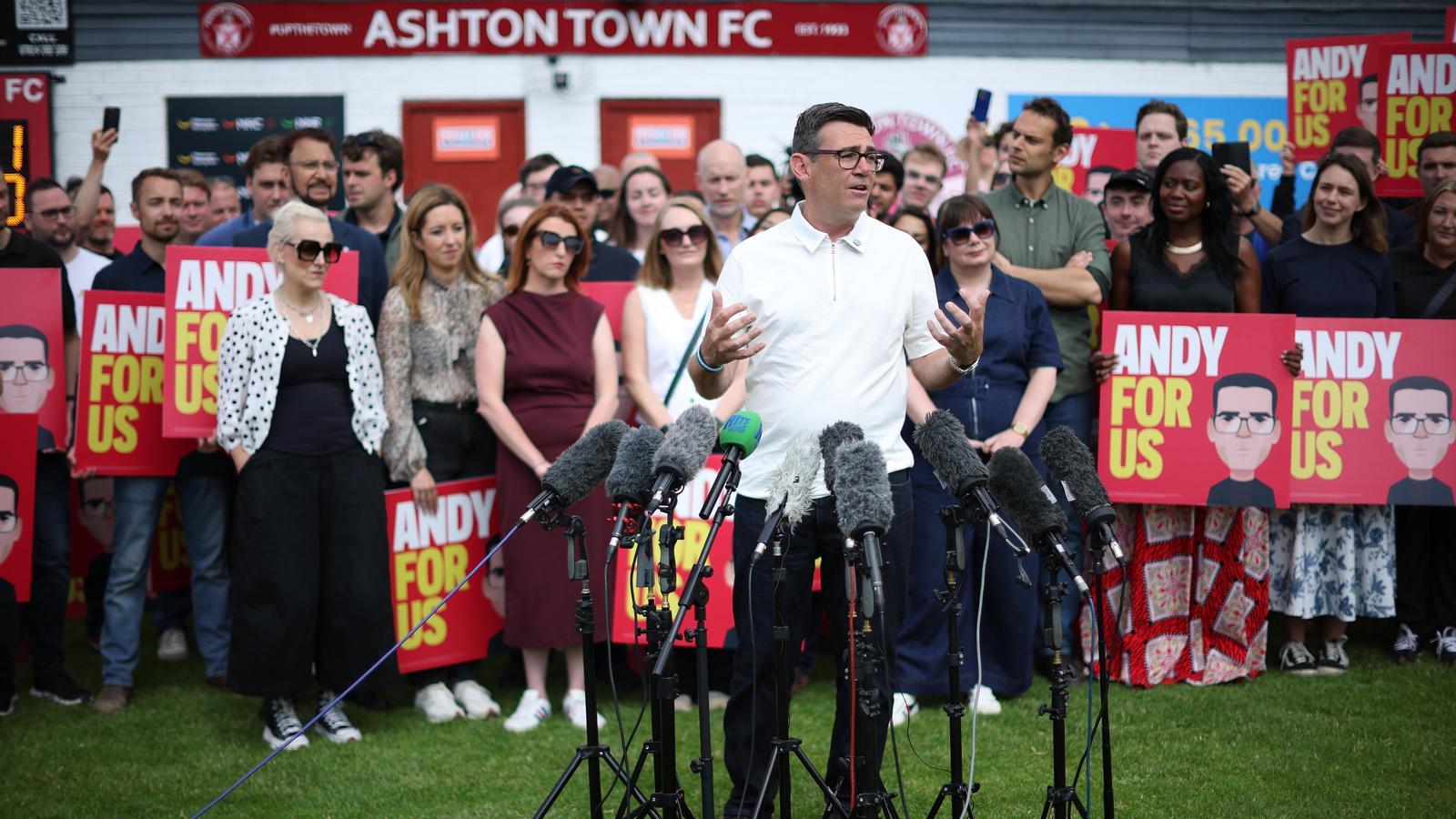
LondonGood news for British Labourism and, at the same time, bad news for Prime Minister Keir Starmer, and also for the ultra Nigel Farage. The incontestable victory in the Makerfield constituency by Andy Burnham in the by-election to the House of Commons held this Thursday opens a new phase in the party's crisis, and positions the Mayor of Manchester as the main contender to succeed Starmer in Downing Street. Burnham obtained 54.8% of the votes (24,927 ballots), very comfortably defeating the Reform Party candidate, Robert Kenyon (15,696). After almost a decade focused on local politics, the so-called King of the North will be able to return to Westminster, where he already tried to seize the party's reins after the electoral defeat of 2010.
The magnitude of the triumph shows, according to his supporters, that Burnham is capable of reconnecting Labourism with the traditional working-class electorate of the north of the country. Voters who, both in the local elections of 2025 and in the most recent ones, on May 7th, had opted for Farage. But in just six weeks, since Burnham announced his candidacy and his intentions to challenge Starmer's leadership, Makerfield has gone from offering a 27-point lead to the Reform Party to giving a 20-point victory to Labour. The swing between the two calls has been 23 points. Burnham overturns the decline of the last two calls and, in fact, widely surpasses the results with which Labour won this seat in the general elections of 2024.
In the early hours of the morning, in his victory speech, the new MP issued a direct warning to Starmer. "This is the last chance to change," he said, assuring that it was the message he had heard repeatedly during the campaign. Burnham has not formally announced a candidacy for Downing Street, but in the preceding weeks he had made it very clear that he would join any leadership race that got underway.
won this seat in the 2024 general electionWithout explicitly stating that he will challenge Starmer's leadership – as the whole country knows he will in the coming days or weeks – Andy Burnham has interpreted last night's result as an "instruction for change; our last chance to change." With a total rejection of four decades of Labour and Conservative policy, the contender to replace Starmer has stated that "for forty years this country has been following a path that has not worked for the people and places of this part of the country; now the time for change has come". His great challenge is to convince the party and the country that to do so, a change also at Downing Street is essential.
The ball is now in Starmer's court, who, for the moment, has decided to bunker down at Downing Street. Despite the magnitude of Burnham's victory, and although almost a hundred of his MPs asked him to step aside six weeks ago, he ratified early this morning that he will fight if they try to oust him from power. "If there is eventually a leadership contest, yes, I would stand. I would compete. I have said it repeatedly: I will not step aside," he assured. The hope for all those who want to see him out of Number 10 is that, little by little, the pressure around him becomes unsustainable until he throws in the towel. Burnham's allies hope that Starmer will reflect over the weekend and realise what the reality of the situation is.
Another of the possible rivals for the Labour leadership, former Health Secretary Wes Streeting, has thrown a poisoned dart at the premier
while congratulating Burnham: "[His victory] gives us all hope that the Labour Party can still win, but Andy's campaign shows that, to achieve this, change is needed."
Throughout his second speech, the Mayor of Manchester warned that the support received is not "a blank cheque". He explained that voters have asked him to "do something to make life more affordable, for people to have more money in their pockets and a better life". In this regard, he defended "an economy that works for everyone, not just for a few in faraway places". The new MP also placed reindustrialisation and state reform at the centre of his programme. "We want a new wave of reindustrialisation in the North of England and the rest of the country," he said, while calling on the government to use public procurement to support domestic companies: "It is time we started supporting British businesses and industry".
has been limited, for the moment, to congratulating Burnham on his victory.
Personal setback for FarageAccording to sources close to Burnham, the new MP already has the support of the 81 parliamentarians needed to formally trigger a leadership contest. The former Health Secretary, Wes Streeting, who resigned after the electoral shock of May, warned Starmer this week that he must either announce a timetable for an orderly departure or risk facing an internal rebellion. The premier has limited himself, for the moment, to congratulating Burnham on his victory.
Personal setback for Farage
The defeat of the Reform Party candidate also represents a personal setback for Nigel Farage and his xenophobic policies. The far-right leader was confident that Makerfield would be one of his great opportunities to demonstrate that he could turn his good results in local elections into parliamentary victories that would facilitate his access, in 2029, to Downing Street. Nothing could be further from the truth. Even by adding the votes (3,111; 7%) of the third party in contention, the also far-right Restore Britain, Farage would not have claimed victory. In this regard, Burnham has insisted that his victory "now offers the possibility of building a new politics based on unity and hope, far from the path that leads to a dark and divisive politics like that of the United States".
Burnham's breakthrough in Westminster twenty-five years after he was first elected as an MP also carries a strong symbolic weight. This is the first clearly positive result for Labour in a competitive by-election since Starmer has been in Downing Street, for practically two years. It also comes at a time when polls show a sustained drop in support for the government.
With Burnham's imminent return to the House of Commons, and the prospect of a leadership battle, the Labour Party now faces decisive days. What until recently seemed like a peripheral criticism of Starmer's leadership has become an alternative with electoral credibility. Burnham's challenge is, indeed, to change the course of the party and the country.
