Tragedy in Colombia: at least 111 dead from a magnitude 7.4 earthquake
Tens of buildings have collapsed due to the earthquake with its epicenter in San José del Palmar, on the Pacific coast
-
CAT -
CAST
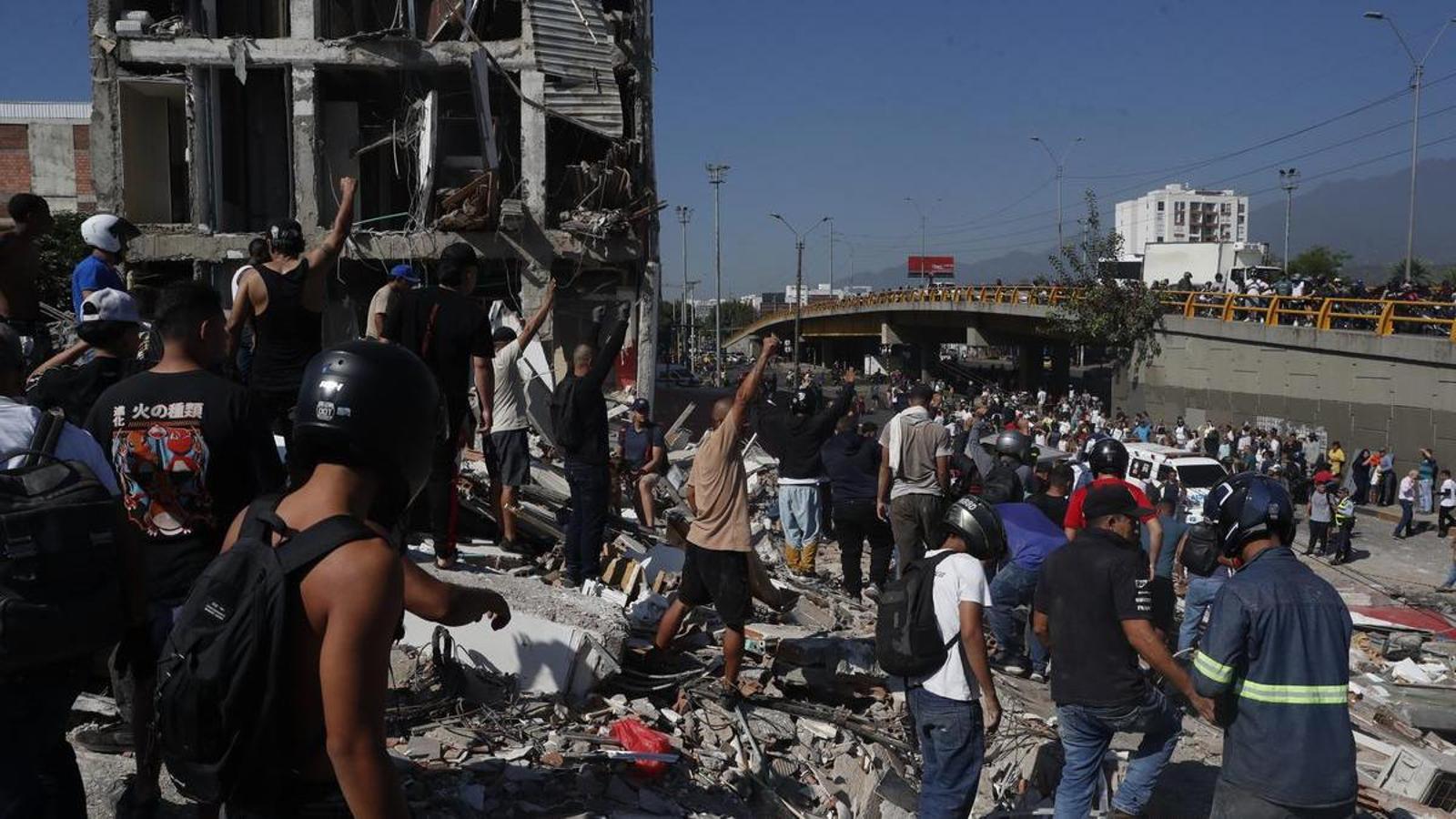
BarcelonaAt least 111 people have died and 87 more have been injured in a magnitude 7.4 earthquake that shook much of Colombia this Monday and caused the collapse of dozens of buildings. The tremor, which took place at 7:34 AM local time (2:34 PM in Catalonia), affected 21 municipalities, according to the Colombian government. The earthquake was felt in Bogotá, Cali, Popayán, Manizales, Armenia, Pereira, Medellín, Quibdó, Antioquia, and other cities in central and western Colombia, as well as in neighboring countries Panama and Ecuador.
The coffee-growing region in central Colombia is one of the most affected. Most of the fatalities are concentrated in the metropolitan area of Pereira, and the situation is particularly concerning in Cali, where dozens of buildings have collapsed with people inside. The Colombian government has declared a "national disaster".
The epicenter of the earthquake was in the town of San José del Palmar, on the Pacific coast, at a depth of 96 kilometers. According to data provided by the Colombian president, Abelardo de la Espriella, at least five departments have been devastated: a total of 1,575 homes have registered damage, of which 37 have been completely destroyed and 61 have collapsed. Also affected were 18 health centers, 52 educational centers, and 18 roads. In addition, at this time, seven airports have suspended their operations due to the damage: those in Pereira, Manizales, Quibdó, Armenia, Cartago, Cali, and Buenaventura. Meanwhile, emergency services are working against the clock to rescue dozens of people trapped under the rubble.

"I had a very strong premonition. I didn't know what was happening, but I had to go look for him. I only found his car parked outside the house," laments Mariela with a broken voice, while rescue teams have begun to clear rubble from the home where her son lived with other colleagues in Cali. Some neighbors are also trying to help with their own hands. The young man is one of the many missing people. His mother calls him insistently, but he doesn't answer the phone. The desperation is absolute.
In Cali, the capital of the department of Valle del Cauca, at least 30 buildings have collapsed, according to its mayor. It is one of the most critical points of the disaster. In the entire department, at least 27 people have died and many more are injured. Governor Dilian Francisca Toro has acknowledged the seriousness of the situation to Caracol Televisión: "There are many injured in the town of Zarzal and the hospitals are overwhelmed."
In San José del Palmar, a town located at the epicenter of the earthquake, significant material damage has been observed, but no provisional victim count has yet been released. The highest number of deaths, according to the provisional assessment, is in the town of Pereira, on the eastern side of the epicenter, where about 65 buildings have collapsed and about fifty people have died.
Regarding the metropolitan area closest to the epicenter, four people have died in Quibdó, the capital of the department of Chocó, with more than 140,000 inhabitants, and the final figure is expected to increase due to the numerous material damages. "There are several injured and serious damage to buildings," reported the governor of the region, Nubia Carolina Córdoba, on X.
The tremor was also felt in the Colombian capital, Bogotá, which is 400 kilometers away from the epicenter, and caused "some cracks in buildings," according to Mayor Carlos Fernando Galán, who detailed that, for the moment, no structural damage has been detected.
Seven airports affected
In addition, at least seven Colombian airports have also suffered damage from the earthquake, reported the Civil Aeronautics of Colombia (Aerocivil): "There are impacts at the airports of Pereira, Manizales, Quibdó, Armenia, Cartago, Buenaventura and Cali". There are fears for the situation at Matecaña International Airport, in Pereira, where the collapse of a terminal's roof has killed at least three people and more could still be trapped. Aerocivil has also reported the closure of these airports until the "structural damage" is assessed.
The Puracé volcano, located in the Colombian department of Cauca, in the southwest of the country, and which has been on orange alert for eruption risk since the end of last month, has expelled ash and gases coinciding with the earthquake. This has also led to the temporary closure of the airport in Popayán, the capital of Cauca, due to the risk that these remains pose to air navigation.
The disaster occurs just three days after the inauguration of Abelardo de la Espriella as president of the country, who has so far traveled to Bogotá to chair an emergency committee. However, he plans to travel to Quibdó, the capital of Chocó, the department where the epicenter of the earthquake is located. "I have ordered the installation of a unified command post to coordinate the attention to the damage and the affected people," he assured through a message on social network X. And he added: "You are not alone. The state is present and is acting".
Several countries have shown their support for Colombia after the earthquake. "Spain is with Colombia in these difficult times," wrote Spanish President Pedro Sánchez on X. For his part, the Minister of Foreign Affairs, José Manuel Albares, reported that the embassy is mobilizing to help Spaniards in the South American country. So far, there is no record of any Spaniards affected.
Other countries have offered material aid and rescue teams. This is what the United States, El Salvador, France, Mexico, and Venezuela have done, which is still recovering from the double earthquake in late June. For its part, the Development Bank of Latin America and the Caribbean (CAF) announced this Monday the donation of 500,000 dollars to Colombia to deal with the emergency. And the UN Secretary-General, António Guterres, has assured that the organization is "prepared" to provide assistance to the South American country "in whatever is needed".
