Absolute uncertainty in the final clash between Lula and Bolsonaro son
Brazil celebrates this Sunday the second round that must decide who will lead the country for the next four years
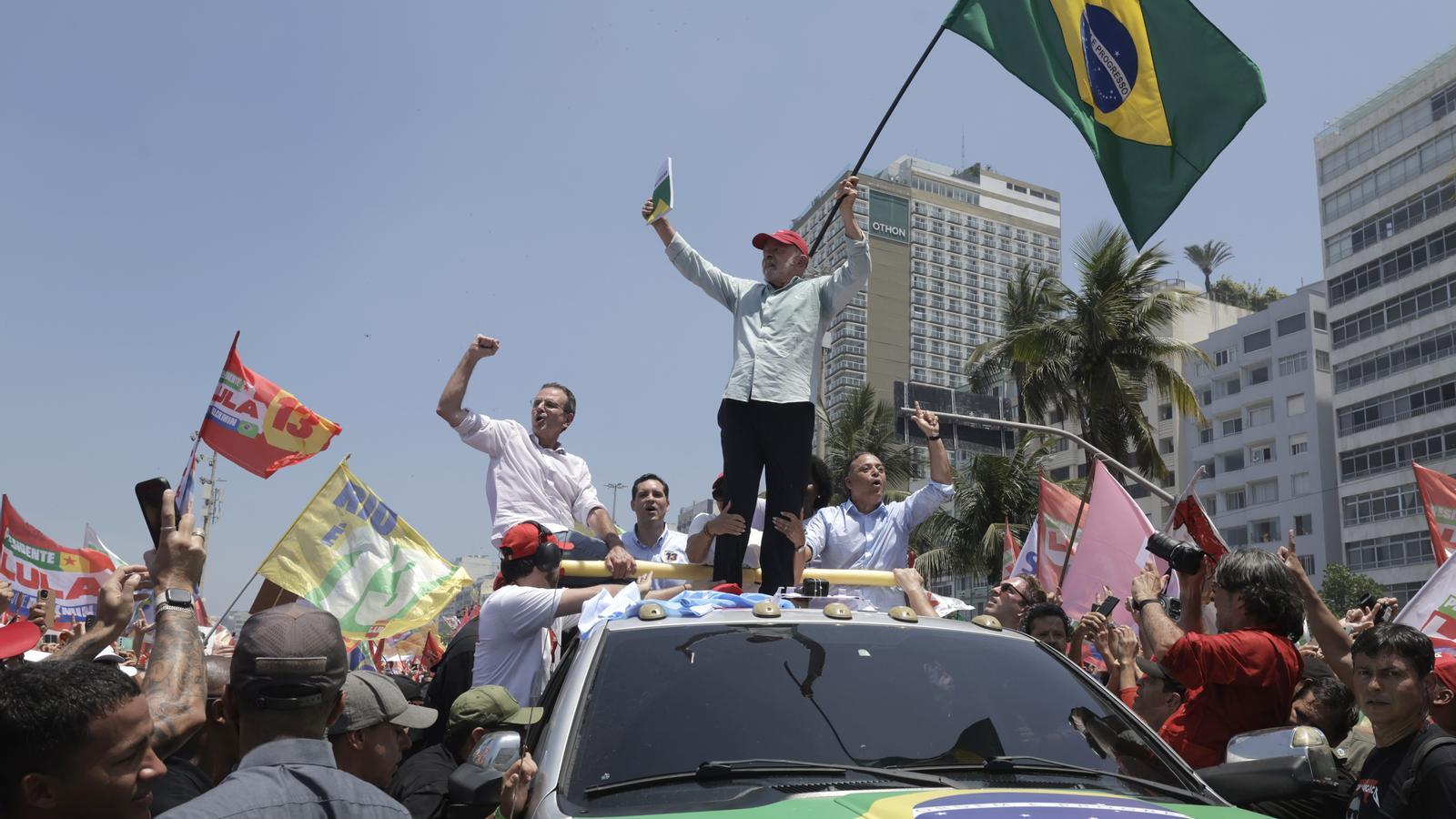

São PauloNearly 159 million Brazilians with the right to vote will decide this Sunday who will occupy the Palácio do Planalto for the next four years and, implicitly, the future of the New Republic as it was conceived in the 1988 Constitution. President Lula da Silva, 80 years old, of the Workers' Party (PT), with a political career spanning five decades, faces Senator Flávio Bolsonaro, 45 years old, of the Liberal Party (PL), the firstborn of the former president imprisoned for an attempted coup d'état. The situation is completely unprecedented: the uncertainty is total.
According to all the polls, Lula and Bolsonaro's son are technically tied. However, the far-right candidate starts with a slight advantage if the number of votes is taken into account. In his favor, there are also historical precedents: until now, those who have won in the first round have taken advantage of the momentum to confirm their definitive victory in the second.
On October 5th, Jair Bolsonaro's son garnered 47.03% of the votes, compared to Lula's 45.16%. The difference of 2,225,000 votes, the smallest ever recorded in the country, has kept alive the hope of the left, which has brought together all democratic sectors with the aim of sealing an unprecedented comeback.
The scenario, however, is of maximum difficulty for Lula, with the majority of the vote already defined by a polarization entrenched since 2018. A triumph of the father of the poor would break the domino effect of the far right in Latin America, which has won the last seven presidential elections with allies of Donald Trump, who is achieving the goal of having governments submissive to his interests in what he considers his natural zone of influence.
The victory of Bolsonaro's son, which would align the South American giant with Trumpism, could endanger the system of democratic institutions, bearing in mind that he would govern with a Congress and a Senate with extremist and ultraconservative majorities. Members of his candidacy have already set out a roadmap that, beyond the impeachments of Supreme Court judges, would include a constitutional reform to automatically extend the term.
Self-esteem boost
The electoral campaign, throughout the three weeks that have preceded the runoff, has intensified significantly, fueled by a first television debate of very low level due to the aggressive attitude and a speech filled with fake news from Flávio Bolsonaro, who followed to the letter the instructions of the coach Pablo Marçal, former candidate for mayor of São Paulo and politically disqualified until 2032.
Lula da Silva has had the merit of knowing how to take the moral blow of the unexpected defeat in the first round. More combative and less institutional, he has appealed to the fear vote among the poor and the elderly in the face of the chainsaw that Bolsonaro will apply to social programs and pensions, following the ideology of Javier Milei in Argentina. The rejection of the entire Bolsonaro clan, splashed by accusations of corruption, has been, however, the engine of the mobilizations of the left, which, as it did four years ago, has positioned itself as a guarantor of the defense of democracy and has warned of the danger of a new coup attempt, through, this time, a political reform that would not require clumsily mobilizing the military.
The red reaction has taken place in two scenarios that the far-right has dominated at will for the last decade. First, Lula's supporters have reclaimed the streets, which had been in the hands of the most regressive and coup-plotting sectors since the massive demonstrations in favor of the impeachment of Dilma Rousseff in 2016. The novelty is that the calls have been successfully organized through social media and not organically by the PT itself. There have been two iconic meeting centers in the country's two largest cities: Copacabana beach, in Rio de Janeiro, and Paulista Avenue, in São Paulo. The rallies throughout the country have been an injection of self-esteem for the progressive electorate.
The digital battle
In parallel, the left has known how to organize itself digitally. The one who has articulated the reaction is the deputy for Minas Gerais, André Janones, who has managed a WhatsApp channel called Exército do Lula, which has ended up gathering 10.7 million followers. The president of the Electoral Justice, Kassio Nunes Marques, who is a member of the Supreme Court by indication of Bolsonaro the father, has ordered its suspension twice at the request of the campaign of Bolsonaro the son. The magistrate is a very controversial figure: accused of bias by the left, he is splashed by the macro corruption case of Banco Master, already liquidated by the Central Bank, and allegedly received sexual favors in orgies with prostitutes. Furthermore, the entity allegedly hired the magistrate's son as a consultant.
For the first time, Lula has counted on the momentum of an organized digital ecosystem –which has not been under the control of the PT–, with a level of efficiency and penetration similar to that of the far right, which has been spreading fake news daily for eight years.
The digital battle has uncovered preferential treatment by the algorithms of major American technology companies towards Bolsonaro's son. The Electoral Justice system has had to act and has demanded explanations from Meta and X. According to the complaint from Lula's candidacy, the recommendation systems, generative artificial intelligence (AI) tools, and advertisement review mechanisms of platforms such as Instagram, Facebook, and WhatsApp have operated for the benefit of the far right. The most notorious incident, which set off all alarms, is the refusal of Meta's AI and X's AI (called Grok) to generate propaganda linked to Lula, something that did not happen when the request was in favor of Bolsonaro.
In this digital interference, the long shadow of the Republican administration from Washington has appeared, in tune with big tech and the Bolsonaro family. Donald Trump's silence, which could have had an unintended effect among the Brazilian electorate, has been, in reality, a false position of neutrality, considering that the second tariff hike imposed by the United States on Brazilian imports remains in effect.
