250 years of the United States: the discrediting of a country that no longer recognizes itself
Trump's attempts to rewrite the country's history mark celebrations that have divided Americans

-
CAT -
CAST
WashingtonThe answers we seek in history often speak more about the present than the past. Amidst the summer heatwave of 1776, a group of men gathered in Philadelphia decided to separate from the British Empire. Delegates like John Adams and Thomas Jefferson signed one of the most ambitious documents of the era, which would serve as a beacon for other upcoming revolutions. "We hold these truths to be self-evident, that all men are created equal; that they are endowed by their Creator with certain unalienable rights; that among these are life, liberty, and the pursuit of happiness," states the preamble to the United States Declaration of Independence. The official date is July 4th, although the 56 delegates took almost a month to formalize the signing of the text.
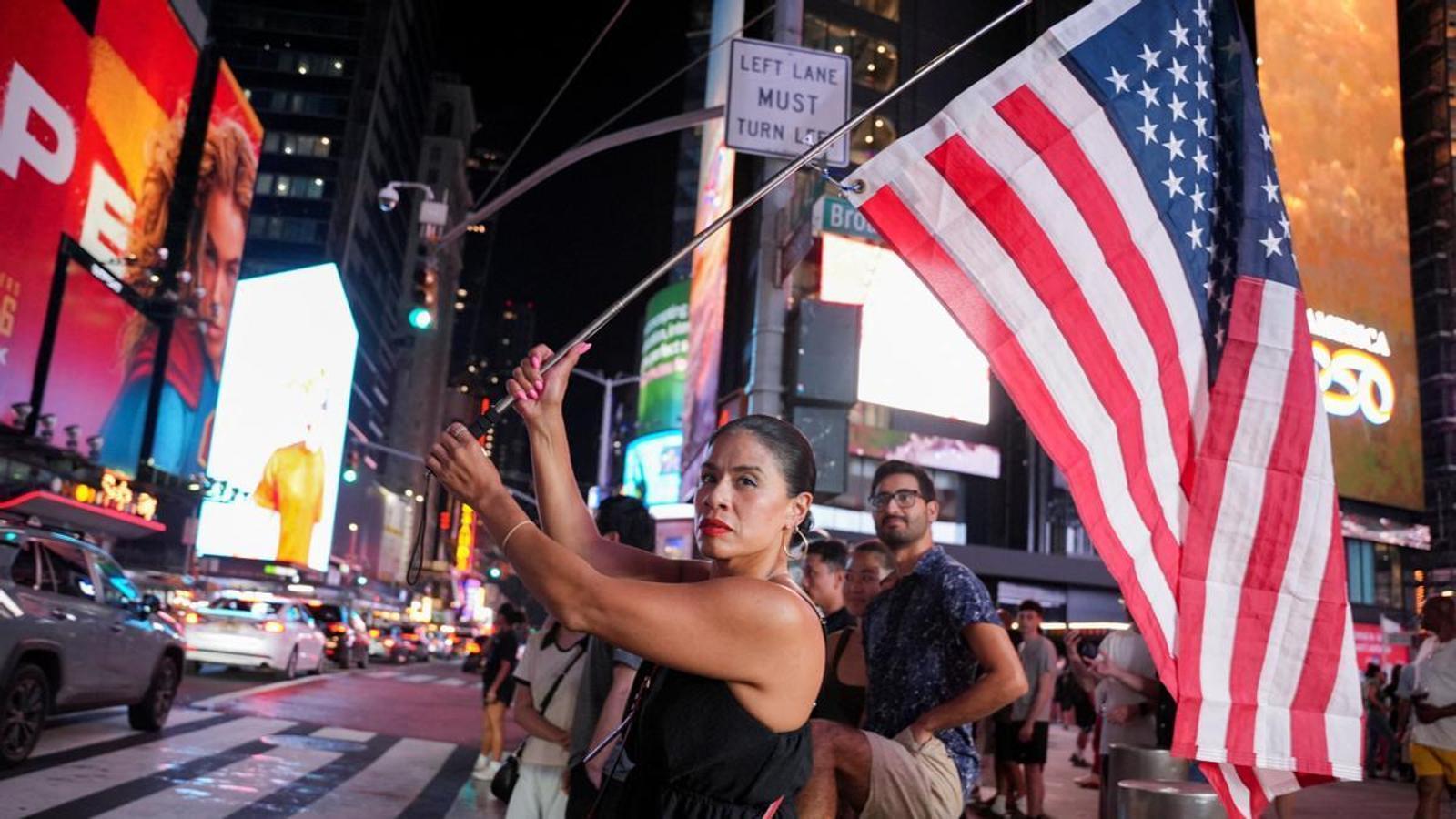
In the initial draft of the Declaration, Jefferson had included a harsh condemnation of slavery, but the Continental Congress removed the mention before approving it. A quarter of a millennium later, that stain on the foundational promise endures in the country's subconscious, which now has taken the form of extreme polarization.On the celebration of the 250th anniversary of independence from the British crown, Donald Trump's administration has filled the Mall with flags and slogans. There are an improvised chapel under a sky-blue tent, a baptismal pool and food stalls. At the foot of the Ferris wheel, next to the silhouette of the Capitol, there is a small-scale replica of the Arch of Triumph that the president wants to build in the capital. Every afternoon on the court of rodeo provisional, the cowboys appear on the horses' backs, recreating a spectacle that the audience already knows.
People move through spaces as if following a human-scale guide to what it means to be American. Everything seems to be ordered around a very narrow idea. At one of the merchandise stalls, the famous red cap ("Make America Great Again) has evolved. It now says "America is back.
Behind the sunglasses and with the original cap, Korbey argues that "the vast majority" of the population is united in the celebration of the country, of which he now feels proud.
—But there is a small part that has been corrupted by communism. I believe that this 25% of the far left, who represent half of the Democratic Party... there will come a time when the rest of Americans, normal people with common sense, will have to decide which side they are on.
—But do you think it is possible to reach a point of understanding again in the future?
—Negotiation and consensus have cost us 40 billion dollars in debt. The time for negotiation and consensus is over. I believe that until there is a political purge [in English uses the expression political bloodletting ] that erases all this far-left nonsense, we will remain fractured.
His wife smiles as she looks towards the Washington Monument, noting to Korbey her impatience to leave.
"A party act"
Near the stands dedicated to recreating each of the country's states, two women stroll curiously. But there is no admiration in their gaze. "This is an absolutely partisan display. Everything is full of Trump's face, down there they are handing out bags and puzzles with his face," says the older one, Carol. "Many neighbors in my neighborhood didn't even want to come because it's been framed as a party event. It's a shame, because this should be a celebration for everyone, funded with our tax money," adds the other, Eloise.
Both are retired federal government workers. Carol dedicated a good part of her life to the Department of Defense and Eloise to the Department of Homeland Security (DHS). Both identify as Democrats. They say they came to the celebration because "it's free and we live right here." Neither of them is particularly enthusiastic about the country's current situation. Their expressions darken when I ask them how they see the future.
"There are things that have been permanently damaged and that I don't think can ever be repaired. The way we are treating immigrants in this country cannot be repaired. And people who are not Caucasian will never look at things the same way again, here," says the former DHS worker, the department from which ICE depends. Anti-immigration agents, previously unknown to a good part of Americans, are now an internationally recognized name. Earlier this year, two ICE officers shot and killed two American citizens in Minnesota.In Carol's case, who is 70 years old, the comparison with the bicentennial is inevitable. Pessimism is not new to her, but how it is being channeled is. In 1976, when the country celebrated its 200th anniversary just after the Vietnam defeat, she was twenty years old and participated in the commemorations in Boston. Democratic disillusionment was also present, not only because of the war, but also due to the shock of the Watergate scandal that ended Richard Nixon's presidency.
"My God. Fifty years ago the climate was different. People were returning from the war and we had learned to live with different people. We had a lot to celebrate. Back then, no one talked about politics, we focused on having a good time. I was president of the USO in New England and I went out on the ship USS Constitution to see the parade of large sailing ships from other countries... It was so positive!," she recalls. And she adds: "The administration back then [Gerald Ford] tried to focus on uniting people. Nobody wore "}Make America Great" hats. Because America is already great, we don't need to make it great again, right? Those hats only divide."
Wrestling at the White House
American history professor Benjamin Waterhouse acknowledges that memory can sometimes be a bit "conflicting" because people tend to remember childhood and youth experiences more vividly. "But it is true that in 1976, pessimism was not structured around the polarization between Democrats and Republicans as it is today," he explains. Waterhouse notes that "Ford saw the bicentennial as an opportunity to talk about what Americans had in common." On the contrary, "Trump uses the celebration to talk about himself."
The entire staging at the Mall and the events orchestrated around the date, such as the wrestling match at the foot of the White House or the investment of more than a million dollars to repaint the reflecting pool of the Lincoln Memorial, are an expression of "how the president thinks about America." "There is a strong component of nostalgia. Trump tries to recreate the America of his childhood in the fifties. It all resembles an Americanized version of Disney World," points out Waterhouse.
The security fences surrounding the Mall's tents hide the Smithsonian museum complex, spread along the esplanade. A few meters from where the public celebrates the cowboy's skill in not falling off a bull weighing almost a ton, there is the National Archives museum: there rests the original Declaration of Independence.
Eliminate "anti-American" history
Inside the compound, it's impossible not to see Trump's imprint in every detail. On the other hand, at the National Portrait Gallery, the explanatory plaque for his painting is much shorter and more concise than a year ago. The American president had the references to the two impeachments that he suffered during his first term. It was not an isolated incident. In March of last year, the Republican signed an executive order titled Restoring truth and sanity in American history. The document ordered the Smithsonian to remove “inappropriate, divisive or un-American ideology”.
Last year, the Trump administration also had an exhibition dismantled at the National Historical Park of Independence in Philadelphia about the nine slaves that George Washington had. According to the decree, elements that could "inappropriately discredit" had to be removed." famous Americans. The Republican wanted to erase the slave-holding past of the founding fathers, just as the condemnation of slavery had been eliminated from the draft of the Declaration in 1776.
"No presidential administration had interfered so intensely in how American heritage is taught and publicly understood," warns Samuel Redman, a history professor at the University of Massachusetts and director of the Public History Program. And he emphasizes how this "obsession" of Trump's to rewrite history "reflects a larger problem" on a democratic scale. For Redman, if you can lie about a museum plaque, "you can lie about anything: from the justification for going to war to police brutality."
Tuesday saw two very different celebrations about the essence of the United States overlap on the same plane. While some onlookers wandered through the tents and took photos with the Ferris wheel, on the other side of the Mall, a modest group of people gathered in front of the Supreme Court. Hispanics, whites, and blacks, many of them children of immigrants, celebrated that the high court had just overturned Trump's attempt to eliminate birthright citizenship. The president had limited, by executive order, a constitutional guarantee ratified after the Civil War to recognize freed slaves as full citizens.
From the Supreme Court esplanade, families and activists could not make out the "Freedom250" signs, nor the fair's fences. From inside the Mall complex, it was impossible to know what was happening beyond the hill where the Capitol is located. But, even though they couldn't see each other, the geography was the same.
