The US high court has ruled in favor of two state laws that prohibit trans athletes from participating in women's collegiate sports. A decision that represents a victory for the Trump administration in its persecution of trans people and that will have a national impact, as it sets a precedent affecting the rights of the community across the country. The conservative supermajority established by the American president has once again asserted its weight with its six votes.The rules in question, approved by the Republican states of Idaho and West Virginia, had been challenged by two trans athletes who were left unable to compete due to their application. In their appeals, the two girls had argued that their exclusion from women's collegiate teams due to being trans constituted a violation of Title IX – which regulates discrimination – and the Fourteenth Amendment to the Constitution, which guarantees equality for all before the law.
Judicial defeat for Trump: the Supreme Court upholds the right to birthright citizenship
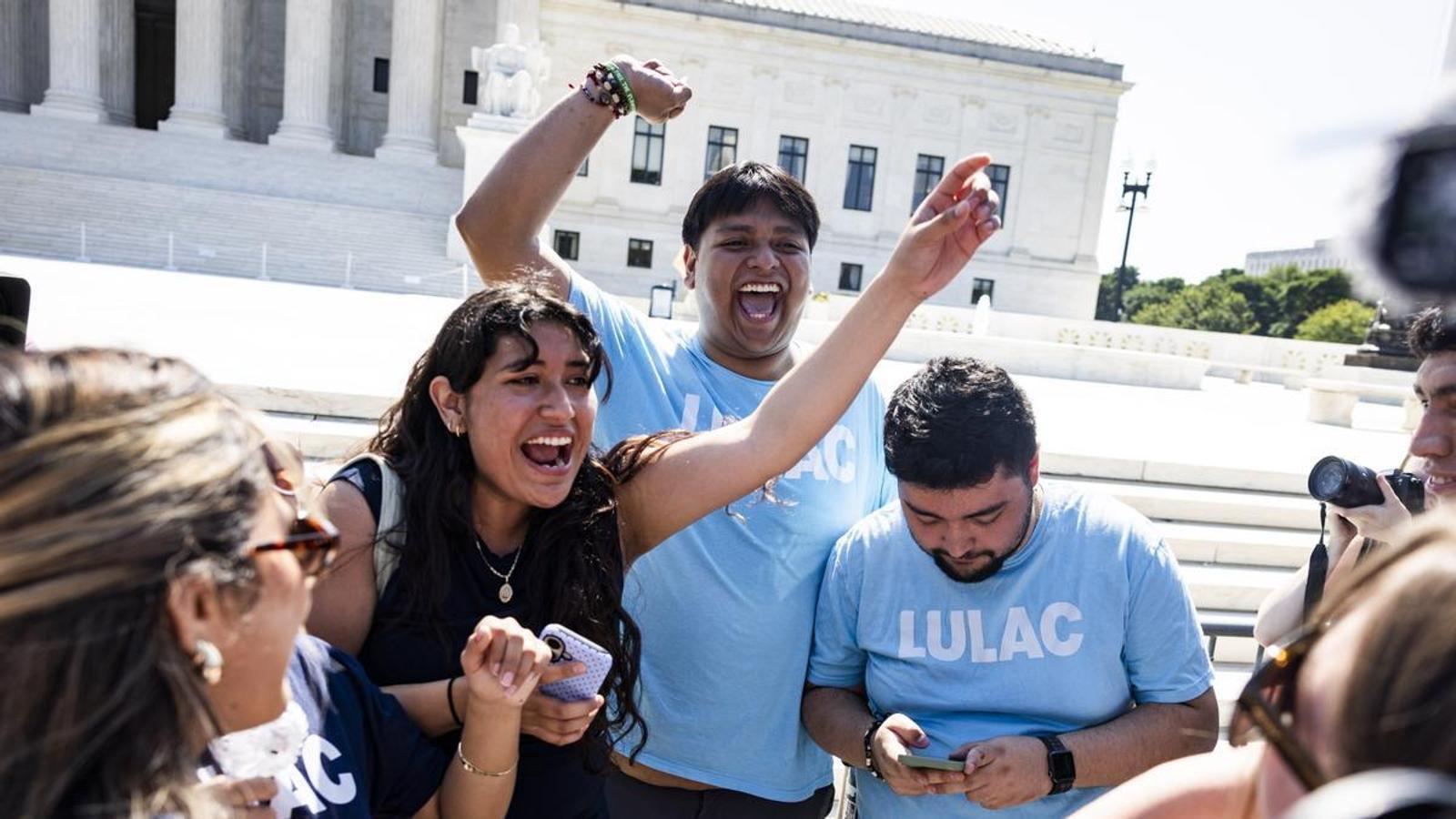
With six votes in favor and three against, the high court confirms that every person born on US territory is a full citizen

-
CAT -
CAST
WashingtonThe Supreme Court of the United States has overturned Donald Trump’s attempt to override the limits of presidential power and abolish birthright citizenship, a right enshrined in the Fourteenth Amendment to the Constitution. By a vote of six to three, the high court ruled that the executive order through which the president sought to revoke one of the fundamental principles of a country built on immigration was unconstitutional. Unlike in many other countries, citizenship in the United States is acquired by virtue of being born on American soil, regardless of the nationality or immigration status of one’s parents.
Revoking that right would not only have struck at one of the country’s defining principles, but would also have distorted the history of the fight against slavery that gave rise to it. The amendment declaring that “all persons born or naturalized in the United States are citizens” was ratified in 1868, after the Civil War, to overturn an earlier Supreme Court ruling that had denied people of African descent the right to citizenship. During oral arguments in April, both the Trump administration and the three conservative justices who sided with it argued that the provision’s historical origins—initially intended to secure citizenship for formerly enslaved people—did not extend to children of immigrants born in the United States today.
That argument is reiterated in the dissenting opinions, including the 91-page opinion written by Clarence Thomas. He describes the ruling as “another chapter in the sad history of the Fourteenth Amendment, which was designed and understood to guarantee the equal rights of freed slaves, but which, in contrast, has been reused for political projects that the Reconstruction Congress did not support.” Under the interpretation advanced by the three conservative justices and the Trump administration, this right would be fundamentally different from other rights that are universal and cumulative: it would instead be limited and exclusionary.
By contrast, Chief Justice John Roberts, who wrote the majority opinion, recalled: “Citizenship, then and now, was the right to have rights, to participate freely in our political community.” “The framers of the Fourteenth Amendment extended this promise to ‘all persons born free in this land.’ Today we uphold that promise,” he wrote.
As the chief justice notes, revoking birthright citizenship would have left many newborns from vulnerable families—including families legally residing in the country—without access to a range of health and food benefits. It could also have created a real risk that many children would be left in legal limbo or even rendered stateless, automatically exposing them to the risk of deportation.
On January 20, 2025, Trump signed the executive order seeking to end birthright citizenship, further advancing his anti-immigration agenda. The order was quickly blocked after more than 20 states and several migrant-rights organizations filed lawsuits challenging it. The ensuing legal battle eventually made its way to the Supreme Court.
The president had defended the order as a way to put an end to what are commonly referred to as “anchor babies”—children of undocumented immigrants who acquire U.S. citizenship by being born in the country. Republicans and other conservative groups argue that undocumented immigrants use this route to obtain legal status more easily, although the parents remain at risk of deportation and generally cannot begin the process of applying for a green card—a permanent residency permit—through their child until the child turns 21.
However significant the setback for the president, the ruling was not entirely unexpected. During oral arguments in April, when Trump made the unusual decision to appear in person, several justices already appeared skeptical of the idea of revoking the Fourteenth Amendment’s guarantee of birthright citizenship.
Although migrant-rights groups have welcomed the decision, the Supreme Court had handed Republicans two major victories on immigration matters just the previous week. In one case, it ruled that the government could terminate the temporary protected status currently enjoyed by hundreds of thousands of Haitians and Syrians. In another, it cleared the way for asylum seekers to be denied access to the asylum process at the border. The court ruled that border authorities could physically prevent migrants from crossing into the country, including those seeking asylum.
