The Penedès vineyard, under high tension: winegrowers foresee a nosedive in grape prices
The drop in cava sales, plus the number of bottles Freixenet has stopped producing within the DO, suggests a difficult future in the territory

-
CAT -
CAST
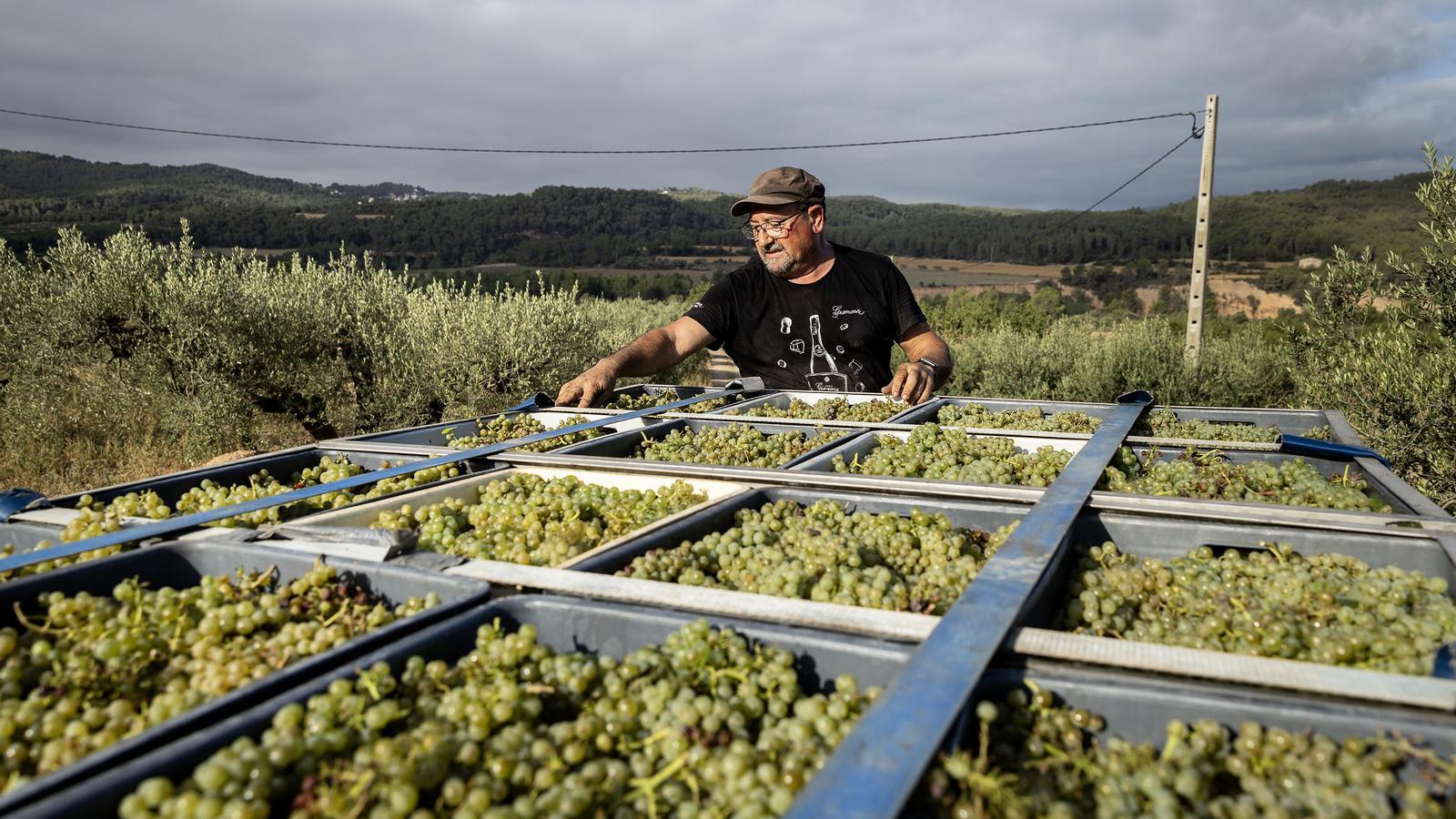
Sant Sadurní d'AnoiaThe winegrowers of Penedès have not been so afraid of the future as they are today. They have several indicators to reinforce their fear: Freixenet (which is 100% owned by the German group Henkell) for the past two years is believed to have stopped producing forty million bottles annually within the DO Cava (a figure the winery neither confirms nor denies), last harvest there was an excess of grapes and base wine, and the figures being released on the sale of wines and sparkling wines in general are not optimistic. For all these reasons, the president of the Associació de Viticultors del Penedès, Josep Anton Vendrell, states that they are living through “a very critical situation, in which 35% of the planted vineyard in Penedès would be surplus (between seven thousand and ten thousand hectares of vineyard), and in this upcoming harvest, the price of grapes could plummet; last year the DO Cava paid between 46 or 60 euro cents”. If there is surplus vineyard, if there is aid from the European Union to uproot it, it is clear that the territory could change in a few years to cease being the green lung between Barcelona and Tarragona, and give way to industrial estates or fields with solar panels, historical threats derived from urban pressure. To this situation is added a certainty: the transfer of some wineries from the DO Cava to Corpinnat, a brand that works to ensure an agreement with the winegrower with a steadily increasing price each year.
Another consequence of the wine surplus in the region is that cooperatives have started selling base wine as table wine; they declassify wines due to the drop in price and demand, because the base wine reserved for cava has not been sold. It has not been necessary because the region's major producer, Freixenet, does not need as much base wine as before. It did not need it in 2025, nor in 2024, when it acquired it from other regions and produced another sparkling product, technically called gran vas. In 2024, it was forced to do so due to the drought, which affected Penedès and the country in general. As Freixenet wanted to continue meeting international demand, especially from the German, Austrian, and Swiss markets, it bought grapes from outside the region and launched another product on the market, which was not cava, but which the final consumer might even think it was due to the play on names it created. The new product is Freixenet Premium Sparkling Wine Cuvée, outside the DO Cava, of course. Last year, in 2025, it continued to do so with the curiosity that it was indeed a good harvest year.
Thus, in 2024 it was due to the drought, but in 2025 because another sparkling product had already been invented and, therefore, it no longer needed to buy grapes in Penedès, resulting in two years where the region's major producer did not buy grapes. Last year, there were vineyards that were not harvested and there were grape growers who sold grapes without a price (without knowing at what price they would be paid).
Vineyard in good condition
In summary, the forecast of the president of the Association of Winegrowers of Penedès is that the price of grapes could plummet this harvest because there will be little demand and a lot of supply. “It has rained, the vineyard is fine, and if there are no other meteorological changes, meaning no frost or hail, everything indicates that it will be a good harvest, but if there is no demand, there will be too much”, points out Josep Anton Vendrell. For their part, Freixenet has not wanted to respond to the ARA's question about the number of cava bottles they have stopped producing, because they state that it is “confidential information”.
Regarding the harvested grapes, the price per kilo of grapes was paid last year between 46 and 60 euro cents. It could not be paid less than 46 cents, but it could be paid more than 60. “It is the price set by the DO Cava, which is based on the cost study carried out by the Institut Català del Vi, Incavi, which usually publishes it in July, and which we disagree with”, says Vendrell. They disagree because they consider that this cost study is not real, “items are missing to be updated, for it to be real; moreover, it would be good if it were published earlier so that the winegrower could make forecasts”. Prices cannot be agreed upon because competition law prevails, which prohibits setting them. Be that as it may, “paying less than 60 cents per kilo of harvested grapes is a ruin for the winegrower”, says the president.

, that is to say 60 million less in two years.
Finally, the president of the Corpinnat brand, Pere Llopart, explains that 10% of the Penedès vineyards are cultivated by wineries affiliated with or linked to Corpinnat, which agrees or sets a reference price "worthy of the work of the winegrower, and which at the same time offers protection for the territory". They agree on minimum prices with the responsibility of increasing them year after year, and they have it written in their regulations, and this fact, in itself, "is an unprecedented fact in the territory and also compared to many other wine-growing areas". This year, the minimum price they have agreed upon is €0.943/kg (or 943 euros/ton) for varieties registered in their regulations, whether for making still wine or sparkling wine, and €0.82/kg for varieties not in their regulations (cabernet, merlot, muscat and others), which can be purchased for making still wine if wineries so wish", says Llopart, who emphasizes that the minimum prices agreed upon by Corpinnat members are unheard of "and I would dare to say that they are unheard of in the world". Llopart considers that, with the volume of bottles they produce, they cannot be the only solution in Penedès, but they do want to explain that there is another way of working with the winegrower and of making sparkling wines.
A dark future, with current figures
In two years, the DO Cava has sold 24% fewer bottles, specifically, from 250 million in 2023 to 190 in 2025, that is 60 million less in two years.
If there is surplus vineyard, grape prices will continue to fall, and that will mean that the winegrowers will not make a living from cultivating the land. From here, other scenarios could open up that no one wants to imagine right now in the Penedès.
