The little village that has found the way to feed the elderly well
The schools of Corbins and Artesa de Lleida and the day center of Fondarella cook menus for the students and for the elderly

-
CAT -
CAST
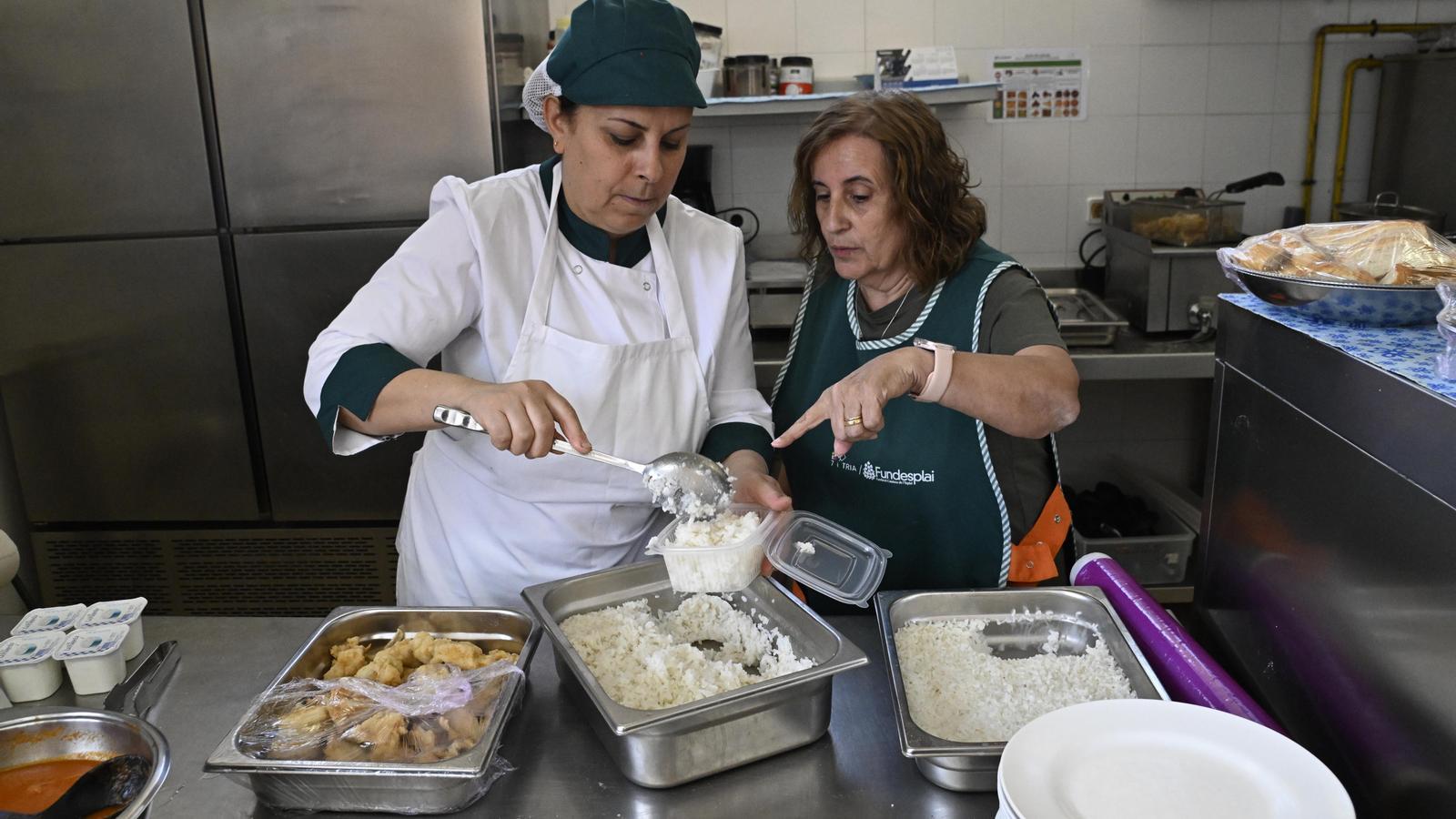
Corbins / TàrregaBroccoli with potatoes and turkey in the casserole: stewed lentils and ham omelette; macaroni bolognese and nuggets of broccoli; chickpea soup and beef meatballs; and every Thursday, fresh fish from the market. These are some of the menus offered by the Sol Ixent school in Corbins (Segrià), for both its primary school pupils and those of the municipal nursery. All dishes are cooked on the centre's premises. Hot meals and, in many cases, locally sourced. And, since last September, it has also been an intergenerational meal.
A dozen elderly people, most of them single or widowed, also enjoy these menus every day. Only on school days, of course. This is an initiative promoted, since the beginning of the school year, by the town council, with the approval of the Parents' Association and the educational company 7 i Tria, which has managed the canteen for several years. The objective is to meet a demand that, although minority, many residents of Corbins consider essential. "If we are not capable of looking after our children and our elderly, we can say goodbye to the town," states councillor Yolanda Romero. And indeed, the municipality, with about 1,500 inhabitants, has 20% of its population over 65 years of age.
For just over six euros per meal, all members of the Santa Quitèria de Corbins Association of Retirees and Pensioners can take their school lunch home or even eat it at the Senior Citizens' Center itself.
The entity has about 200 members, but for now only eleven are registered in this dining service. "They are few, but we trust that word of mouth will cause the initiative to expand over time," says Romero. In any case, "we can confirm that it has been very well received," adds the mayor, Jordi Verdú.

Shortly before twelve noon, when lunch is ready, a municipal brigade worker goes to collect the rations from the school and brings them still warm to the Senior Citizens' Center. There, a member of the board of directors of the Retirees' Association is in charge of distributing them among the users who come to pick them up. “At home, many would make salads and cold dishes, and with this service they have stews that are very popular”, explains Lluïsa Trilla, the president of the association.
Men who live alone are the most frequent profile for this service. “They manage very well even if they live alone”, assures Trilla. The latest to join the service is Josep Llobet, a widower for just over a year. “I'm coming for the first time to try it”, says Llobet, who comes to the center after being notified by a relative.
The menus are exactly the same as those eaten by the school children. “With a more generous portion for the elderly”, clarifies Karima Baouchi, the center's cook. It so happens that this professional joined the job this very academic year, coming from a long experience of 25 years cooking in a geriatric residence in Balaguer. Those from Corbins are now, therefore, school kitchens also designed for the elderly. “I tend to cook with very little salt and less fat –explains Baouchi–, which is also very good for children”.
The cook starts her day at the Corbins school at eight in the morning. She is alone in the kitchen and is responsible for preparing everything so that lunch is ready punctually every midday. In the dining room, there is also Toñi Molina, the coordinator who attends to and collects all requests, both from the school and nursery students and from the Senior Citizens' Center members. In total, about a hundred meals are usually cooked daily. “Here we have the premise that no one can go hungry, neither old nor young”, claims Molina.
“Sometimes, I save a bit of lunch for later, for dinner, because I can’t finish it all”, acknowledges Ramon Solans, another of the grandfathers from Corbins who enjoys the school menu. “I always find it delicious and, above all, healthy because they cook it also thinking about the children”, adds Solans, a widower for seven years who, when there is no school, usually cooks at home “as best as I can”.
But not all users are single men. Frederic Montcasí is a married grandfather who picks up school lunch only on Thursdays and Fridays. “We do it so that my wife can rest a couple of days, before starting to cook a lot for the weekend”, he argues.
A slow oil stain
Corbins has been one of the first municipalities to launch this intergenerational school canteen. In fact, since they announced it, there has been a significant media impact. "I have received calls from various towns in Catalonia interested in learning about the initiative and how it is working," assures the mayor. And it seems that this is beginning to spread like a slow but unstoppable oil stain.
In fact, Corbins is no longer the only town carrying out this initiative today. At the beginning of this 2026, the Til·lers school in Artesa de Lleida is doing exactly the same. There, the canteen is managed by Quàlia, a social initiative cooperative from Tàrregathe Lleida City Council launched a dining service in three municipal senior centersNow, however, in Artesa de Lleida they are starting a new phase. The Til·lers School kitchen serves meals to its students and, for a few weeks now, to about ten elderly people. This is a measure that is expected to grow as it becomes more popular. "If this service did not exist, surely the elderly people in the town who live alone would continue going to the bar or eating pre-cooked meals," says Eva Codina, one of the heads of Quàlia's food area.
The number of elderly diners is still fluctuating, as many are occasional. “It often depends on the daily menu we offer, whether they are interested or not,” acknowledge organizational sources.
On the other hand, intergenerational dining experiences do not necessarily take place within a school. There are other experiences that work in reverse. This is the case of Fondarella, a town in Pla d’Urgell which, also since last September, uses the kitchen of the geriatric residence to feed the pupils of the public school.
Leisure and food experts consider the experience of cooking for more than one group to be organic. The progressive aging of villages has made looking after the elderly a considered essential public service. Indeed, nearly 60% of the dining rooms managed by Quàlia are in municipalities with fewer than 600 inhabitants.
But this concern is not solely the heritage of villages. Precisely this January, the Lleida City Council launched a dining service in three municipal senior centers. People over 60 years old, especially those who live alone, thus have the opportunity to dine every day “in good company, with a balanced diet,” explain municipal spokespersons.
