The sixth meeting between Education and unions ends without agreement, despite a new salary offer
A 28% of teachers have gone on strike, according to the Government, on a day marked by blockades of more than six hours on the AP-7 and A-2
-
CAT -
CAST
BarcelonaThe sixth meeting between education unions and the Government has ended, once again, without an agreement after a session that lasted more than three hours. Although the Department of Education made a salary offer that would mean, in four years, teachers earning about 355 euros more per month than now, the unions have considered the proposal insufficient and have dug in their heels against the Government also regarding staff reinforcements aimed at improving inclusive education.
The meeting began more than an hour late, around four in the afternoon, with the AP-7 and A-2 cut off at various points in the country due to teacher mobilization. This situation caused some tension at the start of negotiations and, in fact, upon leaving the table, the Secretary General of Educational Improvement, Ignasi Giménez, admitted that the department had not "explicitly" asked them to lift the blockades, but that the situation on the roads "did not help the climate of the meeting".
Once in the meeting, and according to USTEC's account, the Government put a new salary increase proposal on the table that would consist of adding the new salary supplement for all teachers that was put on the table on Tuesday to the 200 euros per month already agreed with UGT and CCOO. However, an increase would have to be added after four years. In this way, this same year they would already earn an extra 46 euros per month and in the fourth year, an additional 75 euros would be added. In summary, the proposal would mean that in four years, primary school teachers would earn 351 euros more than now, and secondary school teachers, 356 euros more.
In addition, to this new proposal, the compensation for teachers who did not receive their sexenio payments during the cutbacks would have to be added, which Education had already put on the table and which the unions had valued very positively. In fact, the spokesperson for USTEC, Iolanda Segura, admitted that "it is the first Government" to open up to making this move.
New day of strike, with less follow-up"Inclusive education will not be a stumbling block," assured the Secretary of Educational Improvement upon leaving the meeting. A meeting that the USTEC spokesperson described as "totally disappointing." Segura also criticized that they were not presented with a proposal on inclusive matters and admitted that the salary offer seemed insufficient to them.
Bad blood between unions
Beyond the negotiations with the Government, one of the relevant points of this Wednesday's meeting has been the evident lack of harmony between the unions. In fact, USTEC and CGT have insinuated that one of the obstacles to moving forward with the negotiations is the role of UGT and CCOO – the only two unions that signed the agreement with the Government in March –, and they have assured that the two union forces would be putting a spoke in the wheel when it comes to moving forward. For their part, UGT has issued a statement positively valuing the Government's salary offer and framing it within the agreement they signed a few months ago.

New day of strike, with less follow-up
The meeting took place after a new general strike day in the education sector, the fourth stoppage since the beginning of the year. A day that, according to the assessment – both from the Department of Education and the unions –, has lost strength compared to previous calls. The Government has put the strike participation at 28.74%, while the unions have raised it to 60%. In contrast, in the last stoppages, Education had admitted participation rates of around 40% and the unions had increased it to 70% or 80%.
Despite the decrease in participation, the protests spread across the country, and especially the decentralized road closures, have meant that Wednesday's mobilization has had a significant impact on Catalans. On the AP-7 and A-2 there have been several closures (in Torredembarra, Granollers, Girona, and Lleida) that lasted more than six hours and forced Civil Protection to activate the Procicat in pre-alert phase to bring supplies to people trapped in their cars.
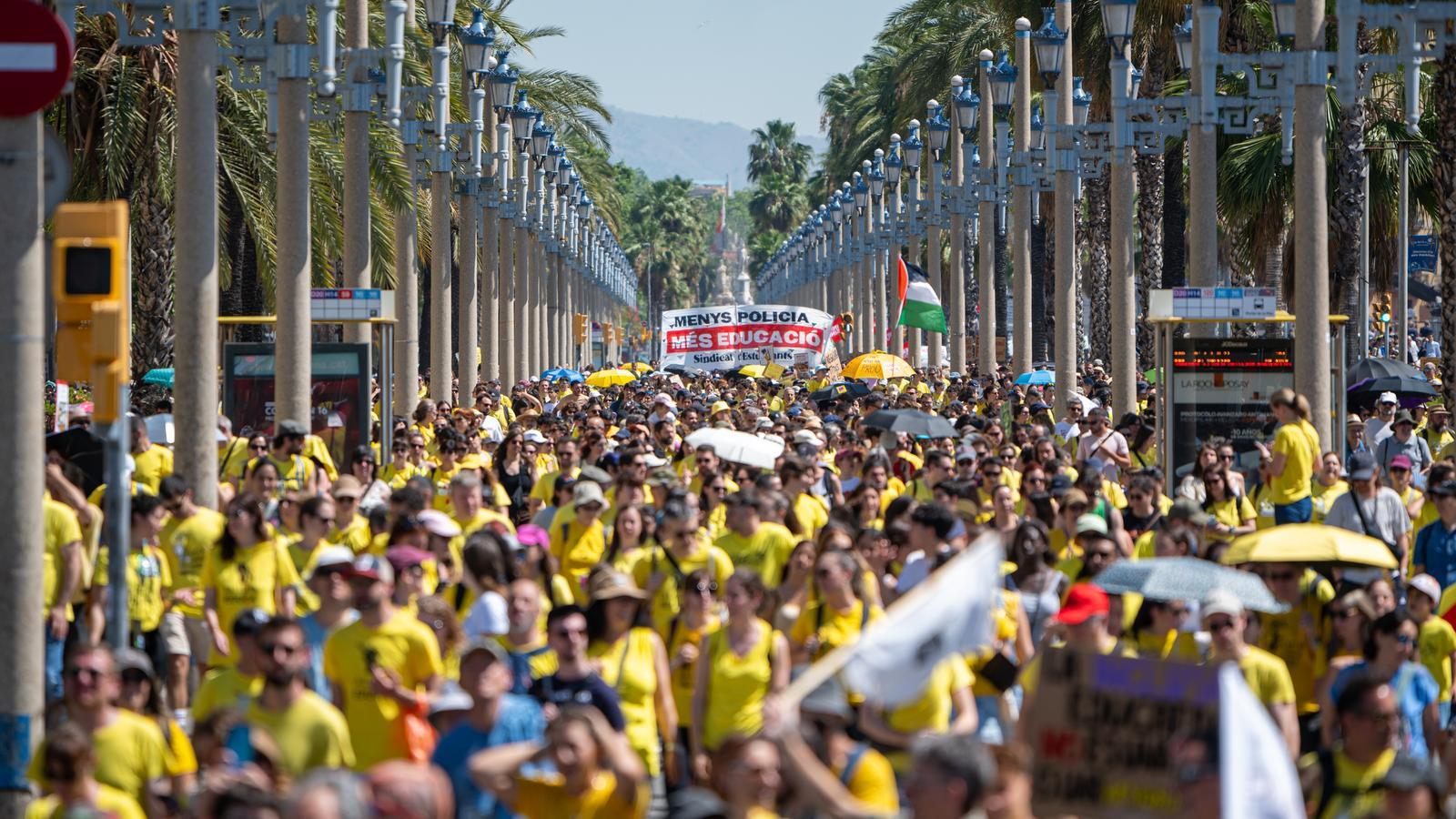
Regarding the demonstrations, they have been called throughout the country with 3,000 teachers mobilized in Girona and hundreds of teachers and professors who have taken to the streets of Tarragona and Lleida. In Barcelona, a slow march was held from Pla de Palau to Plaça Drassanes, in which 7,000 demonstrators participated, according to the Guàrdia Urbana, 15,000 according to the calling unions. Although the demands have been the same as in recent months – salary improvements and more resources to support students –, on Wednesday's strike day, complaints about the heat in classrooms have been constant. "We are roasting," said one of the banners with a drawing of a roast chicken, while others showed the temperature degrees their classrooms had reached in recent days, coinciding with the heatwave.
