Jaume Torras: "Soon a new controversy will begin, which will be about the quality of the potatoes that we eat"
Farmer

-
CAT -
CAST
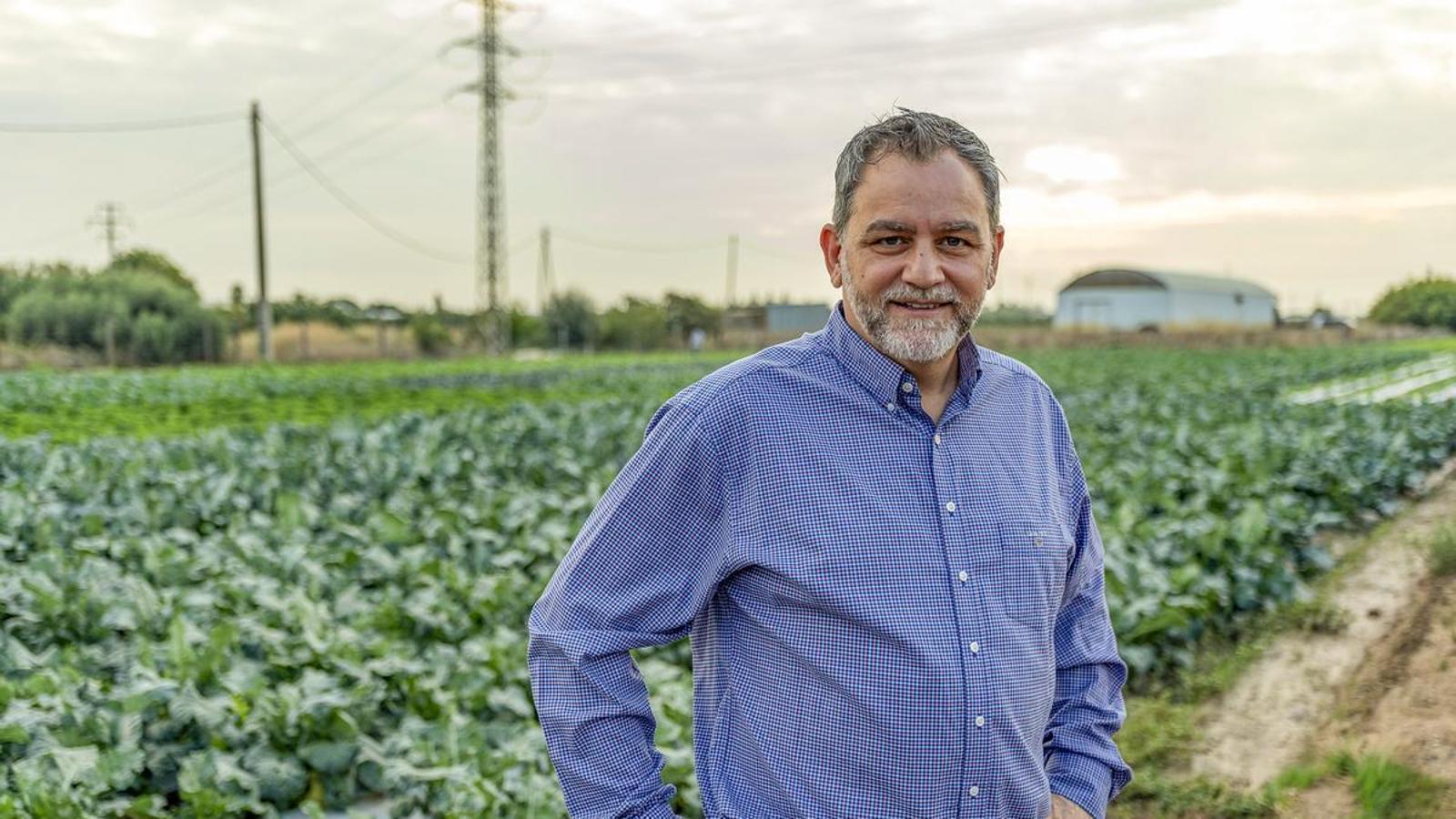
Vilafranca del PenedèsI interview the farmer Jaume Torras (Sant Climent de Llobregat, 1974) one afternoon to talk about his company, Soulblim,, which is a spin-off of the stall his parents had at the Barceloneta market, where they sold vegetables. Everything started in 2007, when Jaume opened a website called L’Hortet del Baix to help his parents sell the vegetables they grew. For a hundred consecutive years, someone from his family had always been at the Barceloneta market, but that year improvement works began, and his parents could not afford the cost, which was three hundred thousand euros. In 2004, they closed the stall. Jaume worked in software sales, he was a salesperson, and he helped his parents with L'Hortet del Baix. Nineteen years ago, the act of selling vegetables through a website was exotic and strange, but it worked for him. He started getting visits from all over the country and the world. Later, something happened to him that helped him reach the present day, where he sells local and organic vegetables and fruit throughout the country. His fields, of organic agriculture, are in Sant Boi, Gavà, Viladecans, and Sant Climent de Llobregat.software, he was a salesperson, and he helped his parents with L'Hortet del Baix. Nineteen years ago, the fact of selling vegetables through a website was exotic and strange, but it worked for him. He started to have visits from all over the State and the world. Then something happened to him that helped him get to today, where he sells local and organic vegetables and fruit throughout the State. His fields, of organic agriculture, are in Sant Boi, Gavà, Viladecans and Sant Climent de Llobregat.

Did you buy the vegetables from your parents and you resold them through the website?
— Yes, I asked my parents, Antoni and Núria, to set the price themselves, I would buy them, and then resell them on the web. I asked them to set a price that would provide a margin to make a living. And I set another one for myself, for the logistics and the preparation of it all.
People usually want to see and touch the fruit and vegetables they buy.
— This is hateful. You cannot go around touching the fruit and vegetables, because if ten people have stuck their fingers into them, then they get spoiled. It should be forbidden to do so. But the fact is that, for us, selling them through the web worked because in 2009 something happened to us that helped.
Which one?
— We appeared on TV3, on the Telenotícies migdia. In Sant Climent de Llobregat, the Cherry Festival is held, or at least it was held until now; perhaps this year was the last one because there are no farmers left and the cherry trees are abandoned. The fact is that at the 2009 festival we had a stall called L’Hortet del Baix, and TV3 filmed us. They liked the project, and they explained it. From then on, we had more impact. We went from having ten visits a week to having two thousand in one day. That year I left the job where I was working. We appeared on TV3 on the fifteenth of August; in September I quit. In 2010 I created the company, I had a warehouse built in Sant Climent de Llobregat and we started earning our living there. We distributed the products to the restaurants in Barcelona that bought vegetables from my parents, such as La Cova Fumada and many others. I had never 100% agreed with the work of a farmer, which looks at the land. I thought it was necessary to look at the land, but also to look up, and that is why I had always dreamed of having my own company. Do you know that my fifteen-year-old son is already asking me what you have to do to have one?
So, in 2010 you have the company set up.
— I have a small cold storage room and a van to make deliveries. We bought it with a mortgage we requested from the bank. After a few months, I was already entering restaurants to explain the company I had. Since I really like eating and cooking, I connected with it immediately. It is easier to sell fruit and vegetables to a restaurant than to sell them software, which is what I had done in my professional life until then. With the software I was selling smoke; with fruits and vegetables, food that they saw and tasted. I also understood that I had the opportunity to sell from the Llobregat Agricultural Park. I spoke to them about our fields, about local food: I was doing all this in 2011!
Once the brand's history has been explained, I ask you about the food products you currently sell.
— In summer, the protagonist has been the tomato. In winter it will be the artichoke, peas, cabbages and cauliflower. In summer, as for fruits, there are peaches, plums, cherries, apricots, loquats and strawberries.
Do you make jams or other food products derived from fruits?
— No, but this year we are looking into it with the people from Imperfect. It is one of the projects we have in mind, so that if there are hailstorms or some phenomenon that leaves the fruit and vegetables bruised, we can find a way to distribute them.
I remember that in 2016, the journalist Rafel Nadal wrote that tomatoes had no taste.
— Then began the great controversy with tomatoes. In 2010 they didn't have any taste either. And it was like that because a resistant tomato seed was made so it could withstand transport across Europe for days. In Catalonia and everywhere else, a resistant variety of tomato was chosen, which people did not like. With the chefs I work with, I began to do some work, which was to take them to the Llobregat Agricultural Park, where I have twenty hectares of fields, and have them taste different tomatoes. I did a test with many chefs so they could tell me which tomatoes they found good. In 2022 I finished the study with the statements that chefs and individuals had given me, and I opted for thirty-five varieties that they told me they liked. Many of the thirty-five varieties are Catalan, of which we have our own seeds. We grafted them. Now I can assure you that the tomatoes have taste, and I think the controversy is over, but soon another one will begin, which will be about the quality of the potatoes we eat.
What will happen to the potatoes?
— That people will start saying that they are not good, that good ones cannot be found. I do not grow them.
Do you think it is true that potatoes have no taste?
— They are grown intensively, and it's true: they don't have any, no. But they are not all the same. The potatoes from Puigcerdà, Prades, or Montseny are very good. The fact is that with potatoes, they have also been grown intensively; they are grown very quickly and they are sold to us from all parts of the world. They take them from underground before they have ripened.
Should we not keep either tomatoes or potatoes in the fridge?
— The fridge is a preservative. The tomato, if it is ripe, like ham, you can keep it in the fridge because you stop its ripening. You just need to take it out at room temperature a while before eating it. If we eat it cold, just coming out of the fridge, it will have no taste.
Where do the potatoes we buy come from? From France?
— Much comes from Murcia. The best ones are from cold areas. That is why the good Catalan ones are from mountain regions. They are planted in the Llobregat, but the ripening time is different, because the cycle is faster. Then it will be noticeable because it will be a potato with a lot of starch, a thick potato.
Do those of you who cultivate the land see as competition those who grow vegetables in water where they have dissolved nutrients, that is to say hydroponic cultivation?
— Do you know that people confuse hydroponic cultivation with greenhouses? It is different. The greenhouse has the crops on the ground, but it encloses them because that way it controls pests. For years greenhouses have been criticized, but they are not bad; the plant gets the sun anyway, only it does so indirectly, because there is plastic in front. The sun does not hit it as directly, but there is soil. With hydroponic cultivation, which is used a lot in Catalonia, and which is a growing business, good fruits are also being made, but I do not consider it competition because with organic farming our war is quality and not quantity. Our battle is to offer food to people who are sensitive to what they eat, to food with taste.
Since the artichoke season will start soon, tell me how I should buy good ones.
— At the Llobregat Agricultural Park we had one, and we fought hard to have one of our own. Now it has been swallowed up by the Green Queen, which has great productivity. And this is what makes me think that the Agricultural Park will end up disappearing, because it makes no sense to have crops in the middle of Barcelona. It is very difficult to do agriculture next to the city. I myself had fields taken away in Viladecans because they wanted to build an outlet. We could not oppose it. There are the large outlet warehouses of Viladecans; our fields, gone. The fact is that we had the Prat artichoke, very good, and suddenly another one appears, which produces much more, and ours disappears. People used to pay for the local one, the quality one. It is a tough artichoke, they have made it grow quickly because they have put a pill in it to make it do so. Currently, at the Agricultural Park, half of the artichokes that are planted are the Green Queen; the other half, the Prat ones. I say it approximately, but it will surely increase. Those that grow quickly are more economical, and we already know that food prices have increased a lot. It is a pity.
Finally, Jaume, give me some advice in case I want to plant a tomato plant in a pot on my balcony next year.
— You have to plant it during the month of April and you must try to place the pot so that it is protected from the cold. I recommend that you plant cherry tomatoes, which are good and are a great success among people, who say they eat them as if they were sunflower seeds. Do not buy seeds for them, but rather a seedling. You will find them at farmers' markets. In Vilafranca del Penedès there are some who sell them. The pot must have a diameter of 30 cm, because the tomato plant will grow two stems. Afterwards, you will need to study how to place the canes because the tomato plant is a climber. If you have a balcony, you may not need to use canes; you will be able to place it between the balcony railings. It must have half sun and half shade, and it must be protected from the cold. If it gets direct sunlight, it will burn, but at the same time it must have light. And then think that perhaps the birds may eat the fruits, because we farmers feed everyone.

