How China is taking advantage of Trump's chaos to reassert itself as a geopolitical center
Xi Jinping benefits from the moment of global instability and presents himself as a reliable leader and defender of multilateralism

-
CAT -
CAST
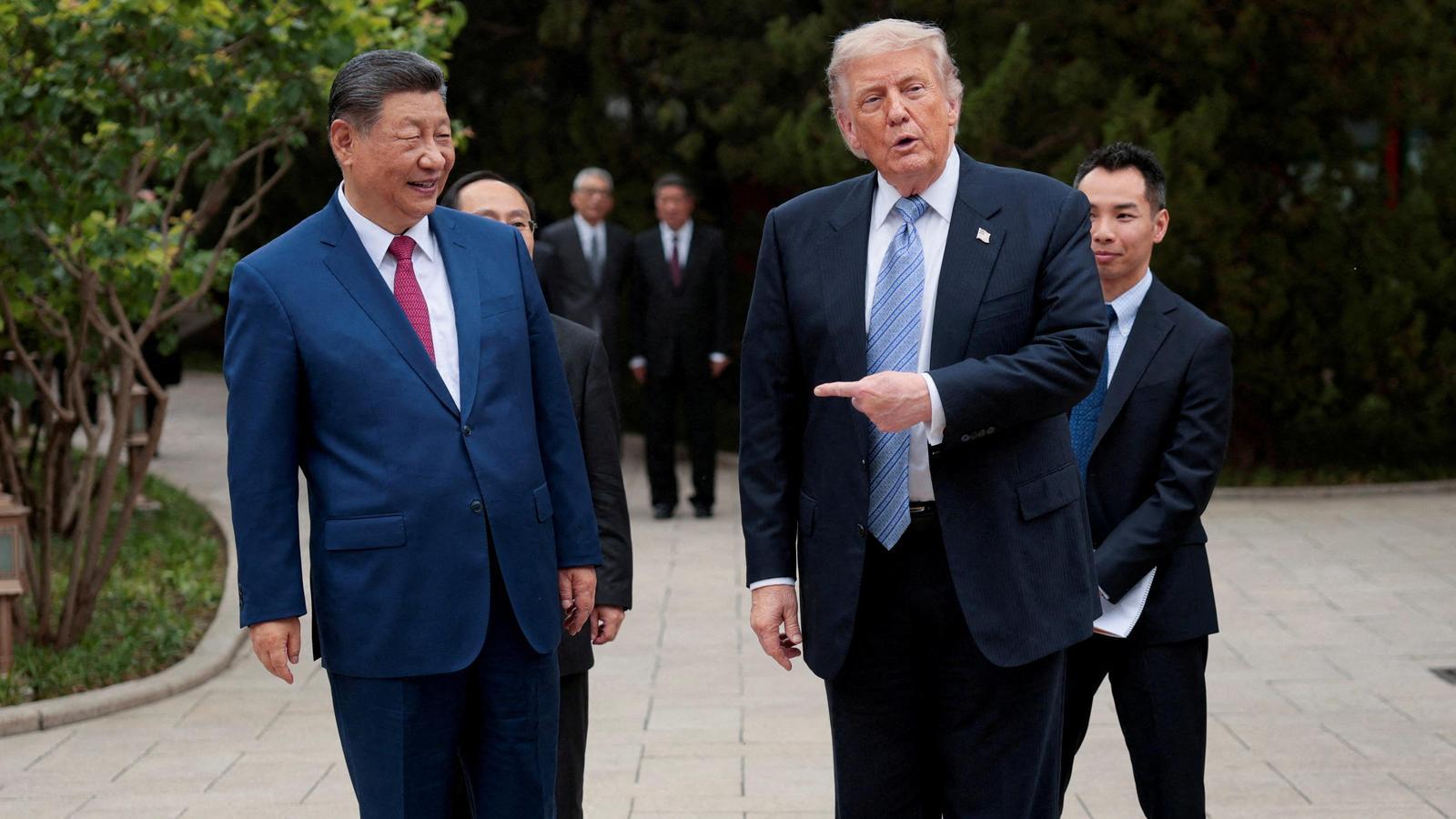
BeijingThe visits within a week of Donald Trump and Vladimir Putin to Beijing have placed China at the center of gravity of world diplomacy. It seems that all roads lead to Beijing, as Trump and Putin have been only the latest and most relevant of a long list of visitors. In recent months, Xi Jinping has received the French president, the German chancellor, the Irish prime minister, the one from the United Kingdom, the one from South Korea, the one from Canada... Pedro Sánchez has also been on the list and his meeting with Xi Jinping coincided with that of the Crown Prince of Abu Dhabi, another example of the Chinese president's intense agenda.
has managed to make the world look to China for stabilityhas managed to get the world to look to China for stability in an international context marked by wars and the energy crisis.
The Chinese press, state-owned and government-dependent, has rushed to boast that Beijing is emerging as the "epicenter of world diplomacy". In the Global Times they highlighted the analysis of Professor Li Haidong, from the China Foreign Affairs University, who assured that the visit to Beijing by the leaders of the four countries with permanent seats on the UN Security Council was “a collective recognition of China's global weight”.
The Asian giant asserts itself as what it has always believed itself to be: the center of the world. Zhōngguó – meaning the country of the center– is the Chinese name for the Asian giant. This diplomatic explosion and China's proud display of this prominence contrasts with the situation a few years ago. It was the so-called "wolf warrior" policy, which consisted of aggressive diplomatic responses to any criticism, leading China to isolation. The covid-19 pandemic intensified this isolation, as the Chinese government reacted with a total border closure, harsh quarantine measures for the population, and the demand that China not be blamed for being the origin of the health crisis. Now everything seems to be changing and Xi Jinping is flaunting China's emergence and its stabilizing role.
Despite the propaganda, the pilgrimage of international leaders is not new. The leaders of the European Union often travel to China in search of trade agreements attracted by its large market. In contrast, Donald Trump's visit can be described as exceptional, as it had been almost a decade since a US president had made an official trip to the country. The coincidence within a few days of Putin's stay has been coincidental. It was Trump who delayed his trip scheduled for April due to the war in Iran.
Trade or diplomacy
Despite the attraction that Beijing exerts, it is an exaggeration to speak of a change of cycle and that Asia is now definitively the center of the world. In fact, it directly suffers the crises or problems that continue to come from the West, in this case, from the United States, the destabilizing agent. It remains to be seen whether Xi Jinping is capable or has an interest in carrying out some diplomatic mediation. So far, his intervention in Gaza, Ukraine, or Iran has not been seen. Chinese policy is refractory to getting involved in conflicts that do not directly affect it.
However, Iran is a real problem for China. The closure of the Strait of Hormuz impacts its economy, as almost half of the Asian giant's gas and oil imports pass through there. Furthermore, the United States' attack on Iran affects the network of interests that China has woven with the Gulf countries. Xi Jinping has called for the reopening of the strait and it is believed that he has intervened with Iran so that it negotiates, but there is little else he can do.
Trump's attacks on Venezuela, Iran and, possibly in the future, Cuba highlight that Xi Jinping also has few deterrents. Trump and Putin's visits have been public relations acts, but without great economic results. Xi Jinping has committed to Trump to increase imports of agricultural products and other raw materials. New agreements are being announced bit by bit, such as the purchase of 200 Boeing aircraft. In return, Trump is receptive to reducing support for Taiwan.
However, for example, no agreement is known regarding artificial intelligence, a sector in which both countries compete for leadership. The United States restricts Chinese companies' access to advanced semiconductors to slow their development. For its part, Beijing controls another part of the production chain, rare earths, which are needed for the manufacture of these microchips. Both countries need to reach agreements and not paralyze the development of the sector.
In the case of Russia, and despite the good rapport between the two leaders, Putin has not managed to close an agreement to build a new gas pipeline. The Russian president blames the wear and tear of four years of war in Ukraine and needs to ensure an increase in the sale of gas and oil to China. Xi Jinping does not want to be excessively dependent on Russian energy and, above all, wants to continue buying it cheaply, but the closure of Hormuz also leaves him weakened.
