La Pobla de Lillet boasts of Antoni Gaudí's legacy
A film and an exhibition recall the impact of Eusebi Güell's cement factory and Gaudí's works on the town

- Lillet Study Centre. Plaça del Molí de la Vila, 1. The exhibition will be open on weekends. Saturday, from 10 am to 2 pm, and from 4 pm to 7 pm. Sunday, from 10 am to 2 pm.
The Asland cement factory, promoted by Eusebi Güell in La Pobla de Lillet (Berguedà), forever marked the history of the town. The factory's impact on the urbanistic and social structure of the municipality has been defined as the leap, in a few years, from the Middle Ages to the modern world. And in the entire project, two works by Antoni Gaudí stand out: the Xalet del Catllaràs and the Artigas gardens, a commission from the businessman Joan Artigas Alart. For this reason, after celebrating the Güell Year five years ago, the town is now celebrating the Gaudí Year, with some sixty events. These include a film about the relationship between Güell and Gaudí and the town, and an exhibition with large-format models of the old Asland factory and Gaudí's works, organized by the Centre d'Estudis Lillet.
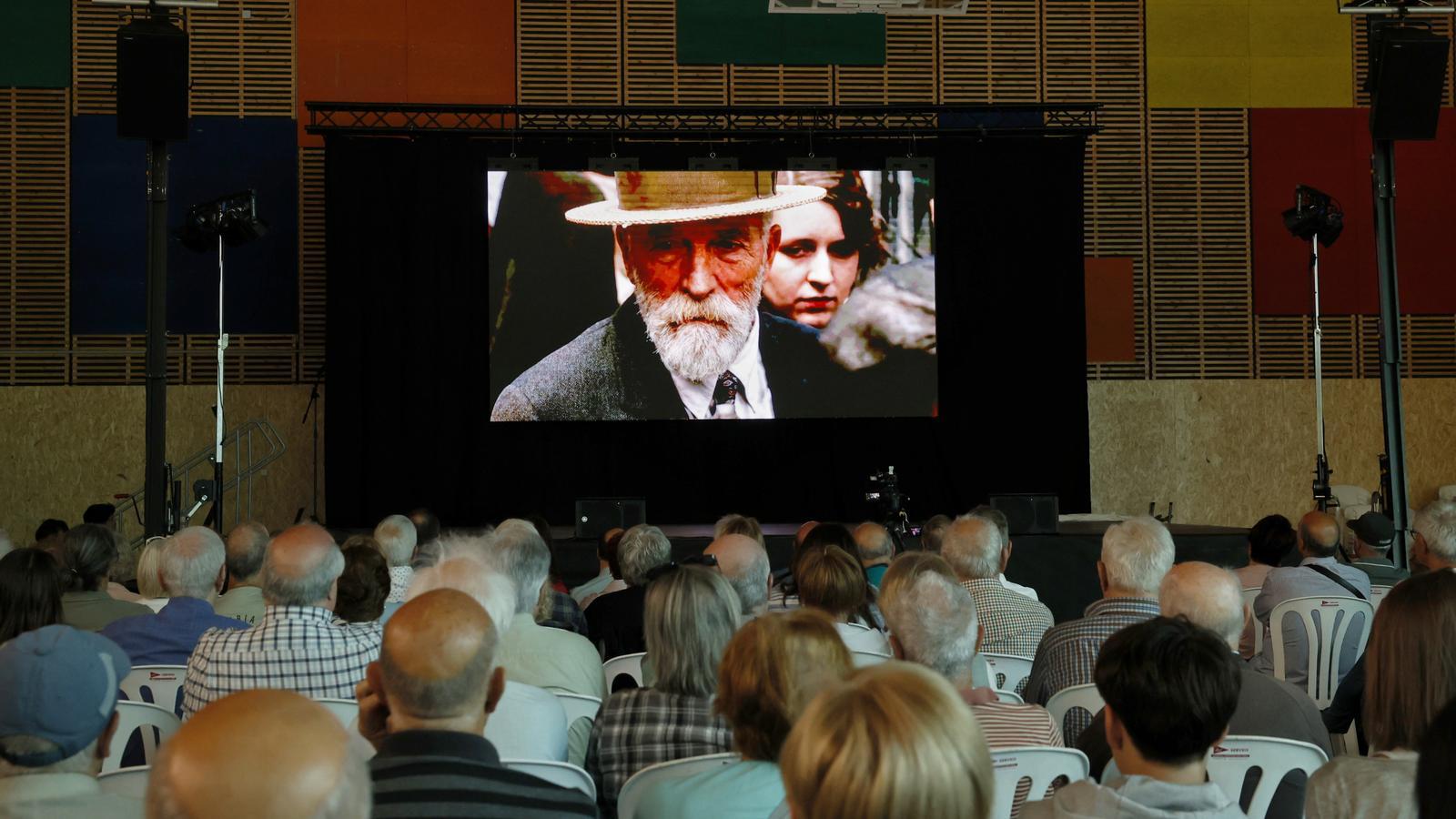
The film, produced and directed by Jaume Fàbregas, premiered this Saturday morning with a massive screening at the municipal pavilion and can be seen all year round within the exhibition. "The film is a mix of a documentary and a virtual reality experience," says Jaume Fàbregas. Yes, the film includes its own footage and AI recreations of historical images. Among the latter is the famous footage in which Gaudí can be seen leaving the wedding of Artigas' sister, Carmen Artigas, with Antoni Costa at the church of La Concepció in Barcelona on June 17, 1922. The footage had already been shown in the town in 2018 in an exhibition commemorating the centenary of Güell's death, and Fàbregas has now incorporated it into his work.
"We held the commemoration of the centenary of Güell's death because the origins of the well-being of La Pobla de Lillet depended a lot on these people, especially Güell. Then we started looking for material to be able, among other things, to bear witness that Gaudí had indeed come to La Pobla, because there were many doubts, and we were able to make a first film. And now, with Gaudí Year, we had to finish the job," explains Fàbregas. The premiere of the film was attended by the occasional actors who play Gaudí, Güell, Artigas and some prominent figures from the town, all of them known to the director. And, on the other hand, the Artigas gardens, under a sun that was beginning to bite, were packed. At the villa, the ARA was able to enter without other visitors, because the villa is currently not open to the public. It is municipal property, and a usage plan is being worked on. One of the notable elements of the villa is that, instead of corridors, there are distributors that lead to different rooms, which represents a space saving.


Furthermore, the film also includes an image of Gaudí that also saw the light in 2018: the architect is in the center of a photograph taken in the Carrer dels Porxos, where the Town Hall of La Pobla de Lillet was located, on July 25, the feast of Sant Jaume. Gaudí had visited the town to attend the laying of the first stone of a monument to the first count Güell, Eusebio Güell Bacigalupi, and of the chapel dedicated to Sant Jaume next to the cement factory. In the photograph, in the foreground, there is also the mayor of the town, Mariano Expósito, and Count Güell, Juan Antonio Güell López. To the left is the Marquis of Ferrer-Vidal, Juan José Ferrer-Vidal Güell, vice-president of Asland. And in the background, the apostolic administrator Valentí Comellas Santamaria. Next to the facade is Filiberto Cisneros, local doctor and for the Asland company, the teacher Albert Trias and the fruit seller Mercè Solé, next to her establishment.

The arrival of Güell in a "living" ecosystem
When Eusebi Güell arrived in La Pobla de Lillet, the town was a "living ecosystem", as Marc Zaballa, architect and curator of the Gaudí exhibition in the Vall de Lillet, says. This ecosystem was formed, as can be seen in the models, by the forests and pastures, the Llobregat river, and the existing textile factories. "It is a natural, industrial, heritage, and social ecosystem," Zaballa concludes. To make cement, Güell took advantage of the limestone from El Clot del Moro, which he crushed and turned into cement in an industrial process that was pioneering in the State. The factory, built with the Guastavino vault system, descended the valley in a cascade. The most ambitious model, recovered from a previous exhibition, allows us to see the circular route of the coal haulage from the mines in the area, which was used to burn the stone, and the cement descent. You can also see the Artigas gardens, a kind of miniature Parc Güell that Artigas, who hosted Gaudí at his home, commissioned.

The Catllaràs villa, Gaudí built it on behalf of Güell for the factory engineers. The exhibition includes a model of the villa's structure, an almost parabolic arch that was questioned because Gaudí designed it with only three courses of flat brick. Gaudí's authorship has been much debated, until a few months ago the Department of Culture made public a positive reportcommissioned to the director of the Gaudí Chair, Galdric Santana. "I believe there is more evidence that says yes than no," says Zaballa. "The discussion is academic, because what does seem evident is that the master builders who finally built it did not faithfully follow some characteristic of Gaudí's design. Specifically, Gaudí had designed a funicular vault that supported the slabs of the first and second floors. But the builders here got scared because they thought the vault would not support the weight of the slabs and they turned the direction of the joists of the slabs," explains Zaballa. "The result is a perversion of the structural system that Gaudí designed, but this does not imply that the design of the curve, as Galdric Santana has shown, is a unique design that at that time only Gaudí used." On the other hand, Zaballa believes that the similarity with the Episcopal Palace of Astorga is revealing of Gaudí's participation in another building in the complex, the Clot del Moro villa.
