Pilarín Bayés: "I have only cooked fried eggs, macaroni, and steak. In this life, I have only learned one thing"
We visit the cartoonist Pilarín Bayés the week she turns 85 and she tells us that cooking is an art that she has not acquired, but that she greatly admires

-
CAT -
CAST
VicI ring the doorbell of Pilarín's house, and she herself opens the door. It's Saturday afternoon, she has just turned eighty-five, and we have arranged to have a snack and talk about food, one of the topics that the artist from Vic enjoys. Wherever she goes to sign books, there is always someone who brings her food. She herself has given away thousands of times Vic sausages. In Vilafranca del Penedès, where she has presented the books of the Castellers de Vilafranca, the Xerigots cheese shop gave her a box full of cheeses. “I’m taking them to my son’s house tomorrow for lunch,” she tells me as she prepares a nice tray on which she places Vi De Muller (she says the ratafia broke the other day), some biscuits from Reus, and the sponge cake that I have brought her. “I have sugar limited because I have had diabetes since I was 70, but having it limited doesn't mean I can't eat it from time to time,” she comments.

We talk about her birthday, April 21st, and she tells me that she always held the theory that it was "one of the joys of the post-war period." And she says it laughing because Pilarín is joy, which doesn't mean she doesn't know what suffering means. She has buried her partner, Joan, and a daughter, Maria, who died of cancer. "And look how Maria wanted to live; I saw her swimming in the summer with such strength that I thought: she's cured." Pilarín is doing well despite diabetes, which she has under control, and despite the fall she suffered in Argentina last November. "The first day I arrived, I tripped and broke my arm." At the hospital in Buenos Aires they told her she needed surgery, and they also advised her to go back to her country because she would be better cared for. Literally. "I had time to stop by a bookstore to buy books by Quino (the author of Mafalda), Messi, and Maradona, and we went back." In Catalonia, they indicated that no surgery was necessary. Today her arm is fine, and she won't need rehabilitation. "If I signed three hundred books in Vilafranca, I think that's good exercise."
Soup, fried potatoes, and boiled vegetables
And now we return to cooking. “When I had my four children young, I cooked, not very well done, because I don't have that talent, but I did it,” Pilarín remembers. She cooked soup, fried potatoes, boiled vegetables, macaroni, “and that's it”. Not much fish, “because I had to go buy it in Vic and I was too lazy”. Of course, this mandate must know how to decline well, because she never stopped drawing. Nor did she when her four children were small, nor does she today, with an injured arm; she is finishing a drawing that is larger than her entire dining table.
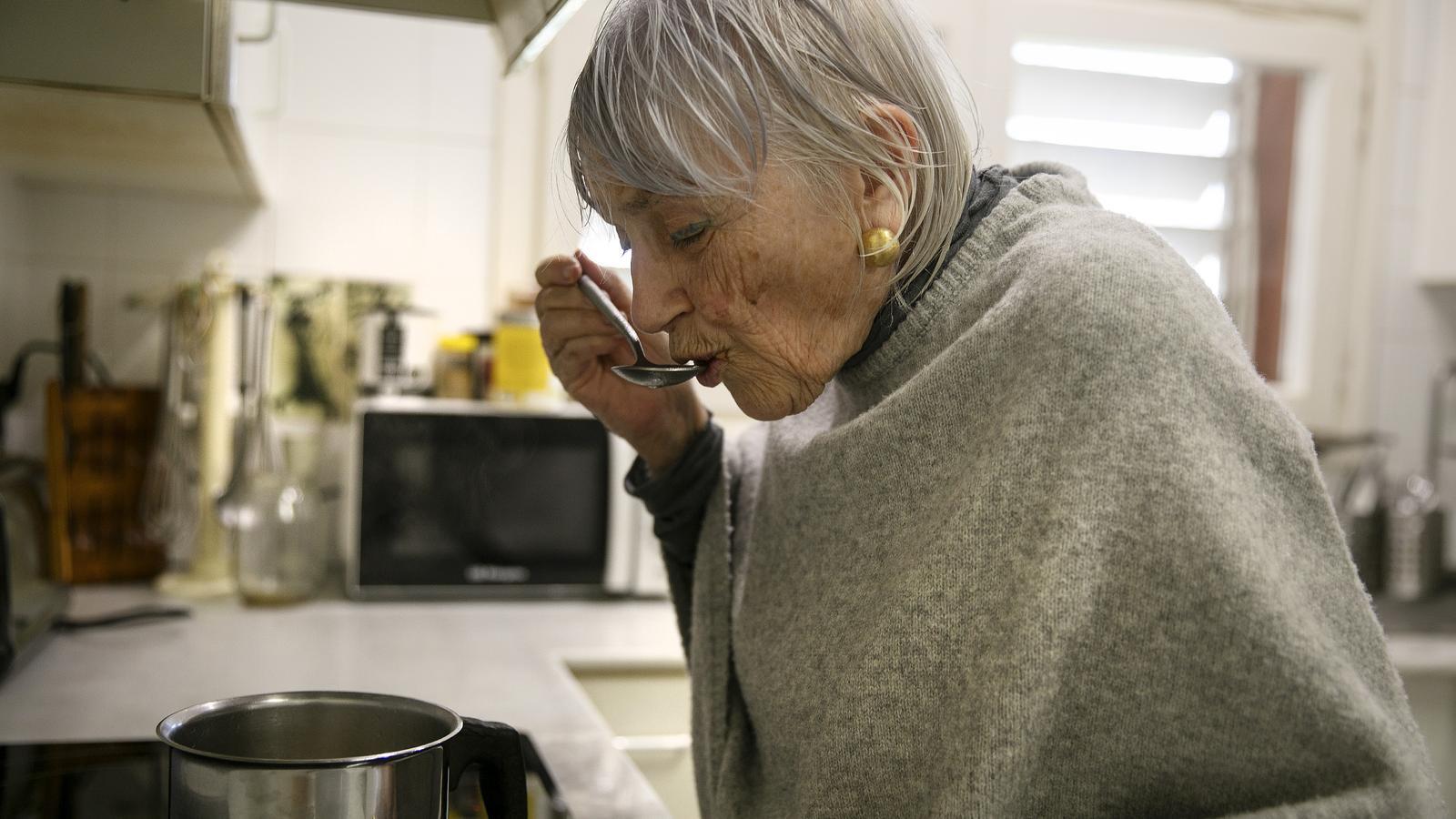
We go to the kitchen; she shows it to me and we photograph it there. “They have just changed my stove, and now I find that I don't even know how to turn it on”. I help her, and I can't manage either. We click all the buttons, one after another, and nothing. “One day when you came I cooked you fried eggs and sobrassada, which I like to do because at Christmas a cousin from Mallorca gives me sobrassada, and I give him sausage”.
Today, then, she doesn't turn on the stove, and hasn't for many years either. “There was a day when Joan, my husband, told me that he would take care of Sunday meals because everyone at home said they were tired of me making them the same dishes, which were asparagus from the marsh, ham and clams for the first course; for the second, steak”. Then, when Joan took the reins of Sunday meals, they started eating fideuà.
All this is in the past. With young children, I used to prepare dishes to feed them, but "now I've gotten worse" because I no longer have that need. With the diabetes diet, I have very specific meals: in the morning, a slice of bread; at noon, vegetables, soups; in the evening, salads. "I make the salads myself, but at noon I yield the honor to someone to prepare them for me." I used to eat rice, legumes, and pasta, which I liked, but now I can't. And before, Pilarín emphasizes to me, they had people around who were gifted with the art of cooking. "At Joan's house they had a cook, Maria, who was extraordinary, and she used to send me lunchboxes so that we at home could also eat what she had prepared." In fact, her mother-in-law had even told her that she didn't know if Maria was sending her leftovers or if she was deliberately making extra food to send to her. The fact is that they ate Maria's preparations for many years, and today a nephew of Joan's replicates them at the bar he runs in Vic, Bartvic. "I have never forgotten Maria's hake with garlic," says Pilarín, who remarks that the cook, Maria, had understood Pilarín's difficulties and wanted to help her. To the difficulty of cooking, Pilarín adds another. "I also don't know how to play the piano, and I say this because I consider music and cooking to be an art, and I have only cooked fried eggs, macaroni, and steak; I have only learned one thing in this life: to draw."
Pilarín has always had a close bond with chefs and pastry chefs like Lluc Crusellas. With Carme Ruscalleda, she made a voluminous recipe book that the artist has never replicated at her own home. "I already told Carme that I wouldn't follow any of them." She has a close friendship with the chef Nandu Jubany. "I really like Nandu's cuisine; I enjoy Can Jubany a lot, and I think I'm a good guest because I can tell how good the dishes are, because at my home I know they haven't been." Her children, she says, also experienced the same thing when they went to someone else's house. Regarding Nandu Jubany's food, Pilarín comments that it is truly good. When I go, when I have the tasting menu, my sugar doesn't rise, because they don't add sugar, which doesn't happen to me at other restaurants, where I tell them I can't have it, and then I find that it has risen."
And, finally, some final details. Pilarín comments that if she has to mention her favorite dishes, she names paella. “I think it’s a baroque dish, but I haven’t been able to eat it for many years.” Today she settles for a good soup; let there be no shortage of soups. There is always someone in the family who makes good stews and someone else who prepares creative salads. She doesn’t want to learn anything else. “I have enough with what I know; I am a way of being that I have learned only to draw; I cooked when I had to feed the family, and they were very lucky not to end up poisoned.” Poisoned, never, but she did once sugar a meal that should have been salted. “What I know how to do is draw,” and as soon as she finishes saying it, she makes an appointment for another day: the next time I visit her, we will eat xató. I will bring the sauce and she will prepare the salad. We won’t need to turn on the stove.
