Cristina Cabañas: "People take the yogurts from breakfast and the little spoons. We lose thousands of small spoons"
Guitart Hotels

-
CAT -
CAST
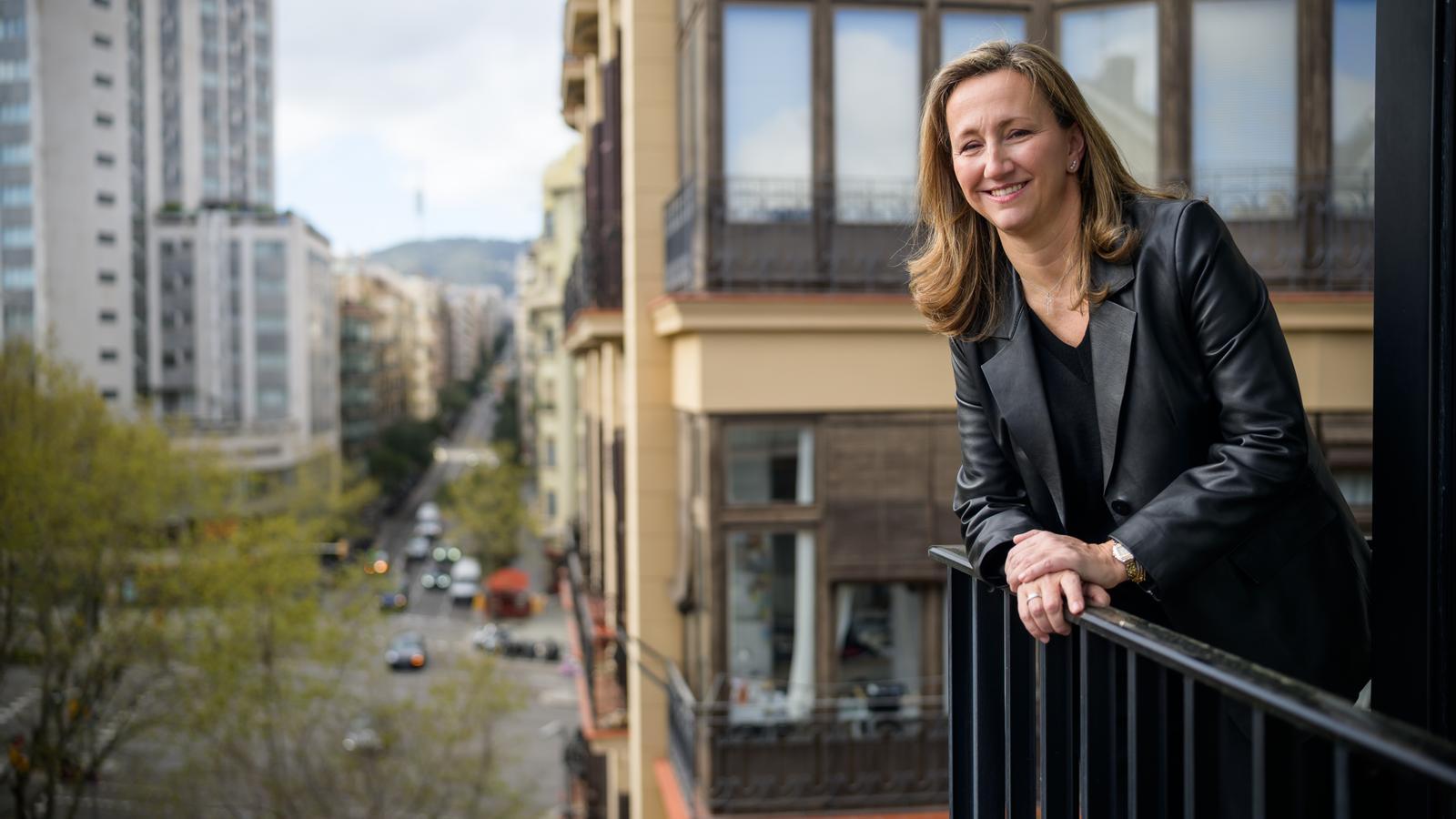
BarcelonaI interview the hotelier Cristina Cabañas (Lloret de Mar, 1974) at Guitart Grand Passage, the hotel she manages in Barcelona. Cabañas, a pharmacist by training, took over Guitart Hotels following the death of her husband, Climent Guitart. She has presided over the hotel chain for twelve years, and does so with the intention of passing the baton to her three sons, who confessed to her as children that they would like to dedicate themselves to their father's work. In parallel to her business work, she presides over the Climent Guitart Foundation, in memory of the businessman, to preserve his legacy in the world of tourism, as well as collaborating with other foundations. Through the foundation, she has managed to have over a thousand young Ukrainians visit Lloret de Mar and Catalonia so they can breathe away from the war their country is experiencing.

You put aside your vocation as a pharmacist.
— Not entirely. I am keeping the pharmacy operational in Lloret de Mar.
Among the hotels and aparthotels in Lloret de Mar, Barcelona, and La Molina, many people, of different nationalities, end up staying. What are the breakfast buffets like?
— I thought about it together with the nutrition representative of the College of Pharmacists. We created a balanced diet program even though people are on vacation. And we did it with a color system, so that people can graphically see which food group the foods they choose belong to. The point is to emphasize that, even though you are on vacation and relaxed, you can have a balanced and healthy diet.
What criteria do you use to choose breakfast buffet ingredients?
— We try to ensure that as many products as possible are local, to support local trade, and seasonal products. In addition, we also opt for suppliers who come from social entities. For example, at Hotel Guitart Grand Passage we serve a cookie to wish you goodnight that is made at the Fundació Sant Tomàs. At the breakfast buffet, the yogurts are from La Fageda and the uniforms are made by the Ared foundation, which helps the inclusion of women who have been released from prison. The Fundació Roure is the one we have chosen for laundry services. We always try to find social suppliers, both for food and for other areas of the hotel.
Do tourists want to have breakfast with what they eat at home or do they choose local products?
— There is everything, and I would say that the continental breakfast is the most common, that is to say, bread, pastries, jam... But we, since we want it to be a Mediterranean diet, include a lot of fruit, cereals, and extra virgin olive oil. And when there are typical holidays in our calendar, linked to food, then we also highlight it. For Saint Joseph's Day, we serve small portions of crema catalana.
Are breakfasts always buffet?
— It is the most practical when it is a large hotel. We do costings of what will be consumed in a day, and even though some food may be left over, everything is consumed. In addition, in a breakfast buffet, staff costs are lower. On the other hand, if breakfast is personalized, à la carte, you need more staff, more waiters serving, and in the kitchen, more cooks. In a breakfast buffet, everything is prepared an hour before the schedule starts, and the same people who prepared it are the ones who serve the coffees or replenish the food. That is why breakfast buffets are so widespread everywhere.
Barcelona, and it seems to me that much more Lloret, you have guests of all nationalities.
— Yes, that's right. More than 110 nationalities live in Lloret de Mar and people visit us from everywhere, especially French, English, and Polish people. The food they eat the most, which is common for everyone, is eggs. Foreigners eat a lot of them, while we, Catalans and Spaniards, don't eat as many. The egg is the great wildcard for breakfast. Perhaps we don't eat as many here because many of us still have the idea that you can't eat many per week due to cholesterol. I know that nutrition studies have disproven this, but I think it was an idea that stuck.
I ask you about salmon and avocados.
— In the hotels of Lloret de Mar we don't have it. In Barcelona, yes. In Lloret de Mar, no, because it's where we have more hotel places, and the ingredients we buy take into account environmental, economic, and social aspects. That's why we cannot have salmon in the hotels of Lloret de Mar.
In the hotels of Lloret de Mar, is there the possibility of all-inclusive? I mean, for those who don't want to leave the hotel and have all their meals there?
— Yes, in Lloret de Mar there is the possibility of half board, full board and all-inclusive. All-inclusive means that you can eat and drink anything at any time. And we have verified that they do it the first two days, in excess, but then they cannot keep up this pace. Therefore, I would tell you that, although it may not seem like it, all-inclusive is profitable for a hotel. This concept of all-inclusive comes from the Caribbean, where the idea of the bracelet and going from bar to bar is very widespread.
At the breakfast buffet, don't people also eat in excess?
— Yes, it usually happens. It also depends on profiles and ages. But it's true that there are people who fill their plates to the brim. Notice that in breakfast buffets we provide small plates, never large ones, and, despite this, they can put fried eggs, croissants, bread with butter and cold cuts, all together, piled up.
At home we wouldn't eat a muffin with a custard and a sausage on the side.
— No, we wouldn't, but I also understand that when you are in a hotel, you are relaxed. I don't know anyone who goes on vacation to a hotel and diets. Since you are on vacation, it's time to relax, and there is also relaxation with food, and that's why you see things like this at breakfast buffets.
Do you find that at the breakfast buffet people take food for other times of the day?
— Yes, it happens to us with yogurts. And, with yogurts, the little spoons. We lose thousands of small spoons.
How did you decide to focus only on hotels?
— My husband was ill for two years, with cancer. He died when my children were 7, 5, and 4 years old. His name was Guitart, and the family history is like a Netflix movie. My husband's parents had a dance hall in Puigcerdà, where there was a customer who owed them a lot of money. One day, the customer told my in-laws that he couldn't pay them everything he owed them, but, on the other hand, he could let them have a small hotel he owned in a house in Tossa de Mar. Since they were from the mountains, one summer they accepted the offer: the money they made from running the hotel in the summer was to be used to settle the debt they had at the dance hall in Puigcerdà. My husband was 4 years old when his parents went to Tossa for a summer. They had never seen the sea before. And it turned out that my father-in-law loved it, and he saw that it could be a good business. Later, he left the hotel in Tossa, which wasn't his, but rather he only ran it for one summer, and he rented a hotel in Lloret de Mar. It was a time when tourism agencies lent money to hoteliers so they could build. I would say that the large hotels in Lloret de Mar were built with money advanced by travel agencies. That's why there are so many families in Lloret who dedicated themselves to it. Some were plumbers, butchers, and they saw an opportunity there.
When you grew up, did your husband dedicate himself to the family business?
— He first trained at ESADE and Harvard. And he earned doctorates in law and tourism from the University of Aix-en-Provence. He was a very prepared person. When his father died, his sister sold him her share, and he continued with it and made it grow. When my husband died, I had very young children, but they were already my partners by inheritance from their father. It was at that moment that I wondered what I should do.
Did they make you purchase offers?
— Of all kinds. From the first minute, people started appearing who made me a thousand and one purchase offers. Two days after the funeral, I already had them around me. It wasn't easy because the economic situation at that time was delicate. But I said no to everyone, and I took the lead. I had to do it for my children, who told me they wanted to be hoteliers like their father. It has been very complicated, with everything we have lived through since he died, like COVID, but I would tell you that I have also met very nice people who have helped me.
As you explain everything to me, I feel that you have a passion for your profession as a hotelier.
— I continue doing tasks as a pharmacist too, but always in the background. What also fascinates me is being involved with foundations. I was already involved before Climent, my husband, passed away, but now even more so. I have been with the Association Against Cancer for twenty-two years. We have created the Climent Guitart Foundation, in which we will pool all the charitable work we have done over all these years. I strongly believe in alliances, and I want to continue supporting various tasks: to raise funds for research into breast cancer and to bring young people from Ukraine to our hotels in Lloret so they can breathe away from the war. 1,300 children have come, and I have done this with the alliance of Sister Lucía Caram, who asked for help from the Ministry of Defense of the Spanish government, which is the one that provides the plane to bring them to Lloret. The first ones came by bus, but now they come by plane.
The initiative has become very well known, Cristina.
— The Pope of Rome found out and asked me to visit him so I could explain it to him. It was a magical moment. I was there for an hour, but I could have stayed for more hours. I saw that he wasn't in a hurry, that he was very interested in the topic, his eyes were shining. The project is called Smiles for Ukraine, and we do it three times a year. Do you know what they always tell me? That they like to sleep without having to have their mobile phone next to them waiting for the alert to take refuge in the bunker because of the bombs. Apparently, they have an app that always alerts them when there are any. We have had orphaned children and boys who, at fifteen and sixteen years old, have already gone through military academy.
Boys always?
— Before, only boys; now also girls, but few. Few come because with girls there are more difficulties when it comes to getting them papers; the government wants to avoid the danger of trafficking girls. In Ukraine, there are many missing children. This year we have had older boys and girls who had already been on the front line of the war. The president allowed them to come. The girls could be my daughters. One was introduced to me as the best drone pilot, of war drones. In Lloret they rest, do leisure activities, and are young again. When they arrive, their skin is gray, the gray that skin acquires from being in the bunker, where they don't get daylight. Here they get another color, and we make them put on very high SPF sunscreen.
You are a hotel businesswoman in a job that must be very male-dominated.
— When I started, especially. Now, too. At first, I even wore heels because I thought that way they would hear me more powerful. We have gained a lot in women's equality, but let's say it: we still have a long way to go. Women always feel like we have imposter syndrome; they never feel it. We are our own worst enemies. Now I always go with flat shoes, to all meetings.
