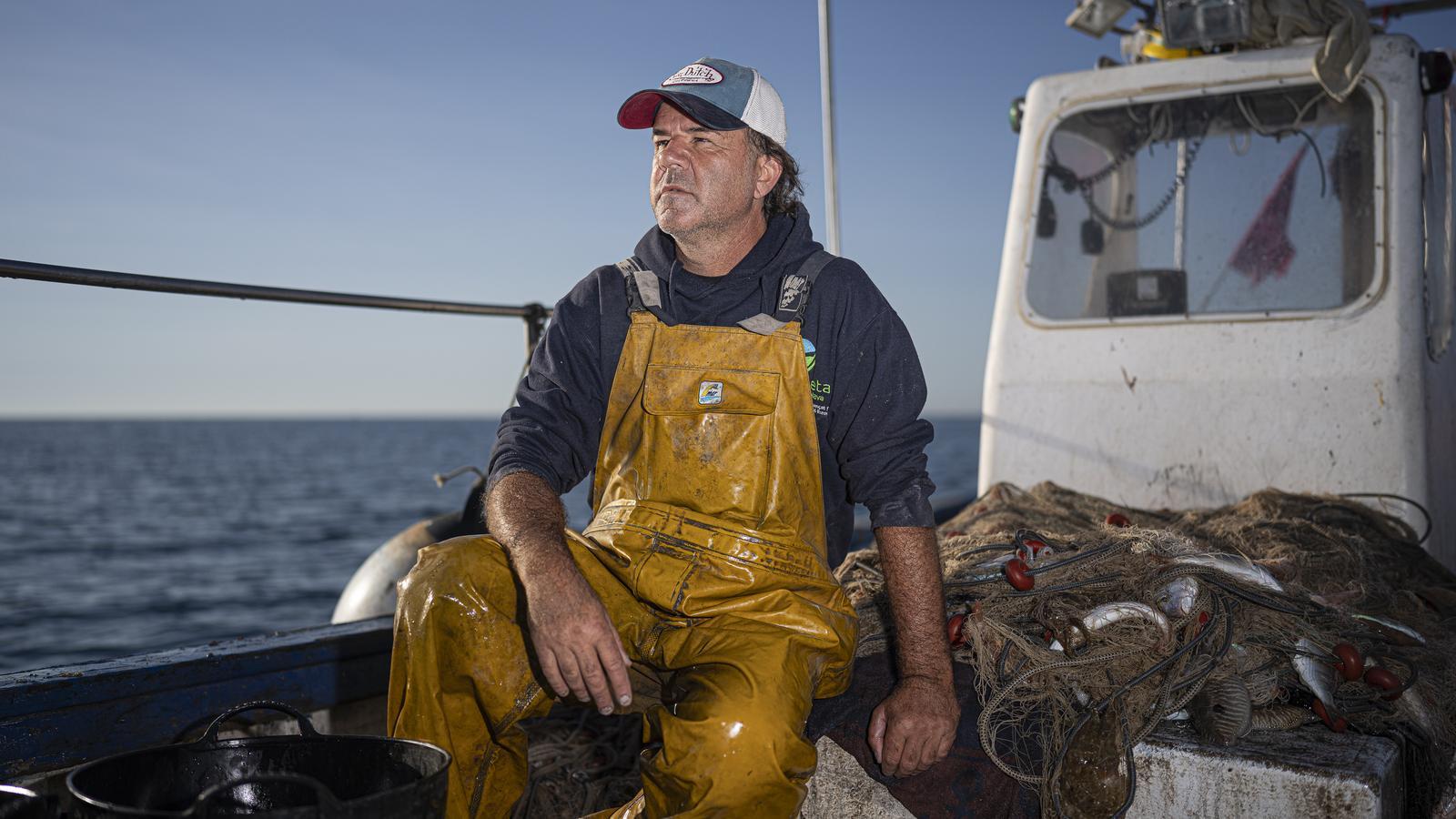
Oriol Serra, the penultimate fisherman of Sitges: "I feel free, I don't have schedules, I am alone and I don't depend on either trains or cars"
Chronicle of a fishing day aboard the boat Fila, specialized in artisanal fishing with the trammel net art

-
CAT -
CAST
Aiguadolç Port of SitgesIt is Tuesday, it is six in the morning, the sea is as flat as a plate and the fisherman Oriol Serra (Barcelona, 1978) is sitting on his boat, the Fila, at the Port d’Aiguadolç in Sitges. Everything is dark, the street lamps are still on. In the sky, a thin moon, concave like a slice of watermelon. Oriol unties the moorings from the dock, where the only two fishing boats in the port are, and we head out to sea, into the blackness. While the boat is sailing, we leave behind the red serpentine made by the cars passing on the Garraf coast road in the direction of Barcelona. Also the breakwaters and the bell tower of the church of Sitges. Everything is left far behind our backs, because we are heading to the 'galls' (roosters), the markers with a red flag that Oriol placed in the sea the previous afternoon to cast his artisanal nets. The goal of the day is to catch prawns. Will we find any?

"September and October are bad times for artisanal fishing, the kind I do with the trammel net, because we are coming from the summer, from very warm water," the fisherman begins to explain during the quiet hours we have while we go to look for the fishing ground. In the autumn the squid season will begin, but he doesn't go for squid, which is the expression fishermen use to refer to the fish they catch. "I go for cuttlefish, sole, turbot, and prawns," and that's it. To catch prawns, he casts the net into the sea on the afternoon of the previous day; for the other three, in the morning, because they work well twenty-four hours earlier. "The prawn lives buried during the day and comes out at night to feed, which is why it is good to set the nets the afternoon before." With the verb calar (to set) we stop for a while, because Oriol says that in the past the verb filar (to spin) was used more. And that is why his boat is called Fila. Traditionally, the differences and similarities between prawns and red shrimp have been sought, and just one of the most important is the fishing system: prawns, artisanal system; shrimp, trawling, and currently with quotas. "Now they have put quotas on it because I think what the system is looking for is to put an end to trawling, that's why they have started with an initial hurdle," he says. Fishing weirs
All fishermen face many obstacles when fishing. He himself has them, as he operates a small boat and fishes artisanally in a port where there are only two fishermen: him and Alfred Piqueras. Oriol has a blue box installed on his boat with which they monitor him: "With this device, which looks like a lantern, they know the hours I leave and enter the port." All the fish must be controlled and must go through the fish market; in this case, the one in Vilanova i la Geltrú. They are the last to go through it because they arrive by car from Sitges; the Vilanova fishermen's guild replies that if they arrived by boat, then they would enter in order of arrival like the rest of the boats in Vilanova. The fact is that "it seems that we are getting closer and closer to managing not to have to go through the fish market," he comments. In Portlligat, the two boats that remain there, the one belonging to Moisès and the one belonging to Isca-Samu, do not go through the Roses fish market during the summer months, because they understand that the road is congested, and it makes no sense to go there by boat due to the fuel cost.And despite all the bureaucracy, Oriol is a fisherman by heart. He remembers being twelve years old when he would go to the beach with a fishing rod. His parents, from Camprodon and Asturias, had a summer house in Sitges, and he would take advantage of it to spend the days by the sea. "Many neighbors remember me as a child with my rod," he says. As an adult, he chose his hobby as his profession, and it has been thirty-five years since then. "And I hope to continue, although nowadays, through the Sitges Fishermen's Guild, I supplement my salary by working as a cook of traditional sailor meals for the Malvasia Interpretation Center, the CIM, for which I cook when they have groups of twenty or more people." Thanks to working as a cook, he can work as a fisherman, because otherwise he "would barely make a living," he says to explain the low economic return of artisanal fishing. And he specifies: "I would have a salary of a thousand euros or less with fishing, and that taking into account that there are months when I don't go out to fish; right now I had gone a month without going out with the boat."I ask him about the reason for the hardships of the trade, and he points to overfishing, the chemicals that have been dumped into the sea so that the waters are crystalline, which have made bivalves disappear. "We have run out of mussels, for example, but also octopus, sea bream, and sea bass, which have gone further out to sea, when before they stayed closer to the shore". Because of all this, "fish has become a product that is worth money, but it is not expensive". And one must understand the nuance. "Fish is not expensive if you value all the effort behind it; I myself set sail today at six in the morning; we will see what we catch, and when I return to port, I will spend until noon taking the catch out of the nets and fixing them". Afterwards, there will still be going to the Vilanova fish market, from three in the afternoon, to sell the fish. For all these hours of work, fish costs money, but it is not expensive. It is an artisanal job. What we buy at the fishmonger's was gone to be sought by someone out at sea for you.
We resume the topic of overfishing, and then Oriol says that ten years ago he was catching double what he catches today. "That is why there is no generational renewal in the fishing ports; that is why some have been left without boats, or very few are left". But there are more obstacles to dedicating oneself to fishing: "Neither are there people who know how to mend the nets; those of the trammel nets, even less so". Oriol has found a contact in Les Cases d'Alcanar, a retired fisherman who he has been assured knows how to do it. He will take them to him. For every fifty meters of repaired trammel net, the net mender will have spent seven or eight hours, which is paid at fifty euros. "There are few of them and they are poorly paid, and those who know how are very old and are almost losing their sight".And despite all this, Oriol Serra assures that he likes the trade. "Every day of the year is different; I feel free, I have no schedules, I am alone, I am not tied to anyone, I do not depend on trains or cars and it is also very intuitive". For the penultimate fisherman of Sitges, fishing also has that element of uncertainty: "You never know how you will end up, what surprises the sea will give you", and this incentive binds, it hooks. Of all the advantages of fishing, there is one that Oriol shows by standing up: "Look around you: there is no one, only the clouds, the birds, the planes, which leave a trail". The beauty of the sea and the sky is what makes Oriol not give up, not think about how many years he has left to be the penultimate fisherman of Sitges.
We arrive at the markers, at the signal with red flags that was set the previous day, and he stops the boat. He starts the winch, which is a kind of large iron pulley, and begins to lift the eight hundred meters of trammel nets. The show begins, the unknowns we had during the hour of being at sea disappear. In front of us, prawns begin to parade by, few of them; razorfish (parrotfish), beautiful with their pink colors; sea bream; common pandora; sole; red mullet and electric rays, quite a few electric rays, which are similar to a stingray. And little else. For meters, the net comes up empty; from time to time, a prawn. When we reach the last stretch, we say: let's see if the last prawn comes out. Let it be a prawn, please.The sea has listened to us. The last catch is a prawn, beautiful, large, that has become entangled in the trammel net. The fisherman rolls up the nets, and turns the boat around, the Fila. We are heading back towards the port of Aiguadolç. Now is the time to look at the sea and the sky, for each of us to be in our own thoughts. I imagine that Oriol must be thinking about the catch, about the amount he has brought in, he must be doing his numbers. Or perhaps not. The catch has been scarce, but he is happy. He is calm. The sea continues to be like a plate, but now who shines in the sky is a round sun like an uncut watermelon.

