Bàrbara Mesquida Mora: "My father made us sign a usury contract to work in his winery"
Viticulturist and oenologist

-
CAT -
CAST
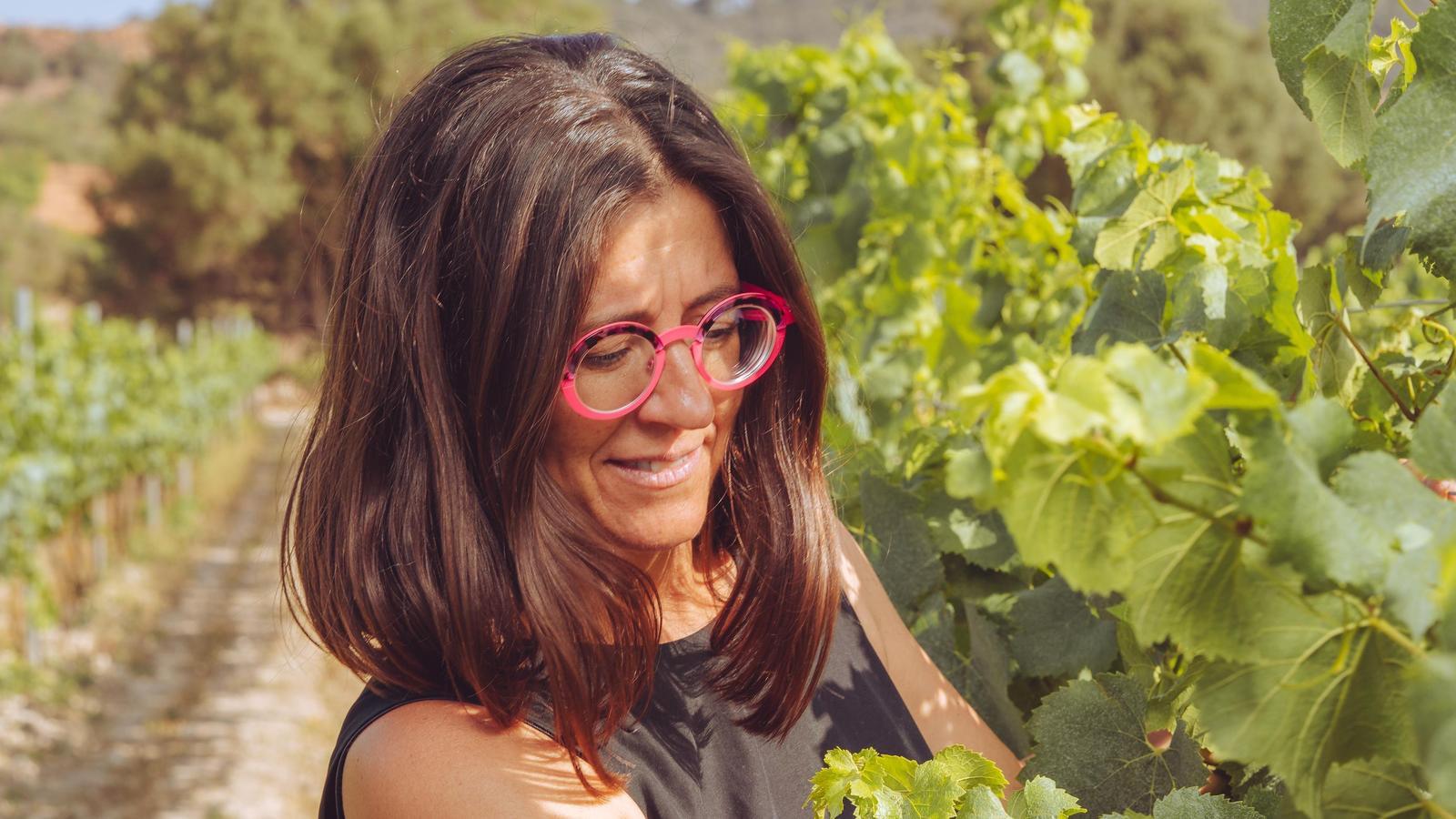
I am interviewing oenologist Bàrbara Mesquida (Porreres, Mallorca, 1979) at her own winery, Mesquida Mora, which she inaugurated in the summer of 2012. On both her father's and mother's side, her family has always been dedicated to vineyards. On her mother's side, it is documented, for more than two hundred years; on her father's side, it is the fourth generation. Bàrbara studied oenology at Espiells, in Sant Sadurní d’Anoia, after graduating in Catalan philology and working at Grup 62, where I happened to meet her. She is passionate about language, wine, and Mallorca. Her entire family has always lived in Porreres, and she also settled there in 2004, where she has put down roots with her own winery and a daughter. This past weekend, Bàrbara was the guest winery at La Nit del Poble, the dinner organized by Vall Llach winery (DOQ Priorat).

You left Barcelona to go work at your father's winery, Jaume Mesquida.
— I worked there from 2004 until 2012, when we had to close it due to strong disagreements, which, if I were to explain them to you, the series Nissaga de poder would seem short. The fact is that, when the Jaume Mesquida winery closed, I decided to continue dedicating myself to wine with my mother's vineyards, located in Porreres, and with the vineyards of Joan, the father of our daughter, which are in Felanitx.
You worked with your brother.
— With Jaume, yes, but when we closed my father's winery, he told me: "Bàrbara, wine is your life, I've been after you because I'm the younger brother, but I don't want to dedicate myself to it nor do I want wine to separate us, in ten years we will be together." So I started on my own with my winery, which I named after my two surnames: Mesquida Mora.
You spent eight years working in your father's winery.
— I started it at twenty-four years old! I believed everything my father said, but then, over the years, we had a reality check, that what my father had made us sign was unsustainable: he had made us sign a usurious contract. When I mention it to him, he tells me there is no solution or we have to go to court. We stopped paying him the rent for the winery, and he kicked us out. It all lasted until last year; it was very hard, because closing the winery also means laying off workers, paying back the improvement loans we had taken out, and a lifelong pension that my father had in his personal capacity. It has been a very tough journey.
In 2012 you started your own winery.
— On August 16th, for Saint Roch, who is the patron saint of Porreres, the first grapes entered the winery while the bells rang to celebrate the town festival. Now I look at it with perspective, and I see the enthusiasm I had. I was rebelling against an unfair situation because I had dedicated my youth, with infinite hours, to my father's winery. When I started, it wasn't a winery starting from scratch, but from minus ten. I had to earn people's trust as a woman and as a young woman!
When you arrive in Mallorca to work there, Mallorcan wine had a great reputation.
— There are several moments in the history of Mallorcan wine. When I was little, there were seven or eight wineries; we all knew each other. In 1999, Ànima Negra winery projected Mallorcan wine to the world, it had a discourse and made good sales. It was the first winery in Mallorca to sell abroad with a modern vision. From 2000 onwards, new wineries joined, and from 2005 to 2020 there was an explosion of wineries. We are more than a hundred wineries; some of us have committed to preserving the landscape, to recovering vineyards, replanting, to organic viticulture, to rooting ourselves.
Island people's investments?
— There are projects from outside investors, of great volume. I think that everything that has happened to other designations of origin has also happened to us. We have more than a hundred wineries that draw a very varied panorama: there are small ones and there are grandiose ones.
How are sales?
— I say that we had never worked so hard to sell half the wine we sold before. The general trend is a decrease in cost. It is not enough to produce, you also have to cultivate the vines, vinify, sell, communicate and deal with bureaucracy. It's a lot of work! There are wineries that are getting by; there are others that have the wine in the cellar.
What wines do you make?
— I work about twenty hectares, all of my own vineyard, where native and foreign varieties coexist, planted forty-five years ago: chardonnay, merlot and syrah. And my own varieties: premsal, giró, gorgollosa, callet, mantonegro, escursac and esperó de gall. Native varieties are gaining more weight, that's the bet, but with the utmost respect for the others, too, that we don't uproot. I make seven references in a very simple winery, which only has one floor, one ceiling, and the tanks. I couldn't afford anything else when I started.
What percentage of wines do you export?
— Approximately half of what we produce; the rest stays in Mallorca. When I say we export 50%, I'm referring to the wines that go to Spain, and I also include Scandinavian countries, Germany, England, Belgium, Switzerland, Canada, and the United States.
From 2004, when you started, to 2026, how have your wines changed?
— I started making them with a lot of structure, power. Now I compare them and I see that the ones I make now are fluid, fresh, light and no one gives up on complexity.
Fluid wines? What do you mean?
— I mean delicate wines; I don't mean they aren't complex. We have gone this way because our native varieties give us this profile; furthermore, there has been a change in consumption, it is a general trend to make wines with a lower alcohol content, easier. I myself am the first one that when I go to a restaurant I want a wine that accompanies me throughout the meal, that doesn't tire me.

Can you make lower graduation wines?
— In Mallorca there are two designations of origin, but my wines are registered with the Protected Geographical Indication Vi de La Terra Mallorca. Our traditional varieties yield low alcohol content, and I believe we should champion this. In the Mediterranean there are two traditions, that of warm wines and another, lighter one. Despite this, I must say that in Mallorca there are also warm wines, with significant overripening.
What future projects do you have left to do?
— First, establish my winery, secure it financially. The issues that occupy and concern me are landscape maintenance, incorporating livestock, and creating pastures. In the future, I plan to make cheeses. For now, I have started with five sheep. I have been practicing biodynamic farming since 2007. I believe in viticulture with the responsibility of tying myself to the landscape, of maintaining it, and of passing all of this on to future generations.
How many cultivated hectares of vineyard does Mallorca have?
— More than three thousand.
Which means less than 1% of the island's territory.
— Hence our fight to maintain the land in Mallorca. Cultivating it is increasingly complicated. You treat the vineyard and the neighbor from the house next door complains, when everything we eat and drink comes from the field. People want to have a second home in Mallorca, therefore, everything built. Resistance in Mallorca is growing tomatoes, creating the need for local, organic consumption.
The resistance you are talking about is the case of the Pla del Buc project.
— Yes. El Pla del Buc is a historic area of Binissalem, which in 2024, thanks to the initiative of Francesc Grimalt, from the 4Kilos winery, and starting from grapes from a farmer named Tomeu Verdura, we decided to buy the grapes from them, so that each winery could make its own wine. Socarrel and Ca sa Padrina also joined. We are romantics clinging to the vineyard; we don't want it to disappear. And we will continue to make wine.
